7 Best Row Markers For Pattern Navigation To Use
Keep your place effortlessly with these 7 top-rated row markers. Discover the best tools to streamline your pattern navigation and improve your craft today.
Stitch markers are the unsung heroes of a successful knitting project, acting as reliable signposts through complex lace charts and endless stockinette rows. Without them, even the most experienced makers risk losing their place in a repeat or failing to execute a crucial increase. Choosing the right tool depends entirely on your project’s construction and the specific quirks of your yarn. This guide breaks down the best options to ensure your knitting remains accurate, stress-free, and enjoyable.
Cocoknits Colorful Nylon Ring Stitch Markers


These markers are a favorite for a reason: they are incredibly lightweight and snag-free. Because they are made of nylon-coated steel, they have a subtle grip that keeps them from sliding around unnecessarily, yet they move smoothly over bamboo or metal needles.
Their greatest strength lies in their color-coding capabilities. If you are working on a stranded colorwork yoke, you can use distinct colors to mark the beginning of a round versus the placement of a pattern repeat.
The trade-off here is the ring shape itself. Since they are closed, they are best suited for knitting in the round where you can simply slip them from the left needle to the right. If you need to mark a specific stitch in the middle of a flat row, these won’t work without a temporary safety pin.
Clover Locking Stitch Markers for Easy Removal

When you need to mark a specific stitch—like the center point of a shawl or the location of a dropped stitch—a locking marker is non-negotiable. Clover’s version is the industry standard because the clasp is secure enough to stay shut but gentle enough not to fray delicate fibers.
I reach for these specifically when I am working on complex cable patterns where I need to count rows between twists. They are essentially tiny safety pins that won’t snag your work, provided you choose the smaller sizes for fine-gauge projects.
Be mindful of the plastic thickness, however. On very tight, small-gauge projects like socks using 2.00mm needles, these can create a slight distortion in the stitch tension. Use them sparingly in those instances to avoid leaving a permanent gap in your fabric.
Katrinkles Wooden Stitch Markers for Organization

Katrinkles markers bring a tactile, artisanal quality to your knitting bag. They are typically laser-cut from birch or bamboo, making them incredibly lightweight and warm to the touch.
These are excellent for knitters who find plastic markers distracting or cold. Because they are often etched with numbers or patterns, they serve a dual purpose: they mark your spot and help you keep track of which repeat you are currently working on.
The downside is durability. Because they are wood, they can be fragile if stepped on or caught in a heavy project bag. They are best reserved for special heirloom projects rather than everyday, carry-everywhere knitting.
Knitter’s Pride Rainbow Metal Stitch Markers

If you find that plastic markers feel too flimsy or static-prone, metal rings are the perfect upgrade. These are thin, smooth, and have a satisfying weight that helps them stay at the bottom of your work rather than flipping over your needles.
The rainbow finish isn’t just for aesthetics; it helps you identify different sections of a pattern quickly. I find these particularly useful when working with slick yarns like silk or bamboo blends, where plastic markers might slide too easily and get lost in the fabric.
One thing to watch for: if you are using very sharp-tipped lace needles, ensure the join on the ring is perfectly smooth. A poorly finished metal seam can occasionally snag a fine mohair or lace-weight strand.
DPN Style Split Ring Markers for Quick Adjusting

Split ring markers are the "set it and forget it" tool for many knitters. They are open-ended, meaning you can slide them onto the needle or directly into a stitch without having to knit up to that point.
These are invaluable when you are checking your gauge or identifying a mistake several rows back. Because they don’t have a locking mechanism, they are very fast to move; you can pop them on and off in a fraction of a second.
The primary risk is that they can fall out if you aren’t careful when moving your project. They are best used as temporary markers during a single knitting session rather than as permanent markers that stay in your project bag for weeks.
Tulip Heart-Shaped Markers for Delicate Yarns
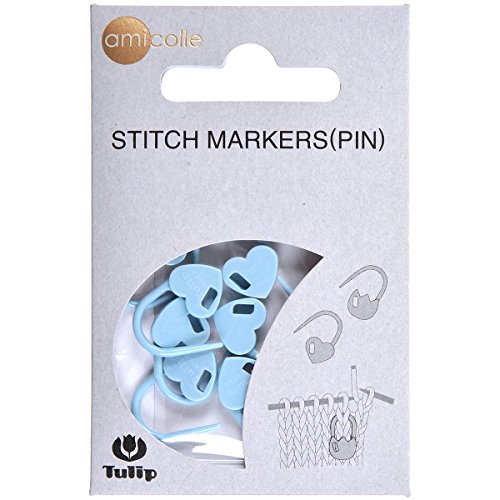
Tulip is renowned for their high-quality manufacturing, and these heart-shaped markers are no exception. The shape is more than just cute; the points allow the marker to sit neatly in the crook of a stitch without distorting the fabric.
These are my go-to for delicate lace projects using fine wool or alpaca. The coating is exceptionally smooth, ensuring that even the most "grabby" fibers don’t get stuck on the marker during a transition.
Since they are slightly larger than standard rings, they can feel a bit bulky if you are knitting a very small-diameter tube, like a finger of a glove. For large-format garments, however, their ease of movement is unmatched.
Susan Bates Crystal Plastic Markers for Value
You will find these in almost every knitting kit, and for good reason. They are inexpensive, come in a variety of sizes, and are virtually indestructible.
These are the workhorses of the knitting world. If you are a beginner, buy a large pack of these. They allow you to practice marking repeats without worrying about losing an expensive, artisanal marker.
They do have a tendency to pick up static, especially in dry winter months or when working with synthetic acrylic yarns. If you find them sticking to your needles, a quick wipe with a dryer sheet or a damp cloth will solve the problem instantly.
How to Choose the Right Marker for Your Project
The most important factor in choosing a marker is the diameter of your needle. A marker that is too small will cause your stitches to tighten up, leading to a puckered fabric, while one that is too large will get caught in your yarn overs.
Consider the fiber content of your yarn as well. If you are working with a sticky, high-twist wool, you want a marker with a very smooth, seamless finish. If you are working with a slippery silk or rayon, a slightly "grippier" marker can prevent it from sliding off the needle accidentally.
Always match the marker to the complexity of the pattern. If you are just marking the beginning of a round, a simple ring is fine; if you are tracking a 20-row cable repeat, use a locking marker that you can move up as you progress.
Essential Tips for Tracking Rows and Repeats
Don’t rely solely on your memory to track rows. Use a locking stitch marker to "anchor" your progress every ten rows; if you lose count, you only have to recount from the last marker rather than from the cast-on edge.
When working with charts, place your markers at the exact intervals indicated by the pattern. If the pattern says "repeat from to ," place a marker at the start and end of that section so you can visually verify your work after every row.
If you find yourself frequently losing your place, try using two different colors of markers. Use one color for the main pattern repeats and a different, contrasting color for the beginning of the round.
Troubleshooting Common Stitch Marker Problems
If your markers are constantly falling off, you are likely using a ring that is too large for your needle size. Switch to a smaller ring or use a locking marker that can be secured to the fabric itself rather than the needle.
Are your markers snagging the yarn? Inspect the seam of your metal or plastic rings. If you find a burr or a rough edge, use a fine-grit nail file to smooth it down, or retire the marker to avoid splitting your yarn fibers.
Finally, if your markers are causing tension issues, you might be knitting too tightly. If you can’t loosen your grip, try using a slightly larger needle size or a thinner, more flexible marker that won’t push against the yarn as it passes over the needle tip.
Stitch markers are essential tools that bridge the gap between a pattern’s instructions and your physical knitting. By selecting the right type—whether it’s a smooth ring for constant movement or a locking pin for precision—you save yourself from unnecessary frustration. Remember that the best marker is the one that disappears into your workflow, allowing you to focus on the joy of creating fabric. Happy knitting, and may your row counts always be accurate.