6 Best Knitting Magnifying Glasses for Intricate Charts
Need help with complex knitting charts? We review the 6 best magnifying glasses to improve visibility and precision for your most intricate projects today.
Tackling a complex lace shawl or a multi-colored stranded sweater often means squinting at tiny, grid-based charts until your eyes ache. A high-quality magnifier can transform these marathon knitting sessions from a strain-filled chore into a relaxing, precise craft. Choosing the right tool depends on your workspace, your lighting needs, and how much you tend to move while you work. These six options represent the gold standard for maintaining your vision while you navigate intricate stitch patterns.
Brightech LightView Pro LED Magnifying Lamp
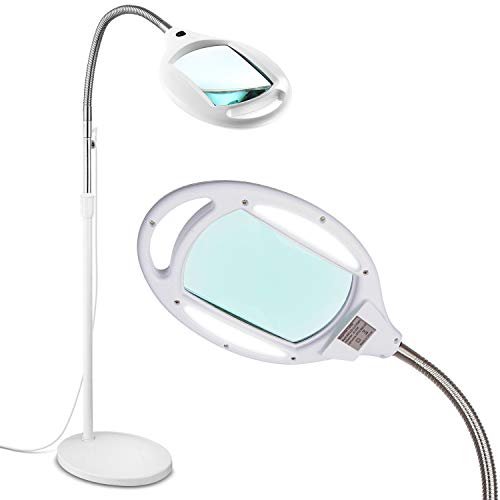

If you have a dedicated knitting nook, this lamp is a game-changer for your posture and your eyes. It features a sturdy, adjustable arm that allows you to position the lens exactly where your chart sits, leaving your hands entirely free for your needles.
The 3-diopter lens provides a clear, distortion-free view of your chart, which is essential when you are counting stitches on a complex cable or lace repeat. Because it is a floor lamp, it doesn’t take up precious space on your side table where your yarn bowl and notions bag usually live.
The trade-off here is the footprint; it is not a tool you can easily toss into your project bag for a trip to the local knitting guild. However, for long-term projects like an heirloom-quality lace blanket, the stability and consistent, shadowless LED light are worth every inch of space it occupies.
Carson DeskBrite 200 LED Magnifier Lamp
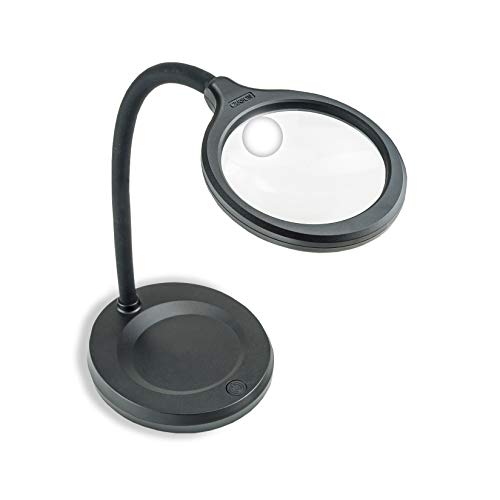
This is a fantastic "workhorse" lamp for knitters who prefer to keep their charts right next to their yarn stash. It is compact enough to sit on a side table without feeling intrusive, yet it offers enough magnification to make even the smallest chart symbols pop.
The dual-power lens allows you to switch between different magnification levels, which is helpful if you are toggling between reading a dense chart and checking your needle size. Its small size means it won’t overwhelm your workspace, making it ideal for knitters working in smaller apartments or shared living spaces.
Keep in mind that because it is a desk lamp, you will need to position it carefully to avoid glare on your knitting needles, especially if you prefer metal needles that reflect light. It is a reliable, no-nonsense tool that does exactly what it says on the box.
Fancii Extra Large LED Magnifying Glass

Sometimes, you just need a massive viewing area to track an entire row of a chart without constantly moving your magnifier. This extra-large lens is designed for exactly that, providing a wide field of view that covers a significant portion of a standard knitting pattern page.
The lightweight design makes it easier to hold than you might expect, though it is still a handheld tool. It works best for knitters who like to keep their pattern on their lap or a flat surface, allowing them to scan across a row of a complex intarsia colorwork chart in one fluid motion.
While handheld magnifiers require you to set your needles down occasionally, the sheer size of this lens minimizes the need for constant repositioning. It is the perfect choice for the knitter who wants a portable solution without sacrificing the clarity of a larger stationary lamp.
MagniPros 3X Large Magnifying Glass

This magnifier is a favorite for those who struggle with the weight of traditional glass lenses. It uses a high-quality acrylic lens that is significantly lighter, which is a blessing when you are holding it for long stretches while trying to decipher a tricky chart.
The built-in LED lights are positioned to provide even illumination across your pattern, preventing those annoying shadows that can make a knit stitch look like a purl. It is particularly useful when working with dark-colored yarns, where contrast is often low and eye fatigue is high.
Because it is a handheld device, it offers the most flexibility for knitters who like to change positions or move from the sofa to a chair. If you find yourself frequently leaning in too close to your work, this tool will help you maintain a more ergonomic, comfortable posture.
Tomiba Hands Free Neck Magnifier for Charts
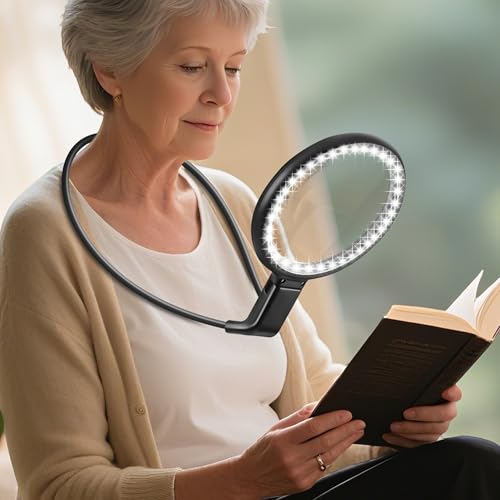
If you are a "mobile" knitter who likes to knit while walking or moving around the house, this neck magnifier is your best friend. It rests comfortably against your chest, providing a hands-free view of your chart while you work on your latest project.
This is an excellent choice for knitters who find that stationary lamps don’t quite reach where they are sitting. It effectively turns your own body into the support system, ensuring the magnification is always aligned with your line of sight.
The adjustment straps are key here; make sure to get them set correctly so the lens isn’t constantly bumping against your knitting needles. It is a unique solution that solves the "where do I put the lamp" problem once and for all.
iMagniphy LED Illuminated Magnifier Set
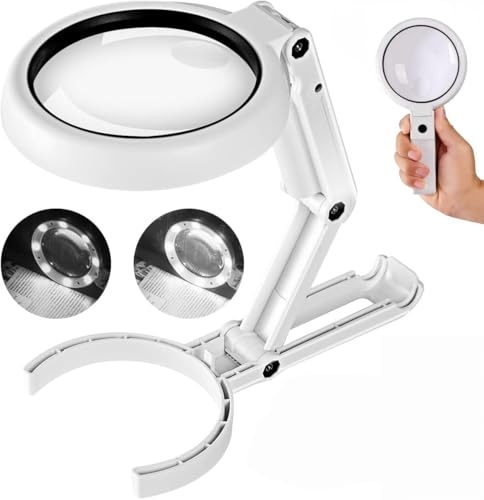
This set is ideal for the knitter who likes options, as it includes interchangeable lenses for different levels of magnification. If you are working on a simple project with large charts, you can use the lower-power lens; when the pattern gets complex, you can swap to the higher-power option.
The illumination is bright and consistent, which is crucial when you are working with fine-gauge lace weight yarn. Having multiple lens sizes means you can adapt your tool to the specific needs of your current project, whether it’s a fingering-weight sock or a bulky-weight sweater.
The handle is ergonomically designed to reduce hand strain, which is a major benefit if you are prone to wrist fatigue. It is a comprehensive, versatile set that grows with you as your knitting projects become more ambitious and detailed.
How to Choose the Best Magnifier for Knitting
When selecting a magnifier, consider the "working distance"—the distance between your eyes, the lens, and your chart. You want a tool that allows you to sit comfortably with your shoulders relaxed, rather than hunching over your work.
- Magnification Power: 2X to 3X is usually sufficient for most knitting charts; anything higher can sometimes create too much distortion.
- Lighting Source: LED is the industry standard because it provides cool, bright light that won’t heat up your yarn or cause glare.
- Portability: Decide if you need a stationary lamp for a specific chair or a portable handheld tool for knitting on the go.
Don’t ignore the importance of the lens material. While glass is scratch-resistant, it is heavy; high-quality acrylic is lighter and often more practical for long knitting sessions.
Lighting Tips for Reading Complex Lace Charts
Lace knitting is all about the "negative space" created by yarn-overs, and poor lighting can make these delicate holes disappear. Always aim for light that hits the page from the side, which helps create subtle shadows that define the chart symbols.
If you are using metal needles, be mindful of glare; a matte-finish magnifier or a diffuser on your LED light can prevent the "flash" that happens when light hits your needle tips. You should also consider the color temperature of your light; "daylight" bulbs (around 5000K) are the best for distinguishing between similar shades of yarn.
Finally, remember that the best light is useless if it creates a reflection on your chart. Adjust your angle so the light source is hitting the paper, not reflecting directly back into your eyes.
Avoiding Eye Strain During Long Knitting Sessions
Even with the best magnifier, your eyes need a break. Follow the 20-20-20 rule: every 20 minutes, look at something 20 feet away for 20 seconds to reset your focal point.
- Posture Check: Keep your feet flat on the floor and your back supported; tension in your neck often manifests as eye strain.
- Contrast: If you are working with black or dark navy yarn, use a light-colored background or a white project bag to increase contrast.
- Hydration: It sounds simple, but tired, dry eyes are more prone to strain; keep water nearby while you knit.
If you find yourself constantly adjusting your focus, you may need to increase the ambient light in the room in addition to your task lighting. Combining a general overhead light with your focused magnifier creates the most comfortable environment for your eyes.
Maintaining Your Magnifying Tools for Longevity
Lenses are magnets for dust, lint from wool, and the occasional stray bit of fiber. Use a microfiber cloth to gently wipe the lens after every few sessions; never use paper towels or tissues, as these can leave tiny scratches on the surface.
If your magnifier is battery-operated, always remove the batteries if you are heading out for a long retreat or storing the tool for the season. This prevents corrosion that can ruin the internal electronics.
Store your magnifier in a dedicated case or a soft pouch when not in use to protect it from accidental drops or heavy knitting needles. Treating your magnifier with the same care you give your favorite set of needles will ensure it stays a reliable part of your knitting kit for years.
Investing in a quality magnifier is one of the kindest things you can do for your craft and your long-term vision. By choosing a tool that fits your specific knitting style—whether you are a stationary lace-knitter or a mobile sock-knitter—you eliminate the frustration of misread charts. Remember that your eyes are your most important knitting tool, so keep them rested, well-lit, and properly supported. With the right setup, you will find that even the most daunting, intricate charts become clear and enjoyable to execute.