6 Best Foldable Rulers For Gauge Checks To Own
Discover the 6 best foldable rulers for precise gauge checks. We analyze durability, accuracy, and portability to help you choose the ideal tool for your kit.
Every seasoned knitter knows that the difference between a sweater that fits perfectly and one that ends up as a costly, ill-fitting mistake often comes down to a few millimeters. A reliable foldable ruler is the unsung hero of your project bag, allowing you to verify your tension before you commit to hours of work. These tools are designed to bridge the gap between your swatch and the final garment. Choosing the right one ensures that your stitch count remains consistent from the first row to the last.
Cocoknits Maker’s Keep: Best Overall Ruler Tool
The Cocoknits Maker’s Keep is far more than just a measuring device; it is a comprehensive system for the organized knitter. Its primary advantage is the magnetic slap-bracelet design, which keeps your needles and small notions close at hand while you work.
For those who frequently lose their stitch markers or struggle to keep their tools in one place, this is a game-changer. The integrated ruler is clear, easy to read, and folds away neatly when you are on the go.
The downside is the footprint; it is a bit bulkier than a simple plastic card. However, the convenience of having your tools magnetically tethered to your wrist while working on a complex lace chart is well worth the extra space in your bag.
Clover Knitting Gauge: The Classic Choice


If you have spent any time in a local yarn shop, you have likely seen the Clover Knitting Gauge. It is the reliable, no-nonsense standard that has been in circulation for decades.
This tool is essentially a multi-functional card that measures needle size, stitch count, and row count simultaneously. Its simplicity is its greatest strength, as there are no moving parts to break or hinges to wear out over time.
While it lacks the modern flair of newer tools, its accuracy is beyond reproach. It is a perfect "set it and forget it" addition to any project bag, especially for beginners who need a straightforward way to verify their needle sizes.

ChiaoGoo Folding Ruler: Compact Precision

ChiaoGoo is well-regarded for their high-quality needles, and their folding ruler follows that same philosophy of precision. It is incredibly thin, making it ideal for those who prefer a minimalist approach to their knitting kit.
The folding mechanism is smooth, allowing you to tuck it into even the smallest pocket of your project bag. It is particularly useful for measuring long swatches or checking the length of a sleeve as you decrease.
Because it is so slim, it can be slightly more fragile than a thicker plastic gauge. Treat it with a bit of care, and it will remain a staple in your kit for years to come.
Katrinkles Wooden Gauge: Eco-Friendly Option
For the knitter who prefers natural materials, Katrinkles offers beautiful, laser-cut wooden gauges. These tools feel substantial in the hand and offer a tactile experience that plastic simply cannot replicate.
Beyond the aesthetics, the wood is durable and lightweight. Many of these gauges are custom-designed with clever shapes, ranging from sheep to knitting needles, which adds a bit of joy to the tedious task of swatching.
Keep in mind that wood can be sensitive to extreme moisture. While perfectly fine for standard use, avoid leaving them in damp areas or near high-heat sources to prevent warping over time.
Susan Bates Knit Check: Budget-Friendly Pick
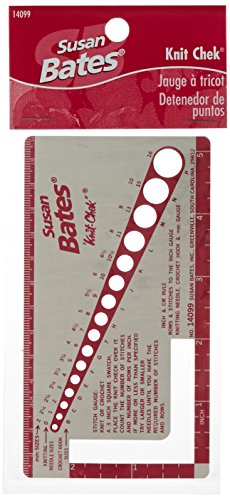
The Susan Bates Knit Check is the quintessential budget-friendly tool that every knitter should own at least one of. It is lightweight, virtually indestructible, and costs less than a single ball of luxury yarn.
It excels at identifying needle sizes, especially when the markings on your older needles have rubbed off from years of use. It also includes a handy inch/centimeter ruler along the edge for quick checks.
While it may not win any design awards, it is a workhorse. If you are the type of knitter who tends to lose things at the bottom of a sofa, having a few of these scattered around your workspace is a smart move.
Knitter’s Pride Folding Rule: Durable Design

Knitter’s Pride has engineered their folding rule to withstand the rigors of heavy travel and frequent use. It features a robust hinge system that feels secure, ensuring the ruler stays flat when you need it most.
The markings are high-contrast, making them easy to read even in low-light conditions. This is a significant advantage when you are working with dark-colored yarns that can strain the eyes.
This ruler is slightly heavier than the others, which some knitters prefer. The weight gives it a grounded feel, preventing it from sliding around while you are trying to count stitches on a large, heavy project.
Why Consistent Gauge Checks Are Essential
Gauge is the foundation of every successful knitting project. If your stitches are tighter or looser than the pattern designer’s, your finished garment will not match the intended dimensions.
Even if you are an experienced knitter, your tension can change based on your mood, the type of fiber you are using, or even the time of day. Checking your gauge throughout a project—not just at the start—is the only way to avoid unpleasant surprises.
Think of your ruler as a safety net. It is much easier to rip back an inch of knitting than it is to re-knit an entire sweater that turned out two sizes too small.
How to Measure Your Stitch Gauge Accurately
To get an accurate reading, you must measure your swatch while it is lying flat on a hard surface. Avoid stretching the fabric, as this will artificially inflate your stitch count and give you a false sense of security.
Always measure over at least four inches of fabric, rather than just one. Measuring a larger area helps account for minor irregularities in your tension that might not be visible in a single inch.
If you find that your stitch count is off, don’t panic. You can often adjust your needle size—going up a size to loosen your fabric or down a size to tighten it—to bring your gauge back into alignment with the pattern.
Plastic vs. Wood vs. Metal: Material Guide
The material of your ruler choice often comes down to personal preference and how you store your tools. Plastic is the most common and affordable, though it can eventually crack if handled roughly.
Wood is warm to the touch and offers an eco-friendly alternative that looks beautiful on your desk. However, wood is susceptible to environmental changes and requires slightly more care to keep it from warping.
Metal rulers are the gold standard for long-term durability. They won’t warp or snap, but they can be slightly heavier and may feel cold in your hands during a long winter knitting session.
Essential Notions for Every Knitting Kit
A great knitting kit is built around utility and preparedness. Beyond your folding ruler, you should always carry a set of locking stitch markers, a tapestry needle for weaving in ends, and a small pair of snips.
I also recommend keeping a small notebook for tracking your row counts and any modifications you make to a pattern. These notes are invaluable when you return to a project after a long break.

Ultimately, the best tool is the one you actually use. Whether you prefer the high-tech functionality of the Maker’s Keep or the simple reliability of a Susan Bates card, keep it accessible so that consistent measuring becomes a natural part of your knitting rhythm.
Mastering your gauge is the single most effective way to elevate your knitting from amateur to professional quality. By keeping a reliable foldable ruler within reach, you empower yourself to make adjustments on the fly rather than guessing at the outcome. Treat your swatch with the same care as your final garment, and you will find that your projects fit exactly as intended every time. Happy knitting, and may your tension always be perfectly consistent.