6 Best Cutting Mats For Precise Sewing Work
Achieve professional results with our guide to the 6 best cutting mats, featuring durable, self-healing surfaces essential for precise sewing and quilting.
Precision in fiber arts isn’t just about the tension of your stitches; it’s about the accuracy of your prep work before the needles even click. Whether you are cutting fabric for a quilt backing or trimming heavy wool felt for an appliqué project, a reliable cutting mat is the foundation of your workspace. Choosing the right surface ensures your rotary cutter stays sharp and your fabric edges remain crisp. Here is a guide to the best mats that will help you achieve professional-grade results in your home studio.
Fiskars Self-Healing Mat: The Industry Standard


The Fiskars mat is the reliable "workhorse" of the sewing world, much like a classic set of aluminum needles. It offers a consistent, medium-firm surface that feels familiar the moment you lay it down on your table.
Its self-healing properties are excellent for those who spend hours rotary cutting fleece or heavy cottons. The surface is forgiving, meaning your blade won’t get stuck in deep grooves, which is essential when you’re trying to maintain a steady hand for long, straight cuts.
The grid lines are clear and high-contrast, making it easy to align your grainlines before cutting. While it isn’t the most heavy-duty option on the market, it is the perfect middle-ground for most hobbyists. If you want a dependable tool that just works, this is your go-to.
Olfa Rotary Mat: Best for Heavy Duty Cutting

If you regularly work with thick, dense materials like boiled wool or heavy-duty canvas, the Olfa mat is your best friend. It is engineered to withstand the pressure of a sharp rotary blade without warping or developing deep "trenching" over time.
Think of this like using a sturdy, polished hardwood needle—it provides a solid, uncompromising structure. Because it is slightly harder than other mats, you will find that your rotary cutter glides across the surface with minimal resistance.
This firmness helps prevent the fabric from shifting, which is a common frustration when cutting slippery silks or delicate linens. It is a fantastic investment if you are a high-volume maker who values longevity over a soft, squishy feel.
Dahle Vantage Self-Healing Mat: Best Durability
Durability is the hallmark of the Dahle Vantage, making it a favorite for makers who treat their tools as long-term investments. It features a unique 5-layer construction that resists cracking and peeling even after years of daily use.
In the knitting world, we often talk about the importance of a well-plied yarn that won’t pill; the Dahle mat is the equivalent of that high-quality fiber. It maintains its integrity even when you’re using heavy-pressure specialty cutters or craft knives.
The non-slip bottom is a subtle but vital feature, ensuring the mat stays put on your cutting table. If you are tired of replacing mats every year because they’ve become too scarred to use, the Dahle is the upgrade you need.
Arteza Self-Healing Mat: Best Value Option

The Arteza mat offers a surprising amount of quality for a very accessible price point. It’s an ideal choice for the beginner knitter or sewing enthusiast who is still building out their toolkit and needs to balance quality with budget.
It features a double-sided design with clear, accurate markings that rival more expensive brands. While it may not have the extreme industrial-grade longevity of the Dahle, it performs admirably for standard garment construction and fabric prep.
Don’t let the lower price tag fool you; it handles standard cottons and wool blends with ease. It’s a great way to get professional results without overextending your budget, leaving you more room to invest in high-quality wool or luxury needles.
MyCrafts Double-Sided Mat: Best for Precision
Precision is everything when you are cutting complex pattern pieces or intricate shapes. The MyCrafts mat stands out because of its exceptionally crisp, non-glare surface, which reduces eye strain during long cutting sessions.
Much like choosing a needle with a sharp, tapered point for lace work, this mat is designed for those who need to see every millimeter. The grid lines are printed with high precision, making it easy to measure small increments without guessing.
It is particularly useful for those who do a lot of "fussy cutting" or appliqué work. If your projects require extreme accuracy and you find yourself squinting at your mat, the high-visibility markings on this model will be a welcome relief.
Alvin Professional Cutting Mat: Best Large Size
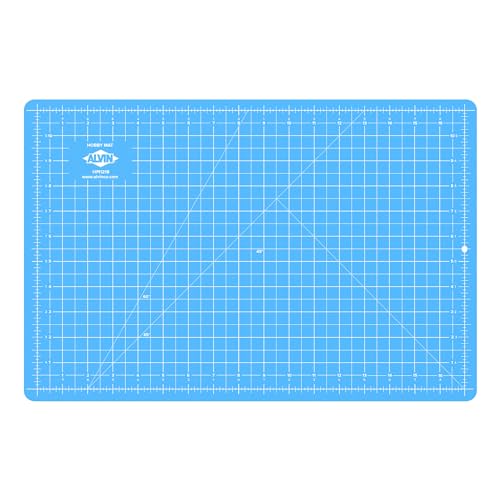
When you are working on a massive project—like cutting yardage for a full-sized quilt or a long, flowing skirt—a small mat simply won’t suffice. The Alvin Professional mat offers a generous surface area that allows you to cut long, continuous lines without having to shift your fabric.
Think of this as having a large, dedicated space to block your finished sweaters; it provides the room necessary for your work to breathe and stay aligned. Having that extra space means you spend less time repositioning and more time actually creating.
Because of its size, it remains very stable on the table, providing a flat, expansive workspace. It is the ultimate choice for the serious maker who has the table space to accommodate a large, professional-grade surface.
How to Choose the Right Size Mat for Your Space
The golden rule of sizing is to measure your workspace and subtract two inches from each side to ensure the mat doesn’t hang off the edge. A mat that is too large for your table will warp, which ruins the accuracy of your cuts and can eventually damage your rotary blade.
Consider your primary projects: if you mostly work on small accessories like hats or socks, a 12×18 inch mat is plenty. However, if you are working on large garments or home decor, aim for at least an 18×24 inch mat to accommodate full pattern pieces.
Always remember that a mat should lie perfectly flat on a hard surface. If you have a small table, it is better to have a smaller, perfectly flat mat than a large one that curves over the edges.
Understanding Self-Healing Mat Maintenance Tips
"Self-healing" doesn’t mean "indestructible." Over time, your mat will collect tiny bits of fiber and thread, which can dull your rotary blades faster than the mat itself.

- Clean regularly: Wipe your mat down with a damp, lint-free cloth and a drop of mild dish soap to remove dust and debris.
- Avoid heat: Never leave your mat in a hot car or near a heater, as heat will cause the plastic to warp permanently.
- Rotate your work: Try not to cut in the same exact spot every single time; move your fabric around to distribute the wear across the entire surface.
If you notice your rotary blade skipping, it’s often a sign that your mat has accumulated too much debris or has deep grooves. A quick cleaning can often restore the "self-healing" performance significantly.
Essential Safety Tips for Using Rotary Cutters
Rotary cutters are essentially circular razor blades, and they require as much respect as a pair of sharp embroidery scissors. Always engage the safety lock the second you finish a cut, even if you are just reaching for a pin or a pattern piece.
Maintain a clear line of sight and keep your fingers well away from the path of the blade. It is a common mistake to push too hard; let the sharpness of the blade do the work, not your wrist strength.
If you are tired or your focus is drifting, stop cutting. Just like knitting complex cables when you’re exhausted leads to dropped stitches, using a rotary cutter while distracted leads to accidents.
Common Mistakes When Storing Your Cutting Mats
The most common mistake is storing a cutting mat vertically against a wall or in a narrow slot for an extended period. Over time, gravity will cause the mat to lean and eventually bow, making it impossible to get a flat, accurate cut.
Always store your mats lying flat, preferably under your cutting table or on a wide, level shelf. If you must store them upright, ensure they are braced so they remain perfectly vertical and supported across their entire width.
Additionally, never place heavy objects on top of your mat while it is in storage. Heavy books or boxes can leave permanent indentations in the surface, which will cause your rotary cutter to skip or veer off course during your next project.
Finding the right cutting mat is just as personal as finding your favorite pair of knitting needles. By considering your workspace, the types of fibers you use, and your specific project goals, you can choose a surface that supports your craft for years to come. Remember that a well-maintained mat is the unsung hero of a beautiful finished garment. Treat your tools with care, and they will ensure your projects are as precise as your stitches.