7 Best Craft Room Wall Organizers For Supplies Reviewed
Maximize your creative space with our top 7 craft wall organizers. We review the best storage solutions to keep your supplies tidy, accessible, and efficient.
A cluttered craft room is the silent enemy of a good knitting rhythm, often burying your favorite circular needles or that perfect skein of hand-dyed wool under piles of half-finished projects. When your tools aren’t within arm’s reach, you lose the flow state that makes complex cable work or delicate lace knitting so rewarding. These seven wall organizers are designed to reclaim your vertical space and turn your stash into a functional, inspiring studio. Let’s look at how to organize your space so you can spend less time searching and more time stitching.
IKEA Skådis Pegboard: Best Overall Organization
The Skådis is a staple in many studios because it is remarkably modular, allowing you to reconfigure your layout as your collection of interchangeable needles grows. Its unique slot system holds hooks, shelves, and containers securely without the need for traditional pegboard hardware.
For a knitter, this means you can hang your favorite gauge swatches, stitch markers, and small snips right at eye level. It’s perfect for keeping your most-used accessories visible, preventing those "where did I put my cable needle?" moments mid-row.
The trade-off here is the proprietary accessory system, which limits you to IKEA’s specific attachments. If you have heavy items, you might find the plastic clips a bit flimsy, so stick to lighter tools like measuring tapes and scissors.
Wall Control Metal Pegboard: Best Heavy Duty Pick


If you are the type of knitter who keeps a heavy collection of vintage wooden swifts or a massive stash of metal circulars, a standard plastic pegboard won’t cut it. The Wall Control system is made of heavy-gauge steel, meaning it won’t bow under the weight of your equipment.
Because it uses standard-sized peg holes, you can source hooks and bins from any hardware store. This is a massive advantage if you need heavy-duty industrial hooks to hold a collection of heavy wool-blend skeins or a sturdy metal rack for your blocking mats.
Keep in mind that metal boards are louder when you swap tools, and they require a more permanent installation than lighter options. It’s a serious commitment for a serious studio, but it will likely be the last organizer you ever buy.
Honey-Can-Do Wall Shelf: Best for Yarn Storage

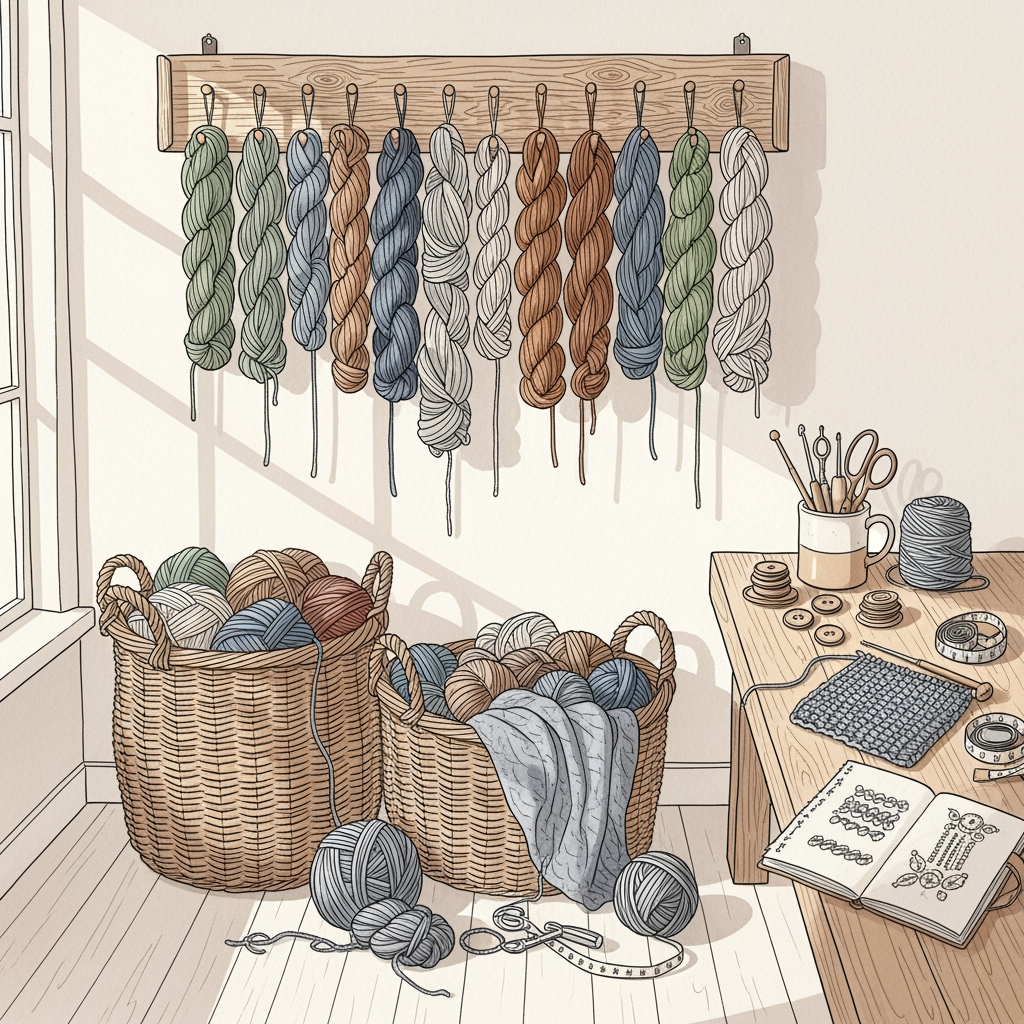
Nothing ruins a beautiful skein of hand-dyed merino like being crushed in a deep plastic bin. A wall shelf allows you to display your yarn by color or fiber content, keeping the fibers airy and preventing the dreaded "felted" look that happens when yarn is packed too tightly.
This shelf is excellent for keeping your current WIP (Work In Progress) skeins visible so you don’t accidentally buy a duplicate colorway. It’s also a great way to showcase your hand-dyed treasures, turning your stash into a piece of wall art.
Just be careful with direct sunlight; if your shelf is near a window, your natural fibers can fade or become brittle over time. Always rotate your stock to ensure your yarn stays in peak condition for your next project.
mDesign Wall Mount Basket: Best for Small Tools

If your desk is currently a graveyard of stray stitch markers, tapestry needles, and crochet hooks, these baskets are a lifesaver. They are compact enough to mount right next to your favorite knitting chair, keeping essentials within reach without cluttering your workspace.
I recommend using these for items you reach for every few minutes, like your row counter or a small tin of point protectors. Having a dedicated home for these tiny, easily lost items saves you from the frustration of hunting for a needle tip when you’re in the middle of an intricate lace repeat.
Because these are open-top baskets, they aren’t great for things that collect dust. Keep your high-end silk or mohair blends tucked away in closed containers, and reserve these baskets for your hard-wearing tools.
Command Clear Hooks: Best Budget Wall Solution

Sometimes you don’t need a full system; you just need a place to hang a pair of scissors or a finished project waiting for blocking. Command hooks are the ultimate "knitter’s hack" because they are renter-friendly and can be placed exactly where you need them.
I use these to hang my circular needle cases by their tags, keeping them off the floor and away from curious pets. They are also perfect for hanging a "project board" where you keep your pattern printouts and current notes.
The biggest downside is the adhesive strength; don’t try to hang a heavy bag of yarn on one of these. They are best for lightweight, frequent-access items that make your knitting life easier.
Spectrum Diversified Wall Grid: Best Display

A wire grid offers an industrial, open look that makes it incredibly easy to see exactly what you have at a glance. It’s a favorite for knitters who like to "shop their stash" because everything is pinned up and visible.
You can use S-hooks to hang your circular needle sets, making it easy to grab the right size for your next pair of socks. It’s also a great way to clip up your colorwork charts so you can follow your pattern without hunching over a table.
The grid aesthetic can get busy quickly, so try to keep your items organized by category or color. If you have too many small items, it can look cluttered, so use small bags or clips to group your notions together.
Wall-Mounted Floating Shelves: Best for Books
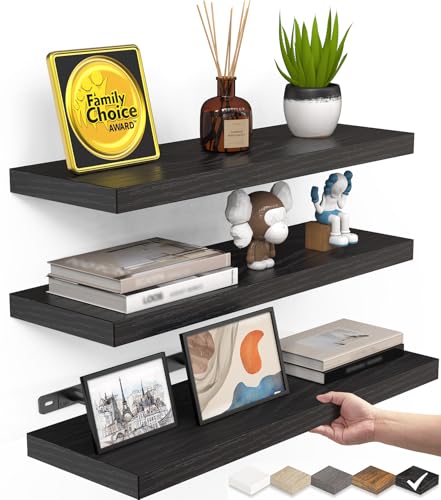
Your knitting library—those thick, well-loved pattern books and technique guides—needs a home that doesn’t hide them away. Floating shelves are perfect for stacking your reference books, keeping them accessible when you need to look up a complex grafting technique or a specific cast-on.
I like to keep my most-used books, like those on sweater construction or yarn substitution, on the bottom shelf for quick access. The upper shelves are great for storing your finished swatches or decorative yarn bowls that aren’t currently in use.
Make sure you install these into wall studs if you have a heavy collection of hardcovers. A shelf full of knitting books is deceptively heavy, and you don’t want your library crashing down mid-project.
How to Design a Functional Fiber Arts Wall Space
A truly functional space starts with the "triangle" of knitting: your stash, your tools, and your inspiration. Place your most frequent tools (scissors, tape measure, row counter) closest to your chair, while your long-term stash can live on higher or secondary walls.
- Categorize by Fiber: Keep your protein fibers (wool, alpaca, silk) separate from plant fibers (cotton, linen) to manage moisture levels.
- Visibility: If you can’t see it, you won’t knit with it. Use clear bins or open hooks to keep your inventory top-of-mind.
- Ergonomics: Mount your grid or pegboard at a height where you don’t have to strain your neck or reach awkwardly to grab a tool.
Remember that your needs will change as you move from simple garter stitch scarves to complex stranded colorwork. Build a system that can grow with your skills rather than one that locks you into a single way of working.
Essential Factors for Choosing Wall Organizers
Before you drill into your wall, consider the weight and frequency of use for your items. If you are storing a massive collection of wooden needles, you need something sturdy; if you are storing light notions, a simple adhesive hook will suffice.
- Material: Metal is durable but heavy; plastic is modular but can be brittle.
- Installation: Can you patch holes, or do you need damage-free options?
- Accessibility: Is the organizer meant for storage (long-term) or utility (daily use)?
Don’t buy an organizer because it looks good on social media; buy it because it solves a specific friction point in your knitting process. If you find yourself constantly walking across the room for a crochet hook to fix a dropped stitch, that’s where your next organizer should go.
Maximizing Vertical Space in Your Craft Studio
Vertical space is the most underutilized asset in a small craft room. By taking your supplies off the table, you create a "clean slate" effect that helps you focus on the texture and tension of the yarn in your hands.
Use the area above your desk for your primary tool board, and use the higher wall space for long-term storage of yarn that needs to stay away from dust or sunlight. Even a narrow strip of wall can hold a vertical rack for your circular needles.
The goal is to create a seamless transition from "I need a tool" to "I have the tool." When your environment is optimized, your knitting becomes a more meditative and less stressful experience.
Organizing your craft room is just as important as choosing the right needle for your yarn weight or checking your gauge before starting a sweater. By selecting the right wall organizers, you move from a state of chaos to a state of creative flow. Take the time to assess your specific knitting habits and choose the tools that will serve your craft for years to come. Your future self—and your next complex project—will thank you for the extra space.