7 Best Project Journals For Documenting Finishing Techniques
Master your craft with our top 7 project journals. Discover essential tools for tracking finishing techniques, ensuring consistent results in every project.
Every knitter eventually reaches the point where a beautiful garment is ruined by a sloppy seam or a poorly executed bind-off. Documentation is the bridge between making a project and truly mastering the craft of finishing. By tracking your technical choices, you transform from a pattern-follower into a confident maker. These seven journals offer the structure necessary to turn your knitting experiments into a reliable personal archive.
The Knitter’s Planner by Making: Best for Detail
This planner is designed for the knitter who treats every project like a research study. It provides ample space for logging the minutiae that often get lost in the shuffle of a busy knitting season.
If you are working on a complex garment with multiple sizes, this journal allows you to track specific modifications. You can document where you adjusted the shaping to accommodate your unique gauge or fiber choice.
The real strength here is the depth of the prompts. It forces you to consider the "why" behind your finishing, not just the "how." It is a heavy-duty tool for those who want a permanent record of their growth.
Fringe Association Knit Project Journal: Minimalist
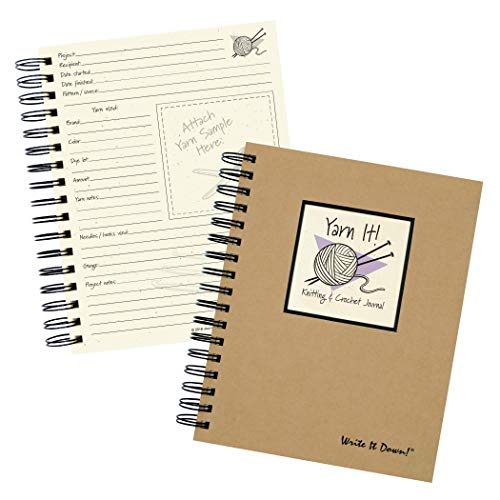

Sometimes, the best tool is the one that stays out of your way. This journal is for the knitter who wants to capture essential data without feeling overwhelmed by checklists.
The layout is clean and intentional, focusing on the core facts of your knitting life. It is perfect for those who find elaborate planners a chore rather than a help.
Because it is so streamlined, you have the freedom to sketch your own seaming diagrams in the margins. It assumes you already know what you need to track and gives you the space to do it your way.
Cocoknits Maker’s Journal: Best for Organization
Cocoknits is legendary for their focus on the structural side of knitting. Their journal reflects a deep understanding of the construction process, making it an excellent choice for garment knitters.
The system is highly logical, breaking down projects into distinct phases. You can easily separate your notes on yarn properties from your technical notes on assembly.
If you struggle with keeping track of which needle size you used for the ribbing versus the body, this is your solution. It turns the chaotic process of finishing into a series of manageable, documented steps.
Scanlan’s Knitting Journal: Best for Swatch Notes
We often forget that the swatch is the most important part of the finishing process. This journal prioritizes the technical data of your yarn and gauge before you even cast on the project.
By documenting your pre-wash and post-wash gauge, you gain a clear understanding of how your fiber behaves. This is critical for predicting how your seams will hold up after the first time you block the garment.
It is an essential resource for those who work with tricky fibers like silk or high-twist wool. Knowing exactly how much a yarn blooms or shrinks allows you to adjust your finishing techniques accordingly.
Moleskine Passion Journal: Best for Custom Layouts
If you prefer a blank canvas over a structured template, the Moleskine approach is unbeatable. It allows you to create a personalized system that evolves as your skills improve.
You can dedicate entire pages to swatches of different bind-off methods. Taping a small sample of a "three-needle bind-off" next to a "Kitchener stitch" sample provides a visual reference you cannot get anywhere else.
The tradeoff is that you must be disciplined enough to create your own structure. If you are the type of knitter who enjoys bullet journaling, this provides the most creative freedom.
Wool & Pine Project Planner: Digital-First Choice
For the modern maker who keeps their life on a tablet, a digital planner offers unmatched portability. You can snap a photo of a tricky seam and drop it directly into your project notes.
Digital files are searchable, meaning you can find that specific mattress stitch technique you used three years ago in seconds. It is a game-changer for knitters who have a large library of past projects.
The ability to zoom in on your own diagrams makes it easy to refine your technique. It is a highly efficient way to keep your project history organized without adding physical clutter to your knitting bag.
Knit Note by KnitPicks: Best Budget-Friendly Pick

You don’t need an expensive leather-bound book to start documenting your work. This option provides all the necessary fields for a fraction of the cost, making it accessible for beginners.
It covers the basics: needle size, yarn weight, and finishing notes. It is a straightforward, no-nonsense approach to record-keeping.
If you are prone to losing your notes or knitting in messy environments, this is a low-stakes investment. It is better to have a budget journal you actually use than a luxury one that sits empty on your shelf.
Why Documenting Finishing Techniques Matters Most
Finishing is the difference between a "homemade" look and a professional, store-quality garment. When you document your techniques, you create a feedback loop that accelerates your learning.
If a seam pulls or a neckline stretches out, your notes tell you exactly what you did wrong. You can then adjust your tension or your seaming method on the next project.
Without records, you are essentially reinventing the wheel every time you cast on. Documentation turns your knitting history into a reliable manual for your future self.
Key Details to Log for Professional Seaming Work
When you finish a seam, don’t just write "seamed." Document the specific method, such as mattress stitch or backstitch, and note the tension you used.

Also, track the yarn you used for the seaming itself. Did you use the project yarn, or did you use a thinner, more durable thread to reduce bulk?
- Seam elasticity: Did the seam need to stretch, or did it need to be stable?
- Needle type: Did you use a sharp tapestry needle or a blunt one to avoid splitting the plies?
- Blocking: Did you block the pieces before or after seaming?
How to Track Your Bind-Offs for Future Projects
Bind-offs are the final word on your project’s fit and drape. Tracking them helps you avoid the dreaded "tight edge" that ruins a perfectly good sweater.
Note the specific bind-off used, such as the Jeny’s Surprisingly Stretchy Bind-Off or a standard bind-off. If you had to go up two needle sizes to get the right tension, write that down.

- Edge appearance: Is it decorative or invisible?
- Functionality: Does it have enough give for the intended use?
- Yarn behavior: Did the bind-off use significantly more yarn than expected?
Documenting your finishing techniques is the ultimate act of respect for your own labor. By tracking these small but vital details, you ensure that every project you finish is better than the one before it. Choose the journal that fits your personality, and start building your archive today. Your future self will thank you when you finally nail that perfect neckline.