6 Best Yarn Needles With Bent Tips For Easier Weaving
Discover the 6 best bent-tip yarn needles for effortless weaving. These ergonomic tools simplify finishing your projects with precision and ease. Read on.
Weaving in ends is the final hurdle between a finished project and a true masterpiece, yet many knitters dread this step. A bent-tip needle transforms this chore by allowing you to slide under stitches without splitting your yarn or piercing your fabric. These specialized tools are designed to navigate the tight architecture of your stitches with ease and precision. Investing in the right needle ensures your hard work stays secure for years to come.
Clover Chibi Bent Tip Tapestry Needles


These needles are legendary in the knitting community for a reason. They come housed in a convenient carrying case, which is a lifesaver for those of us who tend to lose small notions in the depths of our project bags.
The tips are slightly rounded, making them gentle on delicate fibers like alpaca or merino. They glide through finished fabric without catching on the individual plies of your yarn.
If you are working with bulky or super-bulky wool, the eye size is generous enough to accommodate thicker strands. They are a reliable, "set it and forget it" tool for any knitter’s kit.
Susan Bates Finishing Needles with Bent Tips

Susan Bates has been a staple in the craft world for decades, and their finishing needles reflect a focus on durability. These needles are typically made of polished steel, providing a slick surface that slides through dense, tight-gauge fabric effortlessly.
The bent tip on these needles is slightly more pronounced than others, which is excellent for grabbing a loose strand of yarn deep inside a seam. If you are sewing together sweater pieces, this shape helps you maintain consistent tension along the mattress stitch.
Because they are steel, they are quite rigid and won’t bend out of shape over time. They are the workhorse needles you want when you have a large project, like a heavy cable-knit blanket, that requires extensive finishing.
Dritz Yarn Darner Needles with Bent Points

Dritz needles are often found at general craft stores, making them an accessible choice for those who need a tool immediately. These needles are functional and straightforward, designed to handle the rigors of darning and weaving.
The bent point is particularly useful if you are repairing a snag or weaving in ends on a garment that has already been worn. The angle allows you to navigate the "nooks and crannies" of the fabric without needing to flip the garment inside out constantly.
While they may not have the premium finish of boutique brands, they are perfectly capable for most standard acrylic or wool projects. They are a great entry-level option if you are curious about the benefits of bent tips but aren’t ready to invest heavily.
Knitter’s Pride Steel Bent Tip Tapestry Needles

Knitter’s Pride understands the ergonomics of knitting, and these needles are no exception. They feel balanced in the hand, which helps reduce fatigue if you are facing the daunting task of weaving in ends on a large colorwork project.
The steel construction is smooth, ensuring that you won’t snag your yarn as you pull the needle through. This is crucial for high-twist yarns, which can easily fray if a needle tip is too sharp or rough.
These needles often come in a set with multiple sizes, which is a significant advantage. Having a variety of eye sizes allows you to match the needle to the weight of your yarn, preventing your work from becoming distorted by a needle that is too thick.
Boye Bent Tip Finishing Needles for Yarn

Boye needles are classic, no-nonsense tools that have been in knitters’ kits for generations. Their bent-tip needles are designed with a focus on simplicity and ease of use, making them a favorite for beginners.
The tips are rounded enough to be safe, yet sharp enough to pierce through the center of a stitch if you are trying to "lock" your yarn end in place. This technique is essential for ensuring your ends don’t work their way out after a few washes.
These needles are often sold in multi-packs, offering great value. If you are the type of knitter who keeps a pair of needles in every project bag, this is an economical way to ensure you are never without a bent-tip tool.
Cocoknits Steel Stitch Needles with Bent Tips
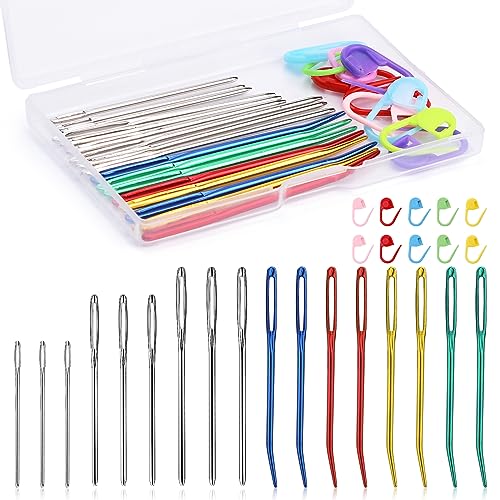
Cocoknits has refined the finishing needle by focusing on aesthetic and functional quality. These steel needles feature a matte finish that feels substantial and premium in the fingers.
The bent tip is perfectly calibrated, striking a balance between being easy to insert and easy to pull through. They are particularly effective when working with luxury fibers like silk or cashmere, where you want to avoid any possibility of snagging.
They are a bit of an investment, but for the serious maker, the tactile experience is worth it. If you spend hundreds of hours on a project, using a high-quality tool for the final step feels like a well-deserved reward.
Why Bent Tips Make Weaving Ends Much Easier
The primary advantage of a bent tip is its ability to "hook" under stitches without needing to lift the fabric away from your body. With a straight needle, you often have to poke and prod to find the right path, which can lead to accidental splitting of the yarn.
The bend creates a natural ergonomic angle that follows the curve of your hand as you move through the fabric. This movement is much more fluid and less taxing on your wrists and fingers.
Furthermore, the bent tip acts as a guide. You can feel the needle "catch" the underside of a stitch, giving you tactile feedback that you are in the right place. This makes the entire process faster and significantly more accurate.
Choosing the Right Eye Size for Your Yarn
The rule of thumb is simple: the eye of your needle should be slightly smaller than the diameter of your yarn. If the eye is too wide, it will stretch your stitches as you pull the yarn through, leaving visible gaps in your finished work.
Conversely, if the eye is too small, you will struggle to thread the needle, leading to frustration and frayed yarn ends. Always test your yarn by threading it through the eye before you begin weaving; it should slide through with just a little bit of resistance.
- For Fingering/Sock Yarn: Use a fine, thin needle with a small eye.
- For Worsted/Aran Yarn: Use a medium-sized needle that allows the yarn to sit flat.
- For Bulky/Super Bulky Yarn: Use a larger needle, but ensure the tip remains tapered to avoid stretching the fabric.
Essential Tips for Securing Your Yarn Ends
Weaving in ends is not just about hiding the yarn; it is about anchoring it so it stays put through wear and laundering. The best approach is to follow the path of the existing stitches, mimicking the "V" shape of the knitting.
Avoid pulling your yarn too tight, as this will pucker the fabric and ruin your gauge. After you have woven the end through several stitches, give your work a gentle tug to ensure it has enough "give" to move with the fabric.
Finally, consider splitting a ply of the yarn with your needle near the end of your weaving path. This adds a physical "lock" that prevents the yarn from sliding back out over time.
How to Properly Store Your Finishing Needles
Because these needles are small and easily misplaced, designated storage is essential. A small magnetic needle minder is a fantastic tool to keep on your project bag, ensuring your needle is always right where you left it.
If you prefer to keep them inside your bag, use a small, dedicated tin or a needle case. Avoid leaving them loose in the bottom of your bag, as the tips can catch on your yarn or, worse, poke through the fabric of your project bag.
Keeping your needles clean is also important. If you notice any oil or debris on the steel, wipe them down with a soft cloth to ensure they continue to glide smoothly through your precious fiber projects.
Mastering the art of the weave-in is the final step toward professional-looking knitwear. By switching to a bent-tip needle, you eliminate the frustration of snagged stitches and uneven tension. Choose the tool that fits your comfort level and fiber choice, and you will find that finishing your projects becomes a meditative, satisfying conclusion. Happy knitting, and may your ends always stay tucked away securely.