6 Best Needle Gauge Rulers For Checking Machine Compatibility
Identify the right needle for your project. We review the top 6 gauge rulers to ensure perfect machine compatibility and prevent costly fabric damage today.
Every knitter has experienced the frustration of a needle label fading away, leaving you guessing about the size of your favorite circulars. Accurate needle sizing is the silent foundation of every successful project, preventing the dreaded "too-tight" fabric or the uneven stitches of a loose gauge. Whether you are working on a delicate lace shawl or a sturdy sweater, knowing your exact needle diameter is non-negotiable. This guide explores the most reliable tools to ensure your needles are always perfectly matched to your pattern requirements.
ChiaoGoo 4-Inch Needle Gauge: The Precise Choice


This gauge is a favorite among those who appreciate industrial-grade accuracy. It is crafted from a durable, thin plastic that resists warping, which is a common issue with cheaper, flimsy alternatives.
Because it includes both metric and US sizing, it bridges the gap for knitters using international patterns. The holes are precision-cut, ensuring that your needle fits snugly without any wiggle room that might lead to a false measurement.
If you are working with high-end, precision-machined needles, you need a gauge that matches that level of detail. It is a no-nonsense tool that fits easily into any notions pouch, making it a reliable companion for stash-busting sessions.
Susan Bates Knit Chek: The Classic Budget Pick
The Susan Bates Knit Chek is the tool most of us started with, and for good reason. It combines a needle gauge with a built-in ruler and a stitch counter, offering a "three-in-one" utility that is hard to beat for the price.
However, the metal can occasionally feel sharp on the edges, and the markings can wear off after years of heavy use. It is best suited for the knitter who wants a utilitarian tool that can take a beating in a crowded knitting bag.
While it might not have the sleek design of modern boutique tools, it remains an essential piece of kit. It is the perfect choice for the beginner who needs to verify needle sizes and check row counts without breaking the bank.
Clover Knitting Needle Gauge: Best For Beginners
Clover’s gauge is incredibly user-friendly, featuring clear, high-contrast markings that are easy to read even in low light. It is lightweight and flexible, which prevents it from snapping if it gets caught at the bottom of a heavy project bag.
The layout is intuitive, guiding you through the sizing process quickly so you can get back to your knitting. It is particularly helpful for those who struggle with the tiny, etched numbers found on many metal gauge tools.
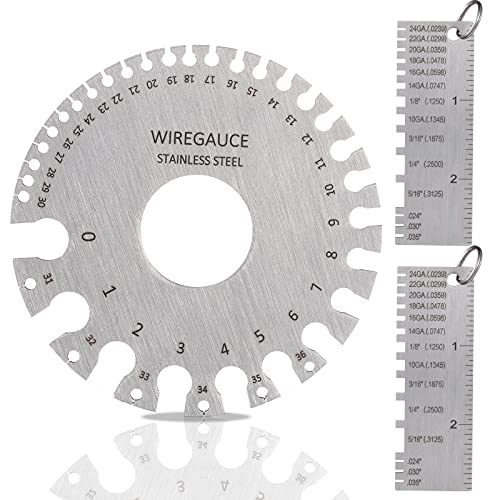
If you find yourself squinting at your tools, this is the upgrade you need. It turns the tedious task of measuring needles into a quick, stress-free step, allowing you to focus on your tension and stitch patterns.
Cocoknits Maker’s Keep Ruler: Top Design Choice

Cocoknits has mastered the intersection of aesthetics and functionality. This gauge is not just a tool; it is a design object that feels substantial and intentional in your hand, often made from sustainable, biodegradable materials like plant-based plastic.
Beyond its looks, the sizing holes are perfectly calibrated to account for the slight variations in manufacturing across different needle brands. It is ideal for the knitter who values a cohesive, beautiful workspace and wants tools that reflect their creative process.
The tradeoff is the price point, which is higher than standard plastic gauges. However, for the knitter who wants a lifetime tool that feels as good as it works, this is an investment in your craft.
Brittany Birch Needle Gauge: Best For Natural Option

If you prefer the tactile experience of wood over metal or plastic, the Brittany Birch gauge is a delight. It is smooth to the touch and features laser-engraved sizing that won’t rub off, even after a decade of use.
Using a wooden gauge feels more "organic," and it won’t scratch or damage the finish on your delicate wooden needles. It is a fantastic choice for those who are sensitive to the sound of metal clicking against metal.
Keep in mind that wood can be affected by extreme humidity, so it is best to keep it in a temperature-controlled environment. It is a beautiful, sustainable choice that honors the natural fibers you likely love to knit with.
HiyaHiya Multi-Gauge: Best For Machine Knitting

Machine knitting requires a level of precision that hand-knitting sometimes allows us to fudge. The HiyaHiya Multi-Gauge is specifically designed to handle the tiny needle diameters used in machine work, where a fraction of a millimeter can change your fabric density entirely.
It is remarkably compact, yet it covers a vast range of sizes, including the very small diameters often found in circular sock machines. The sturdy construction ensures that the gauge holes do not deform, which is critical when you are dealing with needles as thin as a hair.
For the machine knitter, this tool is indispensable. It removes the guesswork from setting up your bed, ensuring that your stitch size remains consistent across your entire panel.
Why Gauge Accuracy Matters For Machine Knitting
In machine knitting, the needle gauge determines how the yarn interacts with the latch mechanism. If your needle is even slightly too thick for the machine’s carriage, you will experience dropped stitches or, worse, a broken needle bed.
- Consistent Tension: Accurate needles ensure the yarn feeds smoothly through the sinkers.
- Preventing Damage: Correct sizing protects the delicate needles from unnecessary stress.
- Fabric Integrity: Proper gauge prevents uneven loops that can ruin a finished garment.
When you are working with a machine, your tools are part of a complex mechanical system. Accuracy here is not just about the final fit of the sweater; it is about the mechanical health of your knitting machine.
How To Check Needle Size For Machine Compatibility
To check a needle, gently insert the tip into the gauge holes until you find the one where it fits snugly but does not force its way through. If the needle slides through with significant play, it is too small; if it requires pressure, it is too large.
Always ensure the needle is clean and free of yarn residue before measuring. Even a tiny bit of fiber buildup can make a needle appear larger than it actually is, leading to a false reading.
If you are unsure, test the needle against a known size you have in your collection. This "control test" helps you calibrate your eyes to the fit, ensuring you aren’t accidentally misreading the measurement.
Measuring Tips For Accurate Machine Gauge Results
Lighting is your best friend when measuring needles. Use a bright, natural light source to ensure you can clearly see the gap between the needle and the edge of the gauge hole.
- Avoid Force: Never jam a needle into a hole; if it doesn’t fit, move to the next size up.
- Check the Taper: Some needles have a slight taper near the point, so measure the shaft, not just the tip.
- Consistency: Measure all needles in a set, as manufacturing tolerances can sometimes lead to slight variations.
Remember that different materials—like carbon fiber versus nickel-plated steel—can have slightly different "feels" when measuring. Trust the gauge, not just the feel, to get the most accurate result.
Essential Tools For Maintaining Your Knitting Tools
Beyond a good gauge, keeping your needles in top shape involves regular cleaning and storage. A soft, microfiber cloth is perfect for wiping down needles to remove skin oils that can cause drag.
For wooden needles, a light application of wax can keep them smooth and prevent them from splintering. For metal needles, ensure they are stored in a dry place to prevent oxidation or rust, which can catch on your yarn.
Treating your tools with care is a sign of a master knitter. When your tools are well-maintained, your knitting process becomes smoother, faster, and far more enjoyable.
Investing in a reliable needle gauge is the simplest way to elevate your knitting practice and protect your equipment. By choosing a tool that suits your personal style—whether it be the precision of ChiaoGoo or the natural warmth of Brittany Birch—you ensure that every project starts on the right foot. Remember, the goal is to eliminate uncertainty so you can focus entirely on the rhythm of your stitches. Happy knitting, and may your needles always be the perfect size for the yarn on your hooks.