7 Best Hobby Knives For Trimming Chart Edges
Achieving crisp chart edges requires precision. We review the 7 best hobby knives for clean, accurate trimming, focusing on blade sharpness, grip, and control.
Organizing your knitting workspace is just as vital as choosing the right yarn for your next sweater project. A crisp, clean knitting chart allows you to track your cable crosses or lace repeats without losing your place mid-row. These seven precision knives are the gold standard for trimming those bulky pattern pages into manageable, project-friendly references. Investing in the right tool ensures your paper edges are as smooth as a perfectly executed kitchener stitch.
X-ACTO No. 1 Precision Knife: Best Overall Choice


The X-ACTO No. 1 is the industry standard for a reason, and it’s likely the tool you’ll see in most professional craft studios. Its lightweight aluminum body feels balanced in the hand, much like a well-weighted pair of carbon fiber needles.
For knitters who prefer to trim their charts while sitting in a comfy armchair, this knife offers the perfect weight-to-control ratio. You won’t feel wrist fatigue even after trimming a dozen pages of a complex, multi-page colorwork pattern.
The real beauty here is the collet chuck system, which holds the blade with a vice-like grip. It prevents the blade from wobbling, ensuring you don’t accidentally tear through a row of vital stitch instructions.
Fiskars Detail Knife: Best Ergonomic Grip Tool
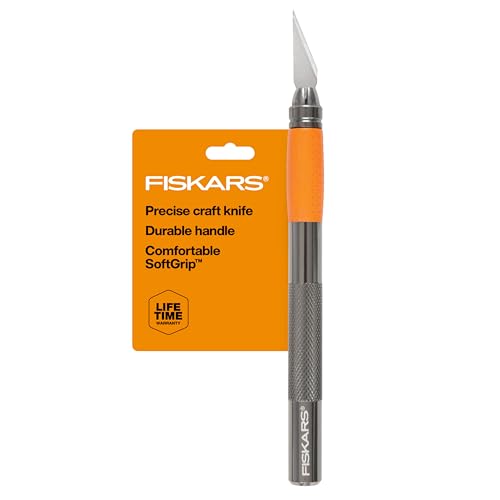
If you suffer from hand strain after hours of cabling or working with heavy wool, the Fiskars Detail Knife is a welcome relief. It features a soft-grip handle that mimics the comfort of ergonomic crochet hooks or needle grips.
This knife is particularly effective for knitters who need to trim charts while managing a tremor or reduced grip strength. The shape prevents the tool from rolling off your project table, keeping it safely within reach when you need to quickly trim a margin.
Keep in mind that the softer grip can sometimes feel a bit less "tactile" than a solid metal handle. However, for sheer comfort during long sessions of preparing pattern binders, it is difficult to beat.
Excel Blades K1 Knife: Best Durable Metal Handle
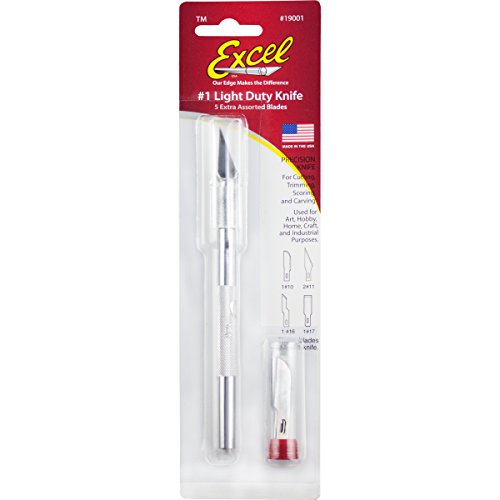
The Excel Blades K1 is built for the long haul, much like a high-quality set of stainless steel needles that will last a lifetime. Its all-metal construction provides a solid, reassuring heft that helps guide the blade through thick cardstock or laminated charts.
Because it is made of durable metal, this tool is virtually indestructible. If you frequently trim your charts on a hard cutting mat near your yarn stash, this knife won’t crack or warp under pressure.
One minor tradeoff is that the metal handle can get cold or slippery if your hands tend to run dry. A quick wipe down or a small piece of grip tape can easily solve this if you find it sliding during a long cutting session.
Olfa Art Knife AK-1: Best for Precise Chart Cuts

The Olfa AK-1 is a Japanese-engineered tool that prioritizes surgical precision. Its slim profile is ideal for those knitters who like to trim their charts into tiny, portable snippets to tuck inside their project bags.
The blade angle on the Olfa is slightly different than its competitors, allowing for a more vertical cutting motion. This is perfect for when you are trimming between tight columns on a dense lace chart.
It is a minimalist tool that does one thing exceptionally well: creating a perfectly straight edge. If you value precision over fancy features, this is the knife that belongs in your knitting kit.
Westcott Craft Knife: Best Value For Your Budget

You don’t need to break the bank to get a high-quality tool that keeps your knitting patterns tidy. The Westcott Craft Knife offers a reliable, no-frills experience that is perfect for knitters who prefer to spend their budget on luxury hand-dyed yarns instead.
It comes with a sturdy cap, which is a non-negotiable safety feature when you have curious pets or children around your knitting space. I always recommend keeping the cap on whenever you aren’t actively slicing.
While it lacks the premium feel of high-end metal tools, its performance is remarkably consistent. It will easily handle standard printer paper and even heavier cardstock without snagging.
Tamiya Modeler’s Knife: Best for Clean Edge Work

Tamiya is renowned in the hobby world for tools that provide a professional finish, and their knife is no exception. It is exceptionally sharp right out of the package, making it ideal for those who want a "factory-cut" look for their pattern sheets.
The blade is designed to stay sharp through many cuts, which is vital when you are trimming a large library of vintage patterns. A dull blade is a dangerous blade, as it forces you to use more pressure and increases the risk of slipping.
This knife is a favorite among knitters who are also perfectionists about their project binders. If you like your charts to look like they came straight from a professional publisher, this is your best bet.
Maped Precision Knife: Best for Delicate Trimming
The Maped knife is a compact, elegant solution for knitters who work with delicate paper or thin vellum charts. It feels more like a fine-tipped pen than a heavy-duty cutter, which allows for incredible control.
This is the knife I reach for when I need to trim a chart that has been annotated with fine-point pens. You can easily maneuver around your handwritten notes without accidentally cutting into your stitch counts.
It is a lighter tool, so it’s best suited for single-sheet trimming rather than heavy-duty cardboard. For your standard knitting pattern printouts, it offers a level of finesse that is truly impressive.
Why Sharp Blades Matter for Knitting Chart Edges
A dull blade is the enemy of a clean knitting chart. When your blade is blunt, it drags through the paper fibers rather than slicing them, resulting in ragged, uneven edges that can catch on your yarn as you move your needles.
Ragged edges are not just an aesthetic issue; they can actually be a distraction. When you are working on a complex lace project, your eyes need to track the pattern seamlessly; a messy edge disrupts that flow.
Furthermore, dull blades require more force. When you apply extra pressure, you lose the fine motor control necessary to keep your cuts straight, often leading to a ruined chart that you have to reprint.
How to Safely Maintain Your Craft Knife Blades
Treat your craft knife with the same respect you give your favorite pair of knitting scissors. Never use your precision knife to cut anything other than paper or light cardstock, as hitting staples or thick plastic will instantly dull the tip.
Always store your knife with the blade retracted or capped. A loose knife in a project bag is a recipe for disaster, both for your hands and for your precious skeins of wool, which can easily be snagged by a stray blade.
When the blade begins to feel like it is "tearing" the paper instead of slicing it, it is time to change it. A fresh blade is inexpensive, and it is a small price to pay to keep your patterns in pristine condition.
Essential Tips for Clean Knitting Pattern Cuts
- Use a self-healing mat: Always cut on a dedicated mat to protect your table and keep the blade sharp longer.
- Use a steel ruler: A metal edge provides a perfect guide for long, straight cuts across your chart rows.
- Cut in multiple passes: Don’t try to force the blade through thick paper in one go; two light passes are safer and cleaner.
- Keep your workspace clear: Remove stray yarn ends and stitch markers before you start trimming to avoid accidents.
Keeping your knitting charts organized with clean, straight edges is a simple way to elevate your entire crafting experience. By choosing the right precision knife and maintaining your blades, you ensure that your focus remains entirely on the joy of the stitch. A tidy pattern leads to a tidy project, allowing you to breeze through even the most complex designs with confidence. Happy knitting, and may your edges always be as crisp as your tension.