6 Best Scale Tools For Weighing Yarn For Precision
Achieving perfect gauge requires accuracy. We review the 6 best scales for weighing yarn, ensuring precision for every project. Master your stash management.
Precision is the secret language of the master knitter, turning a guessing game into a science of perfect yardage. Whether you are playing yarn chicken on a complex sweater or trying to split a precious hand-dyed skein for a pair of socks, a reliable scale is your best friend. These tools transform fiber management from a chore into a seamless part of your creative process. Let’s look at the best options to ensure your stash and your projects always align.
My Weigh iBalance 201: The Professional Choice


When you are working with high-end luxury fibers like silk or cashmere, you need a scale that doesn’t just guess. The iBalance 201 offers the kind of laboratory-grade sensitivity that ensures you aren’t wasting a single inch of expensive yarn.
This scale is designed for those who demand absolute consistency. If you frequently weigh small amounts of leftover yarn to calculate exactly how much you need for a new project, this level of precision is invaluable.
The trade-off here is the footprint and the price point. It is a larger, more specialized piece of equipment that might feel like overkill if you are only weighing full skeins for basic scarves.
Etekcity Digital Kitchen Scale: Best Value Pick

The Etekcity is the workhorse of the knitting world. It is affordable, reliable, and gets the job done without any unnecessary bells or whistles that might complicate your workflow.
For the average knitter, this scale is the perfect entry point. It handles the weight of a standard 100-gram skein with ease, and its slim profile means it tucks away neatly into a notions bag or a desk drawer.
However, it lacks the extreme micro-precision of professional scales. If you are trying to weigh a tiny scrap of lace-weight yarn, you might find the readings fluctuate more than you would like.
American Weigh Scales Blade: Best Portable Scale
If you are a traveling knitter who loves to attend retreats or knit on the train, the Blade is a revelation. Its sleek, pocket-sized design mimics a folding knife, making it the most portable option on the market.
This scale is ideal for weighing yarn while you are out shopping at a local yarn store or festival. You can verify the weight of a vendor’s skein before you commit to a purchase, ensuring you are getting exactly what you pay for.
The downside to such a compact form factor is the surface area. Balancing a large, unruly cake of bulky-weight yarn on the small platform can be a bit of a juggling act.
GreaterGoods Digital Scale: Best Simple Design

Sometimes, you just want to turn a scale on, weigh your project, and get back to your knitting. The GreaterGoods scale excels in its minimalist, intuitive interface that removes all the friction from the process.
This is a fantastic tool for knitters who find digital screens and complex menus intimidating. It is clean, easy to clean, and provides a clear, backlit reading that is visible even in dim lighting.
Because it is so simple, it lacks advanced features like unit conversion memory or specialized calibration modes. It is a tool designed for one purpose: straightforward weight measurement.
Ozeri Pronto Digital Scale: Best for Large Skeins

When you are working on a massive project like a heavy wool blanket or a sweater in a worsted weight, you need a scale with a generous platform. The Ozeri Pronto offers a wide surface that accommodates even the largest, most precarious yarn cakes.

The weight capacity is impressive, allowing you to weigh multiple skeins at once if you are planning a large-scale project. It is sturdy enough to handle the weight without the display being obscured by the fiber.
Be aware that the wide platform can sometimes make it harder to read the display if you have a particularly large, floppy ball of yarn hanging over the edges. Always center your yarn carefully to ensure the most accurate reading.
Escali Primo Digital Scale: Best for Durability
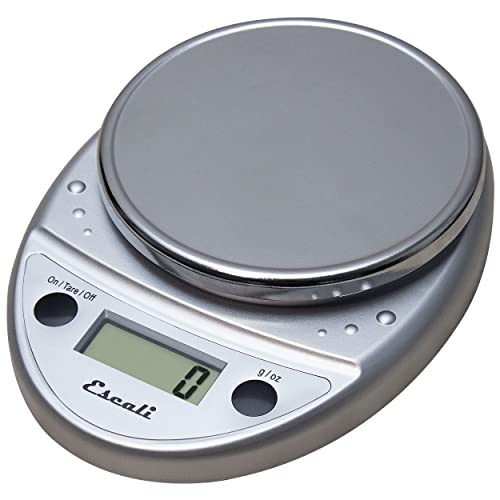
The Escali Primo is legendary among knitters for its sheer toughness. It is the scale that survives accidental drops, yarn dust, and the occasional spill of tea during a long knitting session.
Its physical buttons are a major advantage, as they are less prone to failure than touch-sensitive controls. If you want a tool that will stay in your knitting kit for the next decade, this is the one to choose.
While it is exceptionally durable, the design is purely utilitarian. It doesn’t have the sleek, modern aesthetic of other scales, but in the world of fiber arts, reliability always trumps fashion.
Why Precision Matters When Measuring Your Yarn
Precision is the difference between finishing a project and running out of yarn three rows before the bind-off. When you know the exact weight of your yarn, you can calculate your yardage with much higher confidence.
Many knitters rely on the labels, but factory-wound skeins can vary slightly due to moisture content or manufacturing tolerances. A scale allows you to account for these subtle differences before you start your project.
Furthermore, if you are working with hand-dyed yarns, you often have limited quantities. Weighing your yarn helps you decide if you have enough for a matching pair of socks or if you need to adjust your stitch pattern to conserve length.
How to Calibrate Your Scale for Accuracy
Even the best digital scales can lose their accuracy over time due to environmental factors or general wear. Most scales come with a calibration mode that allows you to reset the internal sensors using a known weight.
If you don’t have a calibration weight, you can use a common household item with a known weight to check your scale’s performance. A standard nickel, for instance, weighs exactly 5 grams.
If your scale is consistently off by a small amount, it is time to recalibrate. Always place your scale on a hard, flat, level surface, as even a slight tilt can lead to inaccurate measurements during your weigh-ins.
Grams vs Ounces: Understanding Yarn Weight Units
In the knitting world, grams are the universal language of weight. Almost all yarn labels display weight in grams, making it the most practical unit for calculating how much yarn you have left in a skein.
Ounces are common in the United States, but they can be cumbersome for calculating remaining yardage. Converting ounces to grams is an extra step that introduces potential for error during your project planning.
Stick to grams whenever possible to keep your math simple and accurate. If your scale allows you to toggle between units, set it to grams and keep it there to maintain consistency across all your fiber projects.
Troubleshooting Common Digital Scale Issues
If your scale starts acting erratic, the first culprit is almost always the battery. Low power often leads to flickering displays or inconsistent weight readings that can ruin your calculations.
Another common issue is the "tare" function not resetting properly. Always ensure the scale is at zero before placing your yarn on the platform, and avoid moving the scale while it is in the process of calculating.
Finally, keep your scale clean of fiber dust and loose bits of wool. These small particles can interfere with the sensors over time, so give your scale a quick wipe-down with a dry cloth after every few sessions.
Investing in a quality scale is a mark of a knitter who respects their time and their materials. By taking the guesswork out of your yarn supply, you gain the freedom to focus entirely on the rhythm of your needles. Choose the tool that best fits your workspace, and you will find your knitting becomes more efficient and far less stressful. Happy knitting, and may your yarn always be enough.