6 Best Measuring Gauges For Stitch Counts To Use
Find the perfect gauge for your knitting projects. We review the top six stitch counters to ensure precision, consistency, and professional results every time.
Achieving the perfect fit in a hand-knit garment begins long before you pick up your needles. While many knitters view gauge swatching as a chore, it is the fundamental bridge between a pile of yarn and a wearable masterpiece. Using the right measuring tool ensures that your stitch counts are precise, preventing the heartbreak of an oversized sweater or a shrunken hat. Here are the best gauges to help you master your tension and ensure your projects turn out exactly as intended.
CocoKnits Maker’s Keep: Best Magnetic Gauge
The Maker’s Keep is a game-changer for those of us who tend to lose stitch markers and needles between the sofa cushions. It functions as a wearable magnetic bracelet, but the integrated gauge is what makes it a powerhouse for on-the-go knitting.
Because the gauge is integrated into the magnetic slap-bracelet, it is always within reach when you need to verify a needle size or check your stitch count. It saves you from digging through a notions bag while you are in the middle of a complex lace repeat.
However, the magnetic surface can be a double-edged sword if you work with certain types of metal needles that might cling too aggressively. If you prefer working with wooden needles, this is a non-issue, but it is a factor to consider if your collection is primarily stainless steel.
Bottom line: This is the ultimate tool for the knitter who values efficiency and keeping their workspace clutter-free.
ChiaoGoo Needle Gauge and Ruler: Best Value


When you need a no-nonsense, highly accurate tool that fits easily into a project bag, the ChiaoGoo gauge is a staple. It covers a wide range of needle sizes and includes a ruler for measuring your stitch count over four inches.
The plastic construction is lightweight, which is ideal if you are trying to keep your knitting kit as portable as possible. It is also remarkably durable; I have seen these tools survive years of being tossed into bags alongside sharp cable needles and scissors.
One slight drawback is that the markings are printed rather than etched, which can fade over a long period of heavy use. If you find yourself measuring swatches daily, you might eventually need a replacement, but at this price point, that is rarely a dealbreaker.
Bottom line: This is the best "workhorse" tool for beginners and veterans alike who want reliability without the premium price tag.
Susan Bates Knit Chek: The Classic Choice
The Knit Chek has been a fixture in knitting kits for decades for a reason: it is simple, functional, and nearly indestructible. It combines a needle sizer, a stitch gauge, and a ruler into one flat, metal plate.
The metal construction is its greatest asset, as it doesn’t warp or bend like some plastic gauges might over time. When you are measuring a swatch, having a rigid tool that sits flat against the fabric is essential for getting an accurate count.
Some knitters find the small holes for needle sizing a bit difficult to read in low light, especially with smaller sock needles. If your eyesight isn’t what it used to be, you might prefer a gauge with larger, high-contrast numbering.

Bottom line: If you want a tool that will last a lifetime and doesn’t require batteries or magnets, this is your best bet.
Twig & Horn Gauge Tool: Best Wooden Option
For those who prefer natural materials, the Twig & Horn gauge offers a beautiful, tactile experience that plastic tools simply cannot match. It is crafted from high-quality wood, making it a joy to handle during long blocking sessions.
Beyond its aesthetic appeal, wood provides a slight bit of friction that can help keep the tool from sliding around on your fabric while you count. This is particularly helpful when you are measuring slippery silk or alpaca yarns that tend to move under the gauge.
Keep in mind that wood can be sensitive to extreme moisture, so avoid leaving it sitting on a damp, freshly blocked swatch for too long. If cared for properly, it will develop a lovely patina over years of use.
Bottom line: This is the perfect choice for the knitter who appreciates heirloom-quality tools that feel as good as they look.
Katrinkles Knitting Gauge: Best Custom Design
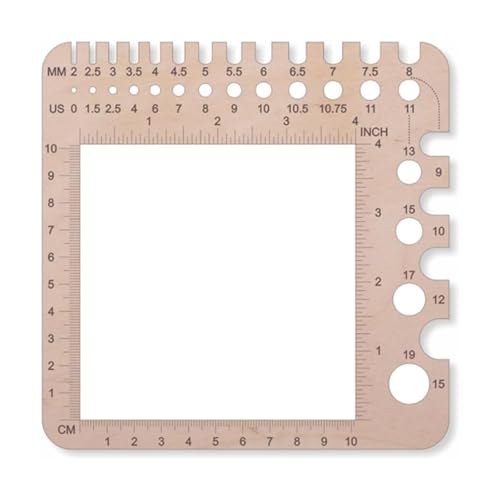
Katrinkles has revolutionized the knitting tool market by offering gauges that are as much about personality as they are about precision. These are often made from sustainable birch and come in various shapes, from sheep to clever geometric patterns.
The precision of the laser-etched markings is excellent, ensuring that your measurements are accurate every time. They are also fantastic for gift-giving, as you can often find designs that match the specific interests of the knitter in your life.
Because they are often intricate in shape, they can be slightly bulkier than a standard rectangular gauge. If you are a minimalist who only carries the absolute essentials, you might find the shape a bit cumbersome in a cramped notions pouch.
Bottom line: Choose this if you want a tool that reflects your personal style while still providing professional-grade accuracy.
DMC Needle and Stitch Gauge: Best Portable Tool

The DMC gauge is remarkably compact, making it the ideal companion for travel knitting or those small "on-the-go" projects. It is small enough to tuck into a pocket, ensuring you are never without a way to check your gauge on the fly.
Despite its small footprint, it provides clear, easy-to-read measurements for both needle sizes and stitch counts. It is particularly useful for those who knit socks, as the smaller scale is perfect for measuring tight, high-tension fabric.
The tradeoff for its portability is that it may not be as easy to use for measuring large sweaters or long rows of stitches. It is best used for spot-checking or smaller accessories rather than large-scale garment work.
Bottom line: This is an essential tool for the commuter knitter who needs to fit their entire life into one small project bag.
Why Gauge Swatching Is Essential for Projects
Many knitters skip the swatch because they are eager to start the "real" project, but this is a dangerous shortcut. A swatch allows you to see how your chosen yarn interacts with your specific needle material and your unique tension.
If you are using a fuzzy mohair or a slick cotton, your stitch count will vary wildly even if you use the same needle size. The swatch provides a "test drive" for your fabric, revealing if the resulting cloth is too stiff or too drapey for the pattern’s intent.
Furthermore, swatching helps you calculate how much yarn you will actually need for your project. Nothing is worse than running out of a discontinued dye lot of yarn three inches before the hem of a sweater because you didn’t account for your personal tension.
Bottom line: Swatching is not a delay; it is an insurance policy against wasting hours of work on a garment that doesn’t fit.
How to Measure Your Stitch Count Accurately
To get an accurate count, you must block your swatch exactly how you intend to block the finished garment. If you wash and aggressively stretch your swatch but only steam-block your sweater, your gauge will be completely different.
Lay your gauge flat on the fabric and count the stitches within a four-inch square, including the partial stitches at the edges. It is often helpful to use a pin to mark the start and end of your four-inch section so your eyes don’t wander.
Always measure in at least three different spots on the swatch and take the average. Our tension often shifts slightly as we get into the flow of knitting, so a single measurement can be misleading.
Bottom line: Consistency is key; measure your swatches the same way every time to ensure your results are repeatable and reliable.
Common Mistakes When Using Measuring Gauges
One of the most frequent errors is measuring a swatch while it is still on the needles. The weight of the needles and the tension created by being on the cable can distort the fabric, giving you an inaccurate reading.
Another mistake is failing to account for the "edge effect," where the stitches at the very beginning and end of a row are often looser or tighter. Always work your swatch at least two inches wider than the four-inch area you intend to measure.
Finally, avoid pulling or stretching the gauge against the fabric. You want to see the fabric in its natural, relaxed state, as that is how it will sit once it is finished and off the needles.
Bottom line: Let your fabric breathe before you measure it, and never force the tool against the yarn.
Proper Care for Your Precision Measuring Tools
Even the best measuring tool can lose its accuracy if it is bent, warped, or covered in grime. Keep your tools in a dedicated pocket in your project bag to prevent them from being crushed by heavy yarn cakes or sharp scissors.

If you use wooden gauges, keep them away from direct heat sources that could cause the wood to dry out or crack. A quick wipe with a soft cloth after a knitting session will remove any natural oils or fiber dust that can accumulate.
Periodically check your tools against a standard ruler to ensure the markings haven’t worn down or shifted. If you notice a discrepancy, it is time to retire that tool and invest in a fresh one; your time is too valuable to risk on inaccurate measurements.
Bottom line: Treat your measuring tools with the same care you give your favorite needles, and they will serve you faithfully for years.
Investing in a quality measuring gauge is one of the most cost-effective ways to elevate your knitting from a hobby to a craft. By understanding your own tension and the unique properties of your yarn, you gain the confidence to modify patterns and achieve the perfect fit every time. Remember that your gauge is a guide, not a judge, and the goal is always to create something you love to wear. Happy knitting, and may your swatches always match your expectations.