6 Best Tapestry Needles For Hidden Tail Weaving
Discover the top 6 tapestry needles for flawless hidden tail weaving. Learn which durable, blunt-tipped tools ensure secure, invisible finishes for projects.
Weaving in ends is the final hurdle between a finished project and a masterpiece, yet it is often the most neglected step in the knitting process. Using the wrong tool can split your yarn, distort your stitches, or leave a bulky knot that ruins your hard-earned tension. These six needles are the gold standard for hiding tails so seamlessly that even you won’t be able to find them later. Choosing the right implement is about matching the needle’s geometry to the delicate architecture of your fabric.
Clover Chibi Bent Tip Needles: The Best Overall


There is a reason you see these in almost every serious knitter’s notions bag. The bent tip design is a game-changer because it allows you to scoop through the back of your stitches without piercing the yarn or catching the fabric underneath.
These needles are made from a smooth, flexible plastic that glides through wool and acrylic alike without snagging. Because they are slightly pliable, they offer a tactile feedback that helps you feel when you are moving through a stitch rather than splitting the fiber.
The Chibi set usually comes in a sturdy carrying case, which is essential because these needles have a habit of vanishing into the couch cushions. If you are looking for one reliable tool that handles 90% of your projects, this is it.
Bohin France Size 18/22 Tapestry Needle Set

Bohin needles are the choice for knitters who prioritize precision and a traditional feel. Unlike plastic alternatives, these are made of high-quality nickel-plated steel, offering a slick, polished surface that slides through dense, felted, or heavy-gauge fabrics with ease.
The sizing here is consistent and reliable, which matters when you are working with fine lace or delicate fingering weight yarns. The eyes are large enough to thread easily but narrow enough that they don’t stretch your stitches as you pull the tail through.
Keep in mind that steel is rigid; if you are weaving into a very tight, stiff fabric, you’ll need to be careful not to bend the needle or poke your fingers. These are the professional’s choice for a clean, permanent finish.
Dritz Yarn Darner Needles: Best Budget Choice
Sometimes the simplest tool is the most effective, and Dritz darners prove that you don’t need a fancy brand name to secure your work. These needles are long and sturdy, making them perfect for weaving in long tails on bulky blankets or heavy sweaters.
Because they are inexpensive and widely available, you can keep a set in every project bag without breaking the bank. They are particularly useful for those "oops" moments where you need to pick up a dropped stitch or weave in a tail while traveling.
The trade-off is that they lack the bent tip found on more ergonomic options. You have to be more intentional about your path through the fabric to avoid splitting your plies, but for the price, they are an essential utility item.
Cocoknits Steel Stitch Needles: Best Durability
Cocoknits has built a reputation on thoughtful design, and their steel stitch needles are no exception. These are incredibly robust and feature a matte finish that provides just enough grip to hold onto the yarn without being "sticky."
The flat, bent tip is specifically engineered to slide between stitches, making it a favorite for those who prefer weaving into the back of a row. Because they are steel, they won’t warp or snap under the pressure of thick, rustic wools.
They are an investment compared to plastic needles, but they are built to last a lifetime. If you are a prolific knitter who finishes dozens of projects a year, the durability of these needles makes them a smart long-term purchase.
Tulip Hiroshima Tapestry Needles: Best Quality
Tulip needles are widely considered the finest in the world, and once you use them, it is hard to go back to anything else. The finish is exceptionally smooth, ensuring that the needle passes through even the most delicate hand-dyed silk or cashmere without a whisper of resistance.

The eyes of these needles are polished to perfection, which prevents your yarn from fraying or snapping during the threading process. This is critical when working with single-ply yarns that are prone to breaking under stress.
While they are the most expensive option on this list, the quality is undeniable. If you are finishing a luxury garment that took months to knit, you owe it to yourself to use a tool that respects the integrity of the fiber.
Pony Aluminum Yarn Needles: Best for Beginners
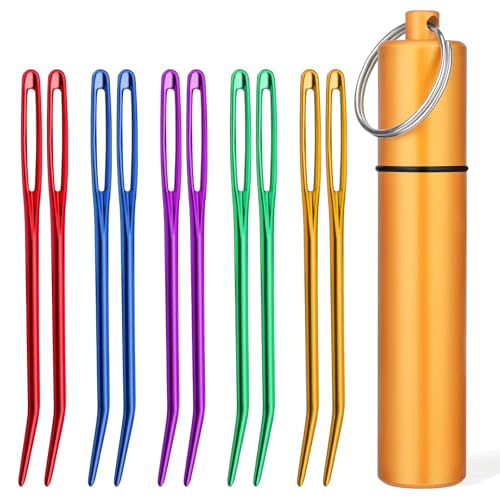
Pony aluminum needles are lightweight, colorful, and incredibly easy to handle for those just learning the ropes. The blunt, rounded tips make them very forgiving, as they are less likely to split the yarn if your weave-in path is slightly off-center.

The bright colors are a functional feature, not just an aesthetic one; they make it easy to identify which needle size you are grabbing from your kit. For a beginner, this removes the guesswork and helps you associate size with specific yarn weights.
Because they are aluminum, they are stiffer than plastic but lighter than steel. They are a great "bridge" tool for someone who has outgrown plastic needles but isn’t quite ready for the precision of high-end steel options.
Why Bent Tip Needles Are Essential for Weaving
The primary goal of weaving in ends is to make the tail disappear without creating a visible bump or a hard spot in the fabric. A straight needle often forces you to push through the fabric at an awkward angle, which can lead to "poking" through the front of your work.
A bent tip acts like a hook, allowing you to navigate the "nooks and crannies" of the stitch structure. By following the path of the yarn—the "duplicate stitch" method—the tail becomes part of the fabric’s natural tension.
If you find yourself struggling to hide ends in ribbing or cables, a bent tip is non-negotiable. It allows you to weave vertically through the back loops of the stitches, keeping the tail completely invisible from the right side of your project.
How to Choose the Right Size for Your Yarn Weight
The golden rule of weaving in ends is to choose a needle that is slightly smaller than the yarn you are using. If the needle is too large, it will stretch your stitches, leaving unsightly gaps that can’t be blocked out later.
- Lace/Fingering Weight: Use a size 22 or 24 tapestry needle to ensure you don’t distort the delicate stitches.
- Worsted/DK Weight: A size 18 or 20 is usually the sweet spot for a balance of ease and precision.
- Bulky/Super Bulky: Use a large-eye plastic or aluminum needle to accommodate the thickness of the yarn.
Always test your needle on a swatch or the inside of your garment before weaving in a long tail. If you feel resistance or see the fabric pulling, size down your needle immediately.
Master the Duplicate Stitch for Invisible Ends
The duplicate stitch is the gold standard for securing ends because it mimics the natural path of the knitting. To do this, thread your needle and follow the "V" shape of the stitches on the wrong side of your work.
By tracing the path of the existing yarn, you distribute the tension evenly. This prevents the tail from shifting or working its way out over time, which is a common problem with simple "zig-zag" weaving.
Remember to change direction halfway through the process. Weaving in one direction for two inches is okay, but weaving one inch one way and then turning back to weave one inch the other way locks the tail in place permanently.
Essential Tips for Securing Tails in Delicate Lace
Lace is notoriously difficult to weave into because there is so much negative space. If you weave a tail through an open eyelet, it will slide right out; instead, focus on the "solid" parts of the lace, such as the base of a cable or a transition row.
When working with slippery fibers like silk or bamboo, your ends are more likely to migrate. In these cases, try to weave your tail through the back of a purl bump and then split the yarn ply itself for the final half-inch to act as a "knot-less" anchor.
Always leave your tails a bit longer than you think you need before trimming. You can always trim them shorter later, but if you cut them too close to the fabric, you risk the tail popping out after the first wash.
Mastering the art of weaving in ends is a hallmark of a truly polished knitter. By selecting the right needle for your specific fiber and project, you ensure that your work remains pristine for years to come. Take your time with these final steps, as they are the quiet, essential work that elevates a handmade item to an heirloom. May your ends always be hidden and your stitches always stay true.