6 Best Adjustable Peg Looms For Beginner Hat Making
Discover the 6 best adjustable peg looms for beginner hat makers. Learn which versatile tools offer the perfect fit and ease for crafting custom headwear.
Stepping into the world of loom knitting opens up a realm of possibilities for creating cozy, professional-looking hats without the steep learning curve of traditional needles. Whether you are aiming for a quick gift or a textured masterpiece, the right adjustable loom serves as the foundation for your success. Choosing the correct tool depends on your desired gauge, yarn preferences, and how much versatility you need for future projects. This guide breaks down the top adjustable looms to help you find your perfect match.
KB Flexee Loom Chunky: Best Overall Versatility

The KB Flexee Loom Chunky is a game-changer because it isn’t a single rigid circle, but a series of interlocking links. This modular design allows you to change the number of pegs on the fly, making it incredibly easy to adjust for different hat sizes, from preemie to adult.
Because the links are flexible, you can move them into shapes beyond a circle, such as flat panels or even oval configurations. This is perfect if you want to experiment with different hat silhouettes without buying a dozen different looms.
The tradeoff here is that the links can occasionally pop apart if you are a very aggressive knitter. Keep your tension moderate, and you will find this is the most adaptable tool in your arsenal.
CinDWood 5/8 Inch Gauge Loom: Best for Durability

If you are looking for a tool that will last a lifetime, CinDWood looms are the gold standard. These are hand-crafted with sturdy, high-quality plastic pegs that feel solid in your hands, unlike the hollow or thin plastic pegs found on cheaper hobby-store alternatives.
The 5/8-inch gauge is the "sweet spot" for most worsted and light-bulky weight yarns. It creates a fabric that is dense enough to be warm, but loose enough to have a lovely, professional drape.
Because these looms are fixed-peg but often come in adjustable configurations, they don’t have the "wiggle" of modular systems. If you find that the constant clicking of modular looms distracts you, this is the sturdy, reliable choice you need.
Boye Adjustable Hat Loom: Best Budget-Friendly Pick

The Boye Adjustable Hat Loom is the quintessential "entryway" into the craft. You will find these in almost every major craft store, and they are usually the first tool a new knitter picks up.
The adjustable slider allows you to change the circumference of the loom, which is essential for learning how to scale a pattern. It is an excellent way to practice your tension without a significant financial investment.
However, the plastic can be brittle over time, and the pegs are sometimes a bit sharp at the tips. If you notice your yarn snagging, a quick pass with a fine-grit emery board will smooth out any manufacturing burrs.
Darice Round Loom Set: Best for Pattern Variety

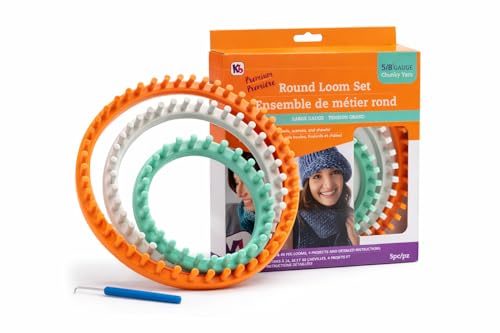
This set is essentially the "Swiss Army Knife" of the loom world. By providing multiple sizes in one package, it allows you to experiment with different hat styles, from slouchy beanies to fitted caps, without needing to purchase additional equipment.
The versatility of having a full set means you can easily match the loom size to the specific weight of your yarn. Using a smaller loom for thin yarn and a larger loom for thick yarn is the secret to getting that perfect, even stitch definition.
While these sets are affordable, they are often made of lighter-weight plastic. They are perfect for learning, but be mindful not to wrap your yarn too tightly, as the pegs can bend under extreme pressure.
Authentic Knitting Board All-N-One: Best for Pros

The All-N-One loom is built for those who want to move beyond simple hats and into complex stitch patterns. It features a double-rail design, which allows you to perform double-knitting, essentially creating a thick, reversible fabric.
This loom is ideal for advanced techniques like cables or intricate colorwork. Because it has so many pegs, you have the freedom to skip pegs to create lace or complex textures that would be impossible on a basic circle loom.
It is a heavier, more substantial piece of equipment, which makes it less portable than a simple round loom. If you are serious about garment construction, the learning curve is worth the investment for the professional results it produces.
Martha Stewart Crafts Loom: Best Starter System

This system is designed specifically for the creative mind that wants to build their own loom configurations. It comes with a variety of straight and curved pieces that snap together, allowing you to create everything from hats to scarves and even small sweaters.
The real benefit here is the ability to experiment with gauge by changing the peg spacing. It teaches you the mechanics of how a loom actually functions, which is invaluable for a beginner who wants to eventually design their own patterns.
The locking mechanism can be a bit finicky, so ensure your pieces are snapped in completely before you start your cast-on. It’s a fantastic tool for those who view knitting as an engineering challenge as much as a craft.
Understanding Peg Gauge and Yarn Weight Matching
The most common mistake beginners make is trying to use thin yarn on a wide-gauge loom, resulting in a hat that looks more like a fishing net than a winter accessory. The "gauge" refers to the distance between the pegs; the wider the gap, the thicker the yarn needs to be to fill that space.
Always check your yarn label for the recommended needle size. As a general rule, if the yarn calls for a US size 8 needle, it will likely work well on a 1/2-inch or 5/8-inch gauge loom.
If you are unsure, knit a small swatch. If the fabric feels too holey, you need a thicker yarn or a smaller loom; if it’s too stiff, you need a thinner yarn or a larger loom.
Essential Tools for Finishing Your Loom Hat
You cannot finish a loom-knitted hat with just the loom itself. You will need a quality loom hook—preferably one with an ergonomic, rubberized grip—to save your wrists during long sessions.
Additionally, a large-eye tapestry needle is mandatory for weaving in your ends and performing the "gather bind-off" at the crown of the hat. Never cut your yarn too short; always leave at least a 10-inch tail for securing the top.
Finally, consider a pom-pom maker. A well-placed pom-pom hides any minor imperfections at the crown of your hat and adds a professional, finished touch that elevates the entire project.
Tips for Achieving Consistent Tension on Looms
Tension is the secret to professional-looking knitwear. Many beginners make the mistake of pulling the yarn tight against the peg, which leads to a stiff, uncomfortable fabric that lacks elasticity.
Instead, wrap your yarn loosely around the pegs and use your loom hook to lift the bottom loop over the top. The yarn should glide over the peg with minimal resistance; if you are fighting the yarn, your tension is too tight.
If you find your stitches are uneven, try resting your hands every 15 minutes. Tension often tightens as our muscles fatigue, so taking short breaks will keep your stitches consistent from the brim to the crown.
Frequently Asked Questions About Loom Knitting
- Can I use any yarn on any loom? Technically yes, but for the best results, match your yarn weight to the peg gauge.
- Why does my hat look like it has holes? Your yarn is likely too thin for the loom’s gauge. Try holding two strands of yarn together to increase the thickness.
- Is loom knitting faster than needle knitting? Generally, yes, especially for simple hats, as you don’t have to manage multiple stitches at once.
- How do I prevent my hat from curling? Add a ribbed brim by alternating knit and purl stitches for the first 10-15 rows; this provides the necessary structure to keep the edge flat.
Mastering the loom is a journey of understanding how fiber reacts to structure and tension. By starting with a high-quality, adjustable tool, you give yourself the freedom to grow your skills from simple beanies to complex, textured headwear. Remember that your best projects will come from balancing the right yarn weight with the correct peg gauge. Pick a loom that fits your current needs, keep your tension relaxed, and enjoy the meditative rhythm of every stitch.