6 Best Blocking Boards For Modular Knitting Compared
Discover the top 6 modular knitting blocking boards. We compare materials, grid accuracy, and stability to help you choose the best tool for your projects.
Blocking is the final, transformative step that turns a collection of stitches into a professional-grade garment. Without the right surface to pin your work, even the most intricate lace or precise colorwork can look uneven and lackluster. Investing in a modular blocking board system allows you to customize your workspace to fit everything from delicate shawls to structured sweaters. Choosing the right set is about finding the balance between surface area, material durability, and grid accuracy.
Knitter’s Pride KnitIQ Interlocking Foam Mats
These mats are a staple in many studios because they prioritize a firm, reliable surface that holds pins securely. The interlocking teeth are cut with high precision, meaning you won’t struggle with gaps that catch your yarn or cause your project to sag.
If you are working with slippery fibers like silk or bamboo, the texture of these mats provides just enough "tooth" to keep your piece from sliding around while you pin. The grid lines are printed clearly, which is a lifesaver when you are trying to ensure a lace shawl is perfectly symmetrical.
The trade-off here is the thickness; while they are standard, they aren’t the thickest option on the market. If you prefer to use long T-pins and drive them deep into your surface, you might find the bottoming out happens sooner than expected.
Exquisite Knits Extra Thick Blocking Boards


When you are blocking heavy wool sweaters or dense cabled projects, you need a board that can handle the weight and the tension. These extra-thick tiles provide a robust foundation that doesn’t buckle under the pressure of heavy, wet fabric.
The added depth allows you to sink your pins at an angle, which is essential for maintaining tension on edges that want to curl. I find that this extra stability is particularly helpful when blocking garments that require aggressive stretching to open up the stitch definition.
Because they are thicker, they occupy more storage space in your knitting bag or closet. If you have limited room, consider whether the extra bulk is worth the added stability for your specific project load.
Clover Blocking Mats for Precision Projects

Clover has built a reputation on high-quality notions, and their blocking mats reflect that commitment to detail. These mats are designed with a very specific grid pattern that makes measuring gauge and dimensions incredibly straightforward.
If you are a knitter who struggles with "eyeballing" the symmetry of a chevron pattern or a complex border, the grid on these mats acts as a built-in ruler. It removes the guesswork, allowing you to focus on the tension of your pins rather than the geometry of the shape.
The material is slightly softer than some industrial-grade mats, which makes pinning effortless but means they may show wear faster over time. Treat these as a precision tool rather than a heavy-duty workhorse.
Hephaestus Modular Grid Blocking Board Set

This system is designed for the knitter who values versatility above all else. The modular nature of these boards means you can configure them into long, narrow strips for scarves or large squares for blankets, adapting to your project in real-time.
The grid system is exceptionally well-aligned, which is a major benefit when you are blocking multiple pieces of a garment, like two sleeves or a front and back panel, to ensure they match exactly. You want your seams to align perfectly, and that starts with identical blocking dimensions.
While the modularity is great, keep in mind that more pieces mean more seams. If you aren’t careful when laying them out, those tiny gaps between tiles can become a nuisance when pinning long, straight edges.
MagKnits Extra Large Interlocking Foam Tiles
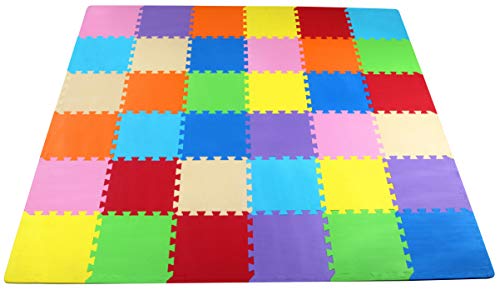
If you frequently block large-scale projects like afghans or oversized wraps, these tiles are a game-changer. They cover a significant amount of floor space, allowing you to lay out your entire project at once rather than blocking in sections.
The foam density is balanced well, offering a good compromise between being easy to pin and firm enough to hold its shape. They are lightweight, which is a bonus if you have to move your project to a different room while it dries.
The downside to larger tiles is that they are less portable than smaller modular sets. If you live in a small apartment, ensure you have a dedicated space where you can leave a large mat setup for 24 to 48 hours.
Boye Blocking Board and Pin Accessory Kit

This is an excellent entry-level option for those who want a complete solution without purchasing components separately. It often comes with a set of T-pins, which are essential for any knitter’s toolkit.
The board itself is functional and reliable, serving the needs of most standard-sized projects perfectly. It doesn’t have the bells and whistles of high-end professional mats, but it gets the job done consistently.
If you are a beginner, this is a low-risk investment that allows you to learn the art of blocking without breaking the bank. Once you graduate to more complex lace or garment construction, you can always supplement this with more specialized boards.
Why Modular Boards Matter for Complex Shapes
Blocking a simple rectangle is easy, but blocking a crescent shawl or a fitted vest is an exercise in geometry. Modular boards allow you to manipulate the shape of your mat to accommodate curves and points that don’t fit on a standard square board.
By arranging your mats to match the silhouette of your project, you ensure that the tension is applied evenly across the entire fabric. This prevents the "scalloping" effect that happens when you try to force a curved piece onto a flat, rigid surface.
Remember that fiber type dictates how much tension you can apply. Superwash wool, for example, grows significantly when wet, so being able to adjust your board size is vital to avoid over-stretching your garment into a shape that no longer fits.
Essential Features for Quality Blocking Mats
When shopping for mats, look for high-density foam that doesn’t crumble after repeated use. Cheap, low-density foam will lose its ability to hold pins firmly within a few projects, leaving you with loose pins and uneven edges.
Grid accuracy is non-negotiable; if the lines aren’t square, your project won’t be either. I always recommend checking that the tiles interlock snugly, as any gap will eventually snag your yarn and cause frustration.
- Firmness: Must hold a T-pin without the pin wobbling.
- Grid Clarity: Lines should be easy to see through the fabric.
- Surface Texture: Should provide enough grip to prevent sliding.
- Portability: Ability to break down into a small footprint.
Comparing Foam Density and Grid Accuracy
Foam density is the unsung hero of the blocking process. A denser mat feels more professional and lasts for years, whereas lower-density foam often develops "memory" where the pin holes remain permanently open after the pins are removed.
Grid accuracy, however, is about the user interface of your blocking experience. A mat with a 1-inch grid is standard, but some include diagonal lines which are incredibly helpful for blocking lace triangles or complex geometric patterns.
If you are a perfectionist, prioritize grid accuracy over thickness. You can always place a towel or a thicker surface underneath a thin mat, but you cannot fix a grid that is printed crookedly.
Proper Maintenance for Your Blocking Tools
Treat your blocking mats as precision instruments rather than floor mats. After each use, wipe them down with a damp cloth to remove any excess moisture or fiber debris that might have transferred from your yarn.
Store them flat or upright in a cool, dry place to prevent warping. If you leave them in a sun-drenched room, the foam can become brittle over time, which will lead to cracking and poor pin retention.
Finally, avoid using harsh chemicals to clean them, as these can break down the materials and cause them to yellow or degrade. A gentle touch ensures these tools will serve you through years of finished projects.
Choosing the right blocking board is an investment in the longevity and appearance of your hand-knit wardrobe. Whether you prioritize modularity, thickness, or grid precision, there is a system that will elevate your finished results. Take the time to consider your most frequent project types and your available workspace before making your final selection. With the right foundation, your knitting will finally reach that polished, professional finish you’ve worked so hard to achieve.