6 Best Felting Needles For Mending Holes Worth Owning
Discover the top six felting needles for seamless garment mending. This guide explores essential tool types to help you restore fabrics with precision.
There is nothing quite as heartbreaking as discovering a moth-eaten hole in a hand-knit sweater you spent months crafting. Needle felting offers a near-invisible way to repair these gaps by locking loose fibers back into the fabric structure. Choosing the right needle is the difference between a seamless mend and a matted, messy patch. Here are the tools I trust for restoring your favorite knits to their former glory.
Clover Pen Style Needle Felting Tool: Best Overall


If you are new to mending, the Clover Pen Style tool is your best entry point. Its ergonomic, pen-like grip reduces hand fatigue, which is essential when you are spending an hour meticulously closing a snag in a wool cardigan.
Because it houses three needles, it covers surface area quickly, making it ideal for larger holes or thinning elbows. However, be cautious; using all three needles at once can be overkill for delicate lace weight yarns.
I recommend starting with just one needle loaded in the tool for precision work. It is the most versatile "all-rounder" for any knitter’s emergency repair kit.
Groz-Beckert 38 Gauge Star Needles: Best Precision
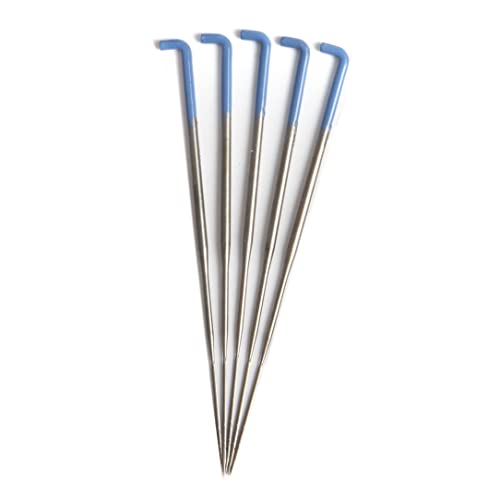
Groz-Beckert is the gold standard for industrial-grade quality, and their 38 gauge star needles are surgical instruments for fiber artists. The star-shaped cross-section features four cutting edges, which grab and interlock wool fibers significantly faster than standard triangular needles.
When you are mending a hole in a fine-gauge sock, you need a needle that doesn’t leave large puncture marks. These needles are incredibly sharp and durable, meaning they won’t snap as easily when you hit a denser part of the knit fabric.
They are my go-to when I need to incorporate a tiny bit of matching roving into a tight stitch. You will find that these needles offer the best balance of speed and clean results.
Hamanaka Regular Felting Needles: Best for Wool

Hamanaka needles are specifically designed with the texture of high-quality wool in mind. They have a subtle, refined barb configuration that catches fibers gently without shredding the yarn structure of your garment.
If you are working with soft, lofty yarns like Merino or Corriedale, these needles are less likely to cause pilling or unwanted distortion. They feel "smooth" as they enter the fabric, giving you better tactile feedback on how the fibers are migrating.
For the knitter who prioritizes fiber integrity above all else, these are a dream. They are particularly effective for blending color into a repair so the mend disappears entirely.
Ashford Fine Felting Needles: Best for Detail

When the hole is tiny—perhaps just a single broken stitch—you need a needle that won’t overwhelm the surrounding area. Ashford’s fine needles are engineered for these delicate, high-detail scenarios.
Their smaller gauge allows you to push fibers into the tightest spots without distorting the surrounding knitting. If you are working on a piece with a complex cable pattern, these needles allow you to navigate the twists and turns without catching the decorative stitches.
Think of these as your "finishing" needles. Use them to tuck in the final stray ends of your repair for a professional, factory-like finish.
Schmetz Felting Needle Assortment: Best Variety

Sometimes you don’t know exactly what the job requires until you see the hole. A Schmetz assortment pack is a smart investment for the knitter who works with a wide range of yarn weights, from chunky wool to fingering weight mohair.
Having different gauges on hand allows you to "size up" or "size down" your needle based on the density of your knit. If you are repairing a thick, felted wool coat, you will need a heavier gauge; if you are mending a baby bonnet, you need the lightest one in the pack.
This is the most economical way to build your toolkit. It takes the guesswork out of buying needles until you discover your personal preference.
Bear Creek Felt 40 Gauge Needles: Best for Finish
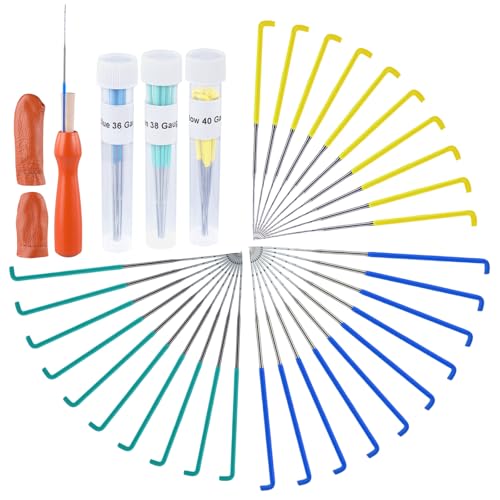
A 40 gauge needle is incredibly fine, making it the perfect tool for the final stages of a mend. When you have filled the hole and need to smooth out the surface, this needle works without leaving visible tracks.
Because the barbs are so small, they don’t pull large clumps of fiber, which keeps your repair looking uniform. It is essentially the fiber arts equivalent of a finishing sander for woodworking.
If you are a perfectionist who wants your mends to be indistinguishable from the original knitting, you need a 40 gauge needle in your arsenal. It is the secret to that "did I even fix this?" look.
Understanding Needle Gauges and Their Uses
Needle gauges work in reverse: the higher the number, the thinner the needle. A 32 gauge needle is thick and aggressive, while a 42 gauge needle is whisper-thin.
- 32-36 Gauge: Best for coarse, heavy-weight wools and deep repairs.
- 38 Gauge: The versatile workhorse for standard knitting weights.
- 40-42 Gauge: Essential for fine-tuning, delicate yarns, and surface finishing.
Using a needle that is too thick for your yarn will leave visible holes in your knit fabric. Always start with a finer needle and move to a thicker one only if you aren’t seeing enough fiber movement.
How to Properly Use Felting Needles for Mending
Place a foam felting pad or a folded towel behind the hole before you begin. You need a soft surface underneath to catch the needle, or you will quickly dull the barbs against a hard table.
Use a straight up-and-down motion. Never pry or leverage the needle sideways, as the hardened steel is brittle and will snap under lateral pressure.
Work in small, circular patterns to encourage the fibers to intertwine. If you pull too hard or move too fast, you risk creating a "divot" in your fabric. Slow, deliberate stabs are the hallmark of a skilled mender.
Essential Safety Tips for Needle Felting Work
Felting needles are essentially barbed spikes, and they are unforgiving. Keep your fingers well away from the needle’s path at all times, especially when working on small items like gloves or socks.
If you are working on a sleeve, insert a small wooden dowel or a dedicated foam block inside the sleeve to act as a barrier. Never hold the fabric in your hand while stabbing, or you will eventually find yourself with a painful puncture.
If you feel tired or frustrated, put the tool down. Most accidents happen when a knitter is rushing to finish a repair after a long session.
Maintaining Your Felting Needles for Longevity
Felting needles are consumables, but they last longer if you treat them with care. Keep them in a dry place to prevent rust, which can ruin your yarn and dull the barbs.
If you notice the needle catching or dragging, it may be dull or have a bit of fiber stuck in the barbs. Use a soft brush to clear out any trapped wool, and replace the needle as soon as it starts to feel "gritty."
A sharp needle is a safe needle. Don’t force a dull one to work; it will only damage your precious hand-knit garments.
Mending is a beautiful act of preservation that honors the time you put into your knitting. By selecting the right needle for your specific yarn and project, you can turn a potential disaster into a hidden repair. Take your time, work with a steady hand, and enjoy the satisfaction of giving your knits a second life. Happy mending!