7 Best Bead Assortments For Floral Accents To Try
Elevate your crafts with these 7 top-rated bead assortments. Discover textures and hues perfect for adding elegant, nature-inspired floral accents to designs.
Adding beads to knitwear transforms a simple floral motif into a dimensional piece of wearable art. Choosing the right bead is not just about color, but about understanding how the shape and weight interact with your yarn. This guide breaks down the essential bead types and technical considerations to ensure your beaded knits look professional and hold up over time. Master these selections, and you’ll elevate your floral lace and stranded colorwork to heirloom quality.
Toho 11/0 Seed Beads: Best for Delicate Petals


Toho 11/0 seed beads are the gold standard for floral petals because of their remarkably consistent shape and large hole size. When you are knitting lace, you need a bead that slides effortlessly onto the yarn without snagging or breaking the fiber.
These beads are slightly more cylindrical than traditional rounded seed beads, which allows them to sit flush against the stitch. This is crucial when you want your petals to look like they are blooming from the fabric rather than just sitting on top of it.
The trade-off here is the sheer volume of color choices, which can be overwhelming. Stick to the Toho "Permanent Finish" line if you are knitting with a fiber that will be washed frequently, as these colors are highly resistant to rubbing and fading.
Miyuki Delica Beads: Precision for Floral Centers

Miyuki Delicas are cylinder-shaped beads that offer a uniform, brick-like structure, making them perfect for the tight, geometric centers of a flower. Because they have such thin walls, they are incredibly lightweight, which prevents your floral motifs from sagging or distorting your knitting gauge.
If you are working on a project with a high stitch density, these are your best friends. They don’t have the "bulge" of round beads, so they won’t cause your fabric to pucker when you move to the next row.
Be aware that because they are glass, they can be brittle if dropped on a hard surface. When working with them, keep a small tray on your lap to catch any "jumpers" before they disappear into the carpet.
Preciosa Czech Glass Beads: Ideal for Leaf Texture

Czech glass beads, particularly the pressed varieties, have a slightly irregular, organic feel that mimics the veins and textures of real leaves. Unlike the perfect symmetry of Japanese beads, Preciosa beads bring an old-world charm that feels less "manufactured" and more artisanal.
These beads often feature unique finishes like AB (Aurora Borealis) or matte coatings that catch the light differently at every angle. This creates a depth of color that is hard to achieve with mass-produced alternatives.
Because they are slightly heavier, use them sparingly in lace weight projects to avoid stretching your yarn. They are best suited for worsted or DK weight floral designs where the yarn has enough structural integrity to support the weight.
Swarovski Crystal Bicones: Adding Floral Sparkle

Swarovski bicones are the ultimate choice for adding a touch of luxury to the center of a flower or the tips of a petal. The precision-cut facets act like tiny prisms, reflecting light and adding a high-end shimmer that glass beads simply cannot replicate.
Use these as an accent rather than a primary bead, as they are significantly heavier and more expensive than standard seed beads. A single 3mm bicone at the center of a floral motif is often enough to make the entire piece pop.
Keep in mind that the sharp edges of bicones can occasionally snag on delicate fibers like mohair or single-ply wool. When using them, ensure your yarn is a tightly plied, smooth variety to prevent long-term wear and tear.
Gutermann Rocailles: Best for Beaded Lace Edges

Gutermann Rocailles are high-quality, rounded beads that are exceptionally smooth, making them ideal for the edges of a shawl or the hem of a garment. Their rounded profile allows them to roll slightly with the motion of the fabric, which is perfect for a scalloped floral lace edge.
These beads are highly durable and hold their finish well against the friction of skin and clothing. They are a reliable, "workhorse" bead that you can trust for items that will see heavy wear.
While they are excellent for edges, they can sometimes be slightly inconsistent in size compared to Japanese brands. Always sort your beads before starting a row to ensure you don’t have one unusually large bead throwing off your stitch count.
Miyuki Bugle Beads: Perfect for Stamen Detailing

Bugle beads are elongated tubes that provide the perfect structural mimicry for floral stamens. By placing these vertically within a flower center, you create a 3D effect that adds incredible realism to your knitting.
The challenge with bugles is their length; if the bead is too long for the stitch, it will cause the fabric to buckle. Always measure your stitch width against the length of the bugle bead before committing to the pattern.
Stick to "twisted" or "hex" bugle beads for extra sparkle, as these catch the light along their entire length. They are fragile, so handle them with care and avoid putting them in areas of the garment that will be subject to heavy folding or creasing.
Fireline Beading Thread: The Best Beading Anchor
While not a bead itself, Fireline is the secret weapon for any knitter looking to integrate beads with confidence. It is a braided, non-stretching fishing line that is incredibly strong, ensuring your beads stay exactly where you place them.
If you are using the "pre-stringing" method, your yarn is doing the heavy lifting. However, for "crochet hook" or "tink" applications, having a strand of Fireline nearby can help you pull stubborn beads through tight stitches without breaking your main yarn.
Avoid using standard sewing thread as a substitute, as it lacks the tensile strength and will eventually snap, causing your beads to migrate or fall off. Invest in a spool of 6lb test Fireline; it will last you for years of projects.
How to Choose Bead Sizes for Your Knitting Weight
The rule of thumb is simple: the bead hole must be large enough to accommodate two strands of your yarn if you are using a crochet hook method. If the bead is too small, your yarn will fray or snap during the process.
- Lace weight (2-ply): Use 11/0 or 15/0 beads for a delicate, balanced look.
- Fingering weight (sock yarn): 8/0 or 11/0 beads provide the best visibility.
- DK or Worsted weight: 6/0 or 8/0 beads are required to ensure the bead isn’t "swallowed" by the yarn.
Always knit a small swatch with your chosen bead and yarn combination before starting the main project. If the bead disappears into the stitch, go up a size; if the bead makes the stitch look distorted, go down.
Essential Tools for Integrating Beads Into Knits
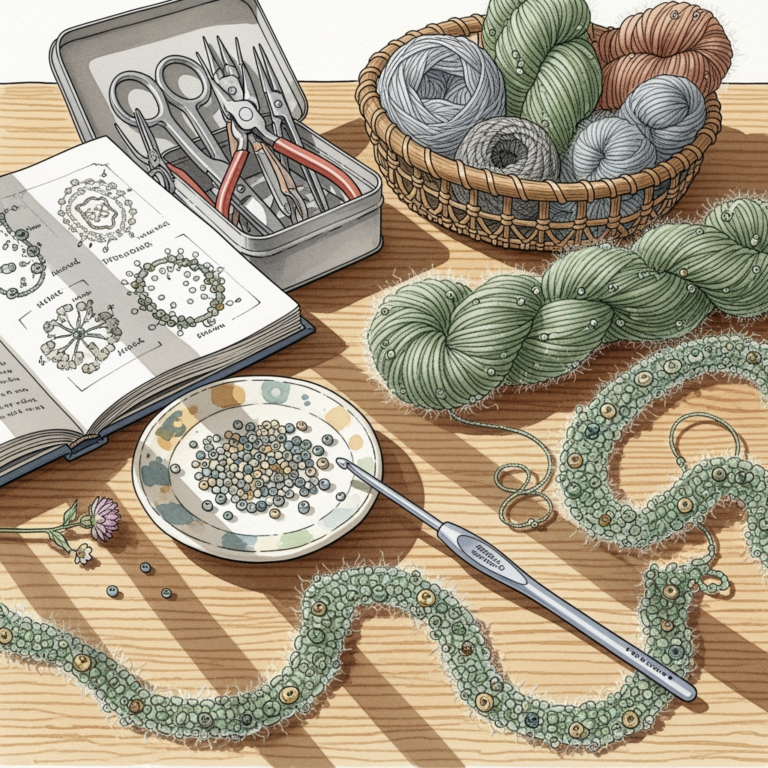
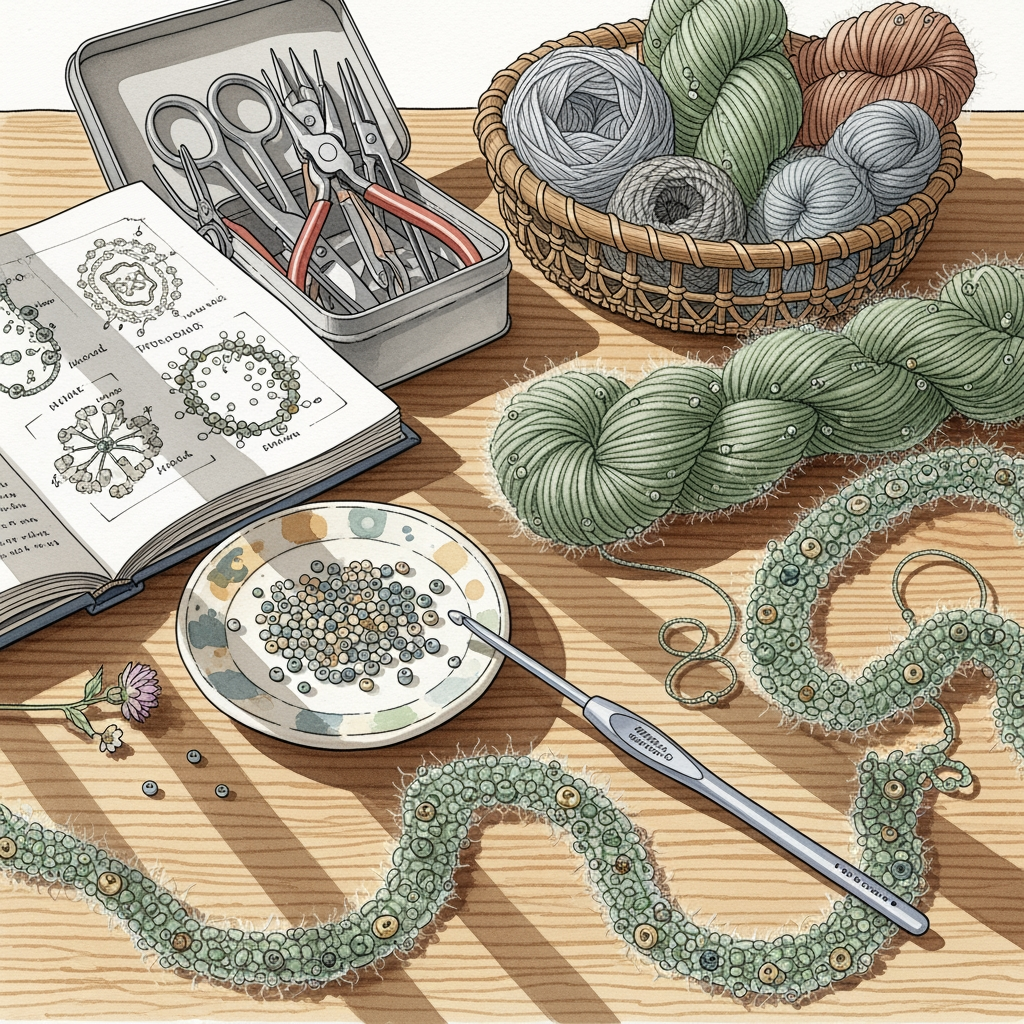
You don’t need a massive kit, but you do need the right tools to keep your frustration levels low. A fine-gauge steel crochet hook (0.5mm to 0.75mm) is essential for pulling yarn through the bead center.
A bead spinner can save you hours of time if you are pre-stringing beads for an entire project. However, make sure you are using a high-quality spinner with a weighted base to avoid beads flying across the room.
Finally, keep a pair of sharp, fine-tipped tweezers in your kit. They are invaluable for nudging a bead into place if it flips the wrong way during the knitting process.
Caring for Beaded Knits: Washing and Maintenance
Beaded knits require a gentle touch, regardless of the fiber used. Always hand wash your finished items in cool water with a wool-safe detergent, and never, ever put them in a machine.
The weight of the water can cause the beads to pull on the stitches, so support the garment from underneath when lifting it out of the basin. Roll the item in a clean towel to remove excess moisture rather than wringing it out.
When drying, lay the piece flat on a blocking mat and use pins to shape the floral motifs. This ensures the beads settle into their intended positions and stay there as the fiber dries and sets.
Knitting with beads is a rewarding journey that adds a professional, tactile dimension to your work. By matching your bead shape to the specific floral effect you want to achieve, you can turn a simple project into a masterpiece. Remember to always swatch, respect the weight of your materials, and take your time with the finishing process. Your patience will be rewarded every time you wear your beautiful, beaded creation.