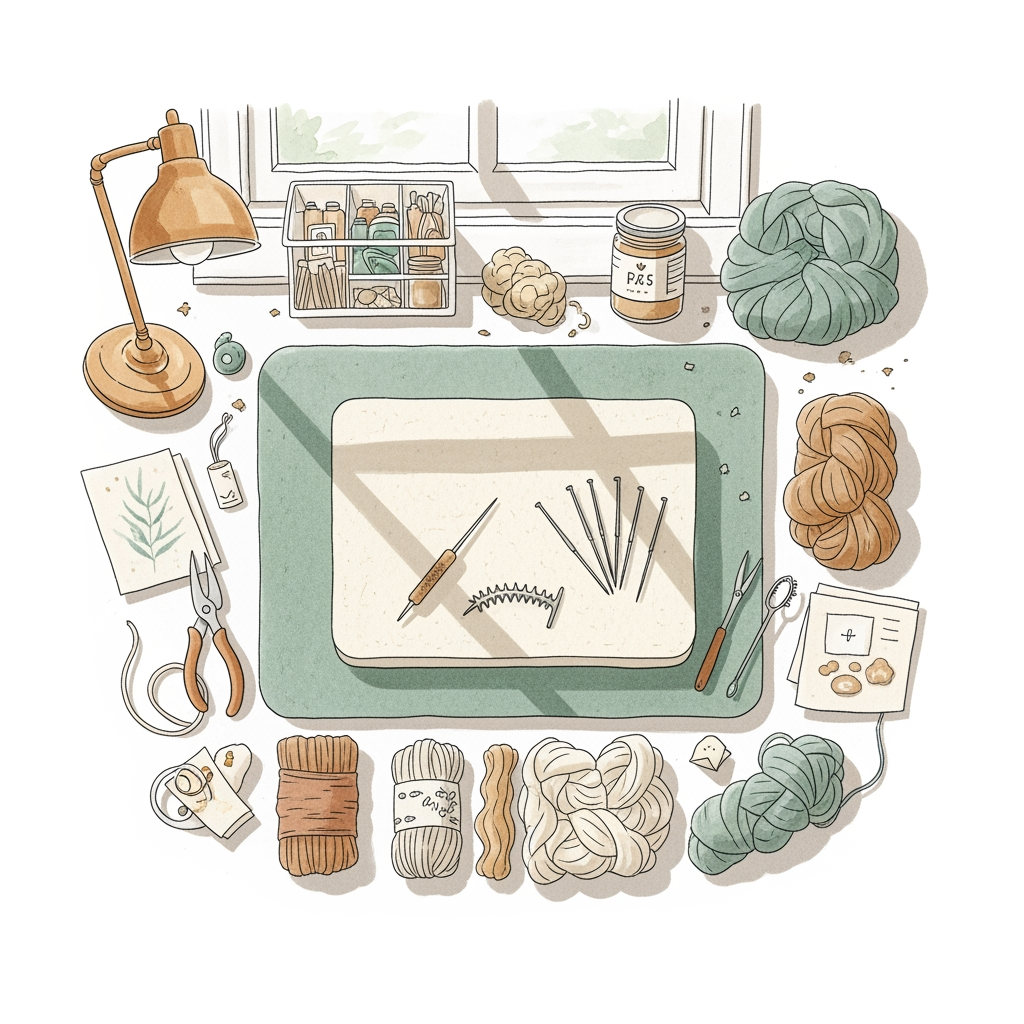
6 Best Felting Needles For Embellishments To Try
Elevate your fiber art with our top 6 felting needles. Discover the best tools for intricate embellishments and achieve professional detail in every project.
Needle felting is the perfect bridge for knitters looking to add texture, dimension, or whimsical embellishments to their finished wool garments. Much like selecting the right needle for your yarn weight, choosing the correct felting needle determines the ease and finish of your surface work. This guide breaks down the essential tools to help you transition from simple stockinette to intricate, needle-felted masterpieces. Mastering these tools will turn your plain sweaters into one-of-a-kind art pieces.
Clover Pen Style Needle Felting Tool: Best Overall


The Clover Pen Style tool is the industry standard for a reason, mirroring the comfort of holding a favorite crochet hook or ergonomic knitting needle. It features a retractable mechanism that makes it incredibly safe to store in your project bag alongside your notions pouch.
If you are adding felted polka dots to a baby cardigan or securing a loose end on a mohair blend, this tool offers excellent control. The ergonomic grip prevents the hand fatigue often associated with repetitive motion, much like using a circular needle for a heavy blanket.
However, the spring mechanism can occasionally feel stiff for those with arthritis. It is an investment piece, but the ability to swap out individual needles makes it a versatile, long-term staple for any fiber artist’s kit.
Ashford Felting Needle Assortment Pack Review

Ashford is a trusted name in the spinning world, and their needle pack is the ultimate "sampler" for those unsure of their specific needs. It provides a range of gauges, which is vital when you are experimenting with different wool breeds, from coarse Corriedale to delicate Merino.
Think of this like having a set of interchangeable needles in various sizes; you wouldn’t use a 2.0mm needle for bulky yarn, and you shouldn’t use a coarse felting needle for fine detail work. This pack allows you to test how different barbs interact with your specific fiber choices.
The downside is that the needles are not color-coded as clearly as some professional brands. You will need to keep them organized in their original packaging to ensure you don’t confuse a fine finishing needle with a heavy-duty structural one.
Groz-Beckert Felting Needles For Precision Work

Groz-Beckert is the gold standard for industrial-grade performance, favored by artists who demand consistency and durability. These needles are exceptionally sharp and hold their integrity through thousands of punctures, making them ideal for high-volume embellishment work.
When you are working on a precise project, such as creating a landscape on a felted wool tote, you need a needle that won’t snap under pressure. These needles penetrate dense fibers with minimal resistance, which protects the integrity of your base fabric.
They are professional-grade tools that require a bit more respect, as they are sharper than standard hobby-store needles. If you are serious about refining your technique, these are the needles that will elevate your work from "crafty" to "professional."
Hamanaka Regular Felting Needles For Beginners

Hamanaka needles are designed with a unique geometry that makes the felting process feel intuitive and smooth. They are widely considered the most forgiving needles on the market, making them perfect for someone who has just finished their first scarf and wants to try felting for the first time.
The barbs on these needles are spaced to catch fibers effectively without shredding the yarn. This is crucial if you are working with hand-dyed wool or luxury fibers that you don’t want to damage or pull out of place.
While they are excellent for learning, they may feel a bit "slow" for advanced sculptors who need to move large amounts of fiber quickly. They are, however, the best choice for building confidence and mastering the basic motion of the needle.
Dimensions Needle Felting Tool For Fine Details

The Dimensions tool is often found in starter kits, but don’t let its accessibility fool you; it is a solid, no-nonsense tool for fine detailing. It is particularly effective for "painting" with wool, where you are adding small, flat shapes onto a knitted surface.
Because it often holds multiple needles, it covers more surface area quickly. This is akin to using a larger needle size to speed up the body of a sweater, allowing you to lay down your base colors before switching to a single needle for the fine-tuning.
The fixed nature of the tool means you have less flexibility than with the Clover pen. It is a fantastic entry-point tool, but you may eventually outgrow it as your projects become more sculptural and complex.
Schacht Spindle Company Felting Needles Review

Schacht is a powerhouse in the weaving and spinning community, and their felting needles carry that same reputation for quality. These needles are robust and reliable, performing exceptionally well when you are working with heavier, more rustic wools.
If you are embellishing a felted bag or a heavy wool coat, you need a needle that can handle the density of the material. Schacht needles provide the necessary "bite" to lock fibers together without bending or breaking during the process.
They are a bit more industrial in feel than the ergonomic options, which might be a drawback for longer sessions. However, for sheer reliability and strength, they are a fantastic addition to any serious fiber artist’s toolbox.
Understanding Needle Gauges And Barb Patterns
Needle gauges function similarly to knitting needle sizes, where the higher the number, the finer the needle. A 32-gauge needle is coarse and designed for fast, heavy-duty felting, while a 42-gauge needle is ultra-fine, perfect for delicate facial features or intricate surface patterns.
Barb patterns also vary, with some needles having barbs along the entire length and others having them only at the tip. Needles with barbs at the tip are much better for surface embellishments because they don’t leave large "pockmarks" on the finished side of your knitting.
- Coarse (32-36 gauge): Best for attaching thick pieces or structural work.
- Medium (38-40 gauge): The "all-purpose" choice for most embellishment projects.
- Fine (42+ gauge): Essential for adding tiny details and smoothing textures.
Essential Surfaces For Safe Needle Felting
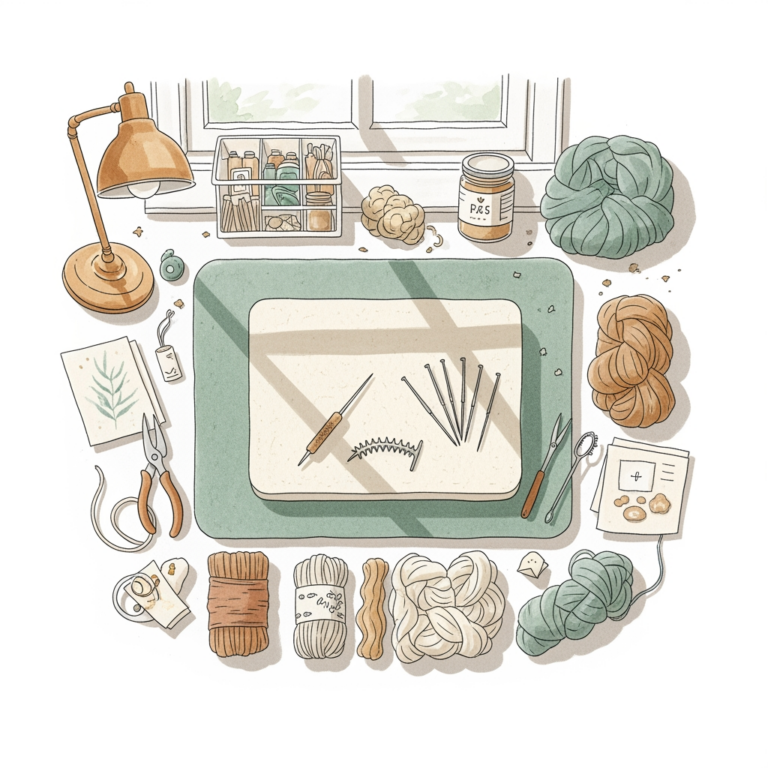
Never needle-felt directly on your table or lap, as the needles will break instantly upon contact with a hard surface. You need a resilient, dense foam pad or a specialized wool-felt mat to catch the needle tip after it passes through your work.
Think of this like using a blocking board; the surface you choose dictates the final shape and quality of your project. A high-density foam pad provides enough resistance to help the fibers interlock while protecting your needles from snapping.
If you prefer a more natural option, a tightly packed wool mat is excellent. It lasts longer than foam and provides a soft, stable base that won’t leave little bits of synthetic debris in your knitted project.
Troubleshooting Common Needle Felting Mistakes
The most common mistake is felting too deeply, which can cause the fibers to pull through to the back of your knitting in an unsightly way. Always use a gentle, shallow motion, letting the tip of the needle do the work rather than forcing it through the entire thickness of the fabric.
If your needle keeps snapping, you are likely using too much force or moving the needle at an angle. The needle must enter and exit the fiber at the exact same straight line; any lateral pressure will cause the metal to fatigue and break immediately.
- Puckering: Usually caused by felting too fast or using a needle that is too coarse.
- Fuzziness: Indicates you haven’t felted deeply enough or you are using a needle with too many barbs.
- Breaking: Almost always a result of hitting a hard surface or bending the needle while it is inside the wool.
Expert Tips For Achieving Smooth Felt Finishes
To achieve a professional, smooth finish, always finish your work with a very fine-gauge needle. This "polishing" pass helps to tuck in any stray fibers and creates a uniform, dense surface that looks like it was woven into the fabric from the start.
Don’t be afraid to use a light touch. Much like tension in knitting, light, rhythmic tapping is far more effective than heavy, aggressive stabbing. You are essentially "weaving" with the needle, so patience is your greatest asset.
Finally, always test your wool on a swatch before committing to your finished garment. Different fibers felt at different rates, and knowing how your specific yarn reacts to the needle will save you from potential heartbreak on a finished sweater.
Needle felting is a rewarding skill that breathes new life into your hand-knitted pieces. By choosing the right needle gauge and maintaining a gentle, consistent technique, you can create professional-grade embellishments with ease. Remember to protect your tools and your workspace, and always prioritize precision over speed. Happy felting, and enjoy the process of transforming your knitted textures into something truly unique.