6 Best Embroidery Patterns For Beginners To Try
Embroidery is a rewarding craft. Explore these six beginner-friendly patterns to master essential stitches and create beautiful, professional-looking designs.
Stepping into the world of embroidery feels remarkably similar to picking up your first set of knitting needles and a ball of worsted wool. Both crafts require a rhythmic patience and an appreciation for how individual threads transform into a cohesive, tactile structure. While your hands are accustomed to the tension of yarn, embroidery offers a different kind of precision that rewards a steady, deliberate pace. These six patterns provide the perfect framework to build your confidence as you transition from loops to stitches.
DMC Floral Bouquet Starter Embroidery Kit
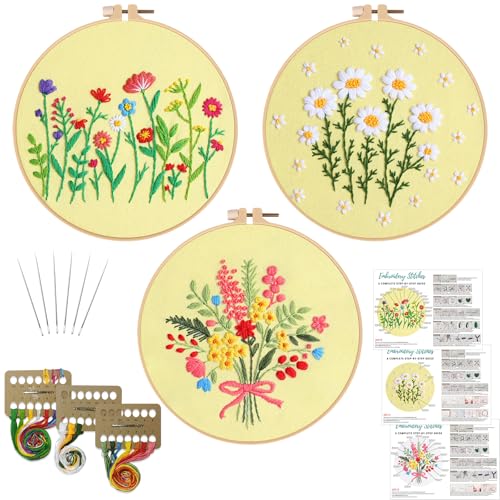

DMC is the gold standard for a reason, much like choosing a reliable, high-quality Merino wool for your first sweater project. This kit removes the guesswork by providing everything you need in one package, ensuring you aren’t struggling with subpar materials while learning the ropes.
The floral designs are forgiving, allowing for slight variations in stitch length without ruining the overall aesthetic. It’s the embroidery equivalent of a simple garter stitch scarf—it looks beautiful even if your tension isn’t perfectly uniform yet.
Because the pattern is pre-printed on the fabric, you won’t waste time transferring designs or worrying about alignment. Focus on your needle control rather than the logistics of the pattern.
Dimensions Learn-A-Craft Embroidery Kits

If you prefer a structured, step-by-step approach to learning, Dimensions kits are excellent for building foundational skills. They treat embroidery like a technical pattern, breaking down complex visuals into manageable, numbered steps.
This is ideal for those who thrive on clear instructions, similar to following a well-written knitting pattern that explains every increase and decrease. You’ll learn a variety of stitches in a single project, giving you a broad toolkit to apply to future designs.
Be aware that these kits often use specific, slightly stiffer thread than premium embroidery floss. Don’t be discouraged if the thread feels different than your favorite soft yarn; the added structure actually makes it easier to manage for beginners.
Kiriki Press Beginner Embroidery Patterns

Kiriki Press specializes in adorable, character-based patterns that are perfect for those who want to create something functional. They offer a whimsical, modern aesthetic that feels fresh compared to traditional, ornate floral designs.
These patterns are printed on high-quality cotton, which holds up well to the repeated piercing of the needle. Think of it like using a sturdy, non-splitty cotton yarn for a dishcloth—the fabric is reliable and won’t distort easily under your hands.
The best part is that their kits often result in finished stuffed toys or patches. This provides an immediate sense of accomplishment, much like binding off your first pair of socks and wearing them the next day.
Penguin & Fish Embroidery Pattern Kits
Penguin & Fish designs are known for being incredibly approachable and user-friendly. They emphasize the joy of the process over the pressure of perfection, which is a vital mindset for any fiber artist starting a new medium.
Their kits often come with video tutorials, which act as a visual guide similar to watching a master knitter demonstrate a tricky cable cross. Having that visual reference can be the difference between frustration and a successful stitch.
If you struggle with written instructions alone, these kits are your best bet. Prioritize kits that offer multiple learning formats to ensure you don’t get stuck on a single technique.
Hook, Line & Tinker Beginner Pattern Set
These sets are designed for the modern maker who appreciates clean lines and minimalist design. They strip away the clutter, allowing you to focus entirely on the relationship between the needle, the thread, and the fabric.
The patterns are printed on high-quality linen, which offers a lovely, organic texture. Just as you might choose a rustic wool for a textured hat, the linen provides a beautiful background that elevates the final look of your stitches.
Keep in mind that linen has a different "hand" than cotton and can be slightly more challenging to pierce. Take your time and ensure your needle is sharp to avoid pulling at the weave of the fabric.
Slow Sunday Embroidery Pattern Bundles

Slow Sunday focuses on the meditative quality of embroidery, encouraging a "slow craft" approach. This is perfect for those who knit as a form of relaxation after a long day; it’s not about the race to the finish line, but the rhythm of the work.
Their bundles are excellent for those who want to explore different styles without committing to a single, large project. It’s like having a collection of small swatches that eventually teach you everything you need to know about complex stitch patterns.
Because these are often sold as patterns rather than full kits, you will need to source your own thread and fabric. This is a great opportunity to start building your personal stash of high-quality embroidery supplies.
Essential Tools Every New Embroiderer Needs
Just as you wouldn’t use a size 10 needle for lace-weight yarn, you must match your embroidery tools to your project. A sharp embroidery needle is non-negotiable; a dull tip will snag the fabric and create unsightly puckers.
You will also need a reliable hoop to keep your fabric taut. Tension is everything in embroidery, just as it is in knitting; if your fabric is loose, your stitches will be uneven and lack definition.
- Embroidery Hoops: Choose wood for a classic feel or plastic with a lip for better tension.
- Embroidery Scissors: Keep a pair of sharp, dedicated thread snips that never cut paper.
- Needle Minders: A small magnet to hold your needles prevents them from disappearing into the carpet.
Choosing the Right Fabric for Your Project
The fabric you choose is the canvas for your art, and its weave density matters immensely. For beginners, a medium-weight cotton or linen blend is ideal, as it provides enough resistance to hold the stitch but is easy enough to pierce.
Avoid overly stretchy fabrics, which can distort your design as you pull the thread tight. Much like choosing a yarn with good stitch definition for a cable pattern, you want a fabric that complements your work rather than fighting against it.
Always wash and iron your fabric before you begin. This removes any sizing and prevents the fabric from shrinking or warping after you’ve completed your beautiful embroidery.
How to Master Basic Embroidery Stitch Types
Start with the basics: the running stitch, the backstitch, and the satin stitch. These three techniques will allow you to complete almost any beginner pattern you encounter.
Think of these as your knit, purl, and yarn-over equivalents. Once you master the mechanics of these stitches, you can combine them to create complex textures and designs.
Practice your tension by stitching a straight line on a scrap piece of fabric. If your thread is pulling the fabric inward, you are working with too much tension; if it’s looping, you need to tighten your pull.
Tips for Finishing and Framing Your Work
Finishing your embroidery is the final flourish, similar to blocking a finished garment to perfection. Never skip the finishing process, as it is what transforms a piece of cloth into a piece of displayable art.
When framing, ensure the fabric is centered and pulled taut across the backing board. A loose finish will make even the most perfect stitches look sloppy, just as a poorly blocked sweater loses its shape.
- Trim excess fabric: Leave enough to fold over the back, but not so much that it creates bulk.
- Use acid-free materials: This prevents your work from yellowing or degrading over time.
- Consider the hoop: Sometimes, leaving the work in the hoop is the perfect, rustic frame for your project.
Embroidery, much like knitting, is a journey of small, deliberate movements that accumulate into something truly special. Do not rush the process or get discouraged by early mistakes, as they are simply part of the learning curve in any fiber art. By starting with these kits and focusing on the mechanics of your tools, you will soon find yourself creating intricate, beautiful pieces with ease. Welcome to the craft, and enjoy every single stitch along the way.