6 Best Blocking Fasteners For Secure Edges To Use
Discover the 6 best blocking fasteners for secure edges. This guide evaluates top hardware options to ensure professional, lasting results for your projects.
Blocking is the final, transformative step that turns a puckered, uneven piece of knitting into a professional-grade garment. While the act of washing and shaping is essential, the tools you use to hold those stitches in place determine the precision of your final edges. Choosing the right fastener can mean the difference between a crisp, clean lace border and a wavy, distorted mess. Here are the top six tools to help you master the art of the perfect block.
Knitter’s Pride Knit Blockers: The Best Overall Pick


These chunky, multi-pin plastic bars are a game changer for anyone who finds individual pins tedious. By anchoring several stitches at once, they ensure a perfectly straight line along long, flat edges like scarves or shawl borders.
The primary benefit here is speed and tension consistency. Because the pins are set at fixed intervals, you avoid the "scalloping" effect that often happens when you accidentally place individual pins at slightly different angles or depths.
They are particularly effective for heavy wools or blankets where you need significant pull to open up the stitch pattern. Keep in mind that they are less effective for tight curves or small, intricate lace motifs where you need surgical precision rather than broad coverage.
Clover T-Pins: The Reliable Classic for Fine Lace

If you have spent hours on a delicate mohair or fine lace shawl, you know that the weight of the blocking tool matters. Clover T-Pins remain the industry standard because they are lightweight, sturdy, and provide a secure hold without distorting the delicate fiber.
The "T" head is the secret to their success. It allows you to push the pin deep into your blocking mats without it disappearing into the fiber, and it provides a convenient handle for quick adjustments.
These are best suited for projects where you need to pin every single point of a lace picot. While they take longer to set up than bar-style blockers, they offer the granular control necessary for complex, airy patterns.
Cocoknits Maker’s Keep: Magnetic Wristband Utility
This isn’t a blocking tool in the traditional sense, but it is an essential companion for the process. If you have ever spent ten minutes crawling around on the floor looking for a dropped pin, you understand the value of this magnetic wristband.
It keeps your pins organized and accessible right at your wrist, allowing you to move quickly around the perimeter of your project. This reduces the frustration of stopping your flow to reach for a new pin.
It works best when paired with steel or nickel-plated pins. If you are using aluminum pins, they won’t stick, which is a common point of confusion for new users.
HiyaHiya Stainless Steel T-Pins: Rustproof Choice
Rust is the silent enemy of the knitter. Nothing is more heartbreaking than finishing a beautiful, light-colored alpaca sweater only to find orange stains on the edges after the blocking process.
These stainless steel pins are an insurance policy for your hard work. They are incredibly smooth, meaning they won’t snag or pull at the fibers of your yarn as you slide them through your knitted fabric.
They are slightly more expensive than standard steel pins, but the peace of mind is worth the investment. Use these exclusively for light-colored or high-value luxury fibers to ensure your project remains pristine.
BQLZR Stainless Steel Blocking Combs: Fast Edging

Blocking combs are essentially the "power tool" version of the Knit Blockers. They feature multiple pins attached to a single base, allowing you to cover a large amount of edge in a single motion.
They are exceptionally good for long, straight edges or large, rectangular blankets. You can place the comb, press it into the mat, and move on, saving you significant time during the blocking process.
Be aware that because they are rigid, they can be difficult to use on circular or highly irregular shapes. They are best reserved for projects with long, linear boundaries where speed is your primary goal.
Boye Blocking Pins: The Budget-Friendly Essential
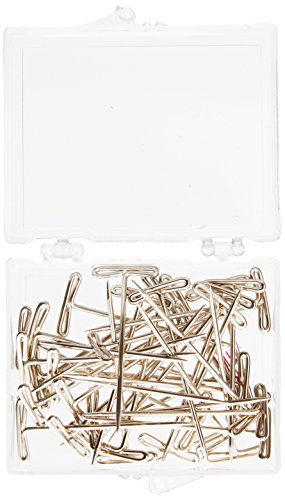
Sometimes, you just need a large quantity of pins without breaking the bank. Boye pins are the workhorse of the knitting world, providing a standard, functional solution for everyday projects.
They are perfect for beginners who are just starting to build their toolkit and don’t want to invest in specialized equipment yet. They get the job done and are widely available in most craft stores.
The main tradeoff is that they may not be as rust-resistant as higher-end stainless steel options. Always store them in a dry place and consider keeping them in a container with a silica packet to prevent moisture buildup.
Essential Factors for Choosing Blocking Fasteners
When selecting your tools, consider the weight and fiber content of your project. Heavy, dense wool blankets require the structural support of blocking combs or bars, while fine lace demands the delicate touch of thin T-pins.
Think about the shape of your project, too. Straight edges benefit from rigid tools, but if you are shaping a garment with curves—like a neckline or armhole—you need the flexibility of individual pins.
Finally, consider your physical workspace. If you are blocking on the floor, you need pins that are easy to see and handle. If you are using a tabletop board, you might prefer shorter pins that won’t poke through the other side.
Why Material Matters for Rust-Free Blocking Success
The material of your pin is the most critical factor in preventing damage to your yarn. While steel is strong, it is prone to oxidation if exposed to moisture, which is exactly what happens during wet blocking.
- Stainless Steel: The gold standard; highly resistant to rust and very smooth.
- Nickel-Plated Steel: Durable and smooth, but can rust if the plating is scratched.
- Aluminum: Lightweight and rust-proof, but often softer and prone to bending under tension.
- Plastic/Coated: Great for preventing rust, but ensure the coating is smooth to avoid snagging.
Always err on the side of stainless steel if you are working with expensive or light-colored fibers. It is a small cost to pay to protect weeks or months of knitting effort.
Proper Techniques for Securing Your Knitted Edges
The secret to a professional block is tension, not force. You want to stretch the fabric just enough to open the stitch pattern, but not so much that you distort the yarn or create holes.
Start by pinning the corners of your project first to establish the overall shape. Then, work from the center of each side outward, spacing your pins evenly to ensure uniform tension across the entire edge.
Avoid the temptation to pull the fabric as hard as you can. A gentle, consistent pull will yield a much more natural drape than a harsh, aggressive stretch that can permanently damage the elasticity of the yarn.
How to Maintain Your Blocking Tools for Longevity
Treat your blocking tools as an investment in your craft. After every use, make sure your pins are completely dry before putting them away in their storage container.
If you notice any pins becoming bent, remove them from your set immediately. A bent pin can snag your yarn or cause uneven tension, which is the last thing you want when you are finally finished with a project.
Periodically wipe your stainless steel pins with a dry cloth to remove any residual moisture or fiber dust. With proper care, a good set of pins can last through decades of knitting projects.
Investing in the right blocking fasteners is just as important as choosing the right needles or yarn. By matching your tool to the specific needs of your project, you ensure that your hard work is presented in the best possible light. Take the time to build a collection that covers all your needs, and you will find that the final step of knitting becomes a rewarding ritual rather than a chore. Happy blocking, and may all your edges stay perfectly straight.