6 Best Row Counter Clips For Pattern Attachments
Keep track of your knitting progress effortlessly. We explore the 6 best row counter clips for secure pattern attachments to improve your crafting workflow.
Every knitter has experienced the sinking feeling of realizing they’ve lost their place in a complex lace repeat. Tracking progress is the difference between a finished heirloom and a project left to languish in the bottom of a project bag. Whether you are working on a simple garter stitch scarf or a sophisticated cable-knit sweater, a reliable row counter is your best defense against frogging. Here are the top tools to keep your stitches on track and your sanity intact.
Cocoknits Maker’s Keep: Best Wearable Counter
The Cocoknits Maker’s Keep is a brilliant marriage of utility and style, featuring a slap-bracelet design that keeps your tools right on your wrist. It uses a magnetic base that holds onto your row counter, stitch markers, and even tapestry needles, ensuring they don’t vanish into the sofa cushions.
For those prone to setting their tools down and losing them mid-row, this is a game-changer. You never have to reach across the couch or pause your rhythm to find where you left your counter.
The magnet is strong enough to hold steel accessories securely, but you must be careful if you use aluminum or plastic markers. If you’re a multi-project knitter, the wearable nature means your row count follows you wherever you go. It is the ultimate choice for the knitter who values organization and mobility.
Clover Kacha-Kacha: The Classic Clicker Choice
The Clover Kacha-Kacha is a staple in knitting bags worldwide, and for good reason. It provides a tactile, satisfying "click" that confirms you’ve successfully registered your row without needing to look down at the device.
This manual counter is incredibly durable and lacks the fragile electronics that often fail in cheaper models. Because it’s mechanical, you don’t have to worry about batteries dying in the middle of a complex cable chart.
Some knitters find the clicking sound a bit loud in quiet environments, but that feedback is exactly what prevents accidental double-clicks. If you prefer a reliable, low-tech tool that feels substantial in your hand, this is the gold standard.
Knitter’s Pride Row Counter: Best Budget Pick


Knitter’s Pride offers a simple, no-nonsense row counter that clips directly onto your needle. It is perfect for those who want their row count to be physically tethered to the work itself.
Because it sits on the needle, it’s always in your line of sight as you finish a row. However, it can add a bit of weight to one side of your circular needles, which might be noticeable if you are working with very lightweight or delicate lace-weight yarn.
It is an affordable solution that works well for most standard projects. Just be aware that it can occasionally snag if you are working with fuzzy mohair or loosely spun singles.
Digital Finger Counters: Best for Large Counts

Digital finger counters are small, lightweight devices that strap onto your index finger like a ring. They are excellent for projects with extremely high row counts, such as a long stockinette blanket where manual dials might become tedious.
The screen is usually backlit or easy to read, and the buttons are large enough to press without disrupting your knitting flow. They are particularly useful if you are holding your yarn and needles in a way that makes reaching for a table-top counter difficult.
The main tradeoff here is the battery; eventually, it will run out. Always keep a spare battery in your notions tin so you aren’t left guessing your row count in the middle of a project. They are the most ergonomic choice for knitters with arthritis or hand fatigue.
Addi Click Counter: Best for Needle Attachment

The Addi Click Counter is designed specifically to integrate with the Addi Click interchangeable needle system. It is a precise piece of engineering that snaps onto the needle join, keeping your count perfectly aligned with your stitches.
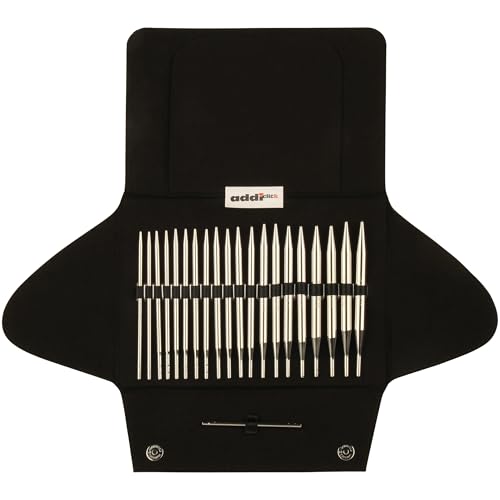
This tool is exceptionally convenient for those who exclusively use Addi needles, as it feels like a natural extension of the hardware. It eliminates the need to remember to pick up a separate tool, as the counter is essentially "part of the needle."
If you switch needles frequently or use a variety of brands, this might not be the most versatile investment. However, for the loyal Addi user, it provides a seamless, integrated experience that is hard to beat.
Susan Bates Quick Count: Best Manual Dial Tool
The Susan Bates Quick Count is a classic dial-based tool that is as simple as it gets. You manually rotate the wheels to track your rows, which is a great way to avoid the "accidental click" issues that plague button-based counters.
It is small, portable, and requires absolutely no power source. It’s a favorite among traditionalists who appreciate the tactile act of turning a dial at the end of a row.
Because it doesn’t clip to anything, it is prone to getting lost if you aren’t disciplined about keeping it in your project bag. It is a perfect, inexpensive choice for someone who wants a simple, foolproof way to track progress without any bells or whistles.
Why Every Knitter Needs a Reliable Row Counter
Even if you think you can "just count the V’s" on your work, your eyes will eventually tire, leading to miscounts. A row counter acts as an external memory, freeing your brain to focus on tension, stitch patterns, and yarn management.
When you are working with dark-colored yarns or intricate lace, counting stitches visually becomes significantly harder. Having a mechanical or digital record ensures you don’t accidentally skip a row of increases or decrease in a sweater sleeve.
Consistency is the key to professional-looking results. A row counter isn’t just a tool; it’s an insurance policy for your project’s symmetry.
How to Track Rows Across Multiple Work Projects
Tracking rows for multiple projects can be a nightmare if you don’t have a system. The best approach is to keep a dedicated counter inside the project bag for each specific item.
Never rely on your memory to carry a row count from one project to another. If you have a "main" project and a "travel" project, ensure both have their own dedicated tracking method, whether it’s a separate counter or a written tally on a project card.
Using a project card or a digital app in conjunction with a physical counter is the safest way to avoid disaster. Always write down your current row count at the end of every knitting session, just in case your counter gets bumped.
Key Features to Consider Before Buying a Counter
When selecting your tool, consider the physical constraints of your knitting style and the project at hand. Here are the critical factors to evaluate:
- Attachment Method: Does it clip to the needle, sit on your finger, or stay on your wrist?
- Feedback Mechanism: Do you need an audible click, or do you prefer a silent dial?
- Durability: Is it a mechanical device that lasts for years, or an electronic one with a battery?
- Size and Weight: Will it affect the balance of your needles or cause hand strain?
Think about the yarn you use most often. If you work with delicate, snag-prone fibers like silk or alpaca, avoid counters that have sharp clips or rough edges. Choose a tool that complements your yarn, not one that fights against it.
Managing Complex Patterns With Row Counters
Complex patterns often require you to track multiple things at once, such as row repeats and shaping increases. In these cases, you might need two counters: one for the overall length and one for the pattern repeat.
When working on stranded colorwork or cables, the row counter allows you to stay in the "flow state" longer. You don’t have to stop and manually count every row of the chart, which keeps your tension even and your rhythm consistent.
If a pattern is particularly long, write your "reset" row numbers on a sticky note attached to your chart. By combining a physical counter with a clear written plan, you can tackle even the most daunting lace or cable charts with confidence.
Finding the right row counter is a personal journey that depends as much on your knitting style as it does on the project in your lap. Whether you prefer the satisfying click of a mechanical device or the convenience of a wearable tool, the goal remains the same: keeping your project on track. Experiment with these different options to see which one feels like a natural extension of your hands. Once you find your perfect match, you’ll wonder how you ever managed to finish a sweater without one.