7 Best Adjustable Lamps For Color Work For Artists
Achieve color accuracy with our top 7 adjustable lamps. Discover how high-CRI lighting improves precision and detail in your professional art projects today.
Finding the right light is just as critical as choosing the perfect wool for your next project. When you are working with dark navy yarns or intricate lace patterns, poor lighting can lead to dropped stitches and eye strain that cuts your crafting time short. These seven lighting solutions are designed to bring clarity to your workspace, ensuring your color choices remain true from skein to swatch. Let’s look at the best tools to keep your stitches visible and your colors vibrant.
OttLite 2-in-1 LED Floor Lamp: Best Overall Choice


The OttLite 2-in-1 is a staple in many studios because it serves two purposes without cluttering your floor space. It easily converts from a tall floor lamp to a shorter table lamp, which is a lifesaver if you rotate between knitting in a recliner and working at a desk.
For those of us working with variegated yarns or complex colorwork, the natural daylight simulation is a game changer. It helps you distinguish between similar shades of gray or brown that often look identical under standard yellow household bulbs.
The primary tradeoff here is the base footprint, which can be a bit bulky in small craft rooms. However, the versatility of the adjustable neck makes it worth the space if you frequently change your seating position.
Brightech Litespan LED Floor Lamp for Precision
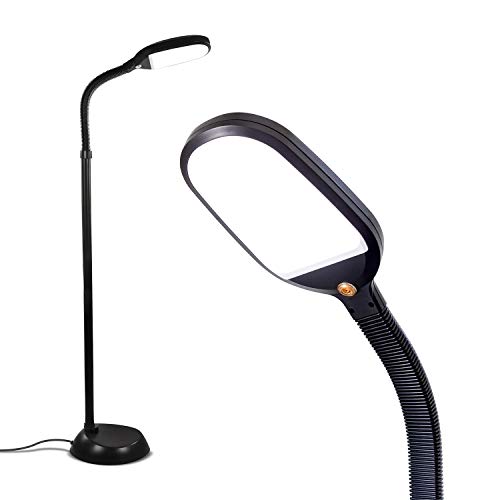
When you are staring at a 2.25mm needle tip for hours, you need a focused beam that doesn’t flicker. The Brightech Litespan is a workhorse that provides a clean, white light that minimizes the visual fatigue associated with long sessions of stranded colorwork.
The gooseneck design is surprisingly robust, allowing you to angle the light directly over your needles without it sagging over time. This is essential for those late-night sessions when you are trying to finish a row before bed.
While it lacks some of the fancy dimming features of more expensive models, its simplicity is its strength. It provides a steady, reliable glow that won’t distract you from the rhythm of your knitting.
Daylight Company Slimline 3 LED Table Task Lamp

The Slimline 3 is the gold standard for crafters who need a wide, even spread of light across their entire project. If you are working on a large-scale project like a cabled afghan, this lamp illuminates the entire width of your lap.
The brightness is adjustable, which is vital when you switch from working with high-contrast fibers to more subtle, tonal yarns. You don’t want the same intensity for a bright white cotton as you do for a deep, light-absorbing mohair.
It is a significant investment, but the build quality is meant to last for years of daily use. Just be prepared to clear some desk space, as the clamp or base requires a stable surface to function correctly.
Neatfi XL 2,200 Lumens LED Task Lamp Performance
If you find yourself squinting even with a standard lamp, the Neatfi XL is the high-powered solution you’ve been looking for. It is incredibly bright, making it perfect for identifying subtle color shifts in hand-dyed yarns that seem to disappear in dim light.

The extra-wide head covers your entire workspace, ensuring you don’t have to constantly adjust the lamp as you move your hands. This is particularly helpful when you are constantly checking your gauge swatch against a pattern.
Because this lamp is so powerful, it can feel a bit industrial for a cozy living room setup. It is best suited for a dedicated craft table where you handle your most detailed, color-intensive work.
Phive LED Architect Desk Lamp with Clamp Mount
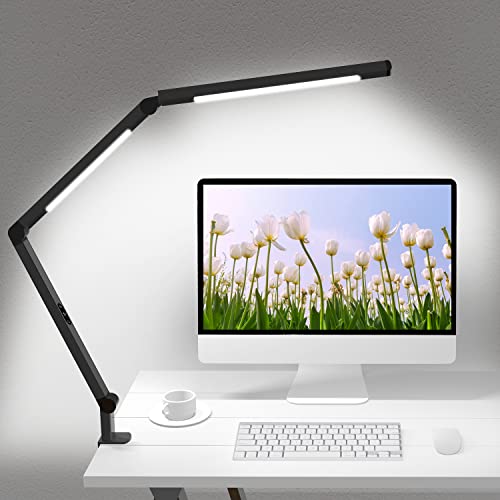
The Phive Architect lamp is a classic design that stays out of your way until you need it. By clamping directly to your table, it frees up valuable room for your yarn bowls, stitch markers, and pattern binders.
The arm is highly articulated, meaning you can pull the light close to your face when you are picking up stitches or fixing a dropped stitch in a complex lace pattern. It’s all about getting the light exactly where the needle meets the yarn.
The clamp is sturdy, but ensure your table edge is compatible before purchasing. It’s a clean, modern choice for the knitter who values a tidy, organized workspace.
TaoTronics LED Desk Lamp with Flexible Gooseneck

This is an excellent entry-level option for knitters who need a portable, lightweight solution. The flexible gooseneck is incredibly easy to manipulate, allowing you to direct light into the dark crevices of a complex garment construction.
It features multiple color temperature modes, which is a neat trick for testing how your project will look under different environments. You can see how your colors shift from a warm, cozy evening light to a crisp, daylight-balanced setting.
While it isn’t as powerful as the dedicated studio lamps, it is more than sufficient for most knitting projects. It is a fantastic choice if you move your project bag between the kitchen table and the sofa.
BenQ ScreenBar Halo LED Monitor Light for Crafters
The ScreenBar Halo is a unique solution that sits on top of your computer monitor, casting light downward onto your workspace. If you knit while watching tutorials or following digital patterns on a screen, this keeps your area bright without creating screen glare.
By removing the need for a separate lamp base, it saves a massive amount of desk real estate. It provides a wide, asymmetrical light path that illuminates your hands and yarn without reflecting off your laptop or tablet.
It is a specialized tool, so it won’t work if you aren’t knitting near a monitor. However, for the modern knitter who lives by digital charts and video classes, it is an ingenious way to keep your work well-lit.
Why High CRI Lighting Matters for Color Accuracy
CRI, or Color Rendering Index, is a measure of how accurately a light source reveals colors compared to natural sunlight. For knitters, a high CRI (90+) is non-negotiable when working with complex colorwork or selecting yarns for a project.
If your light has a low CRI, a deep plum yarn might look brown, or a vibrant teal might appear muted. You could spend weeks on a sweater only to realize the colors don’t actually coordinate once you step outside.
- Look for 90+ CRI: This ensures the colors you see under your lamp are the colors you see in the sun.
- Avoid "Cool" Blue Tones: These can distort yellows and greens, making them look sickly or washed out.
- Check the Kelvin Scale: Aim for 4000K to 5000K for a neutral, daylight-balanced glow that won’t strain your eyes.
Choosing Between Floor and Table Lamps for Crafts
Your choice between a floor lamp and a table lamp should be dictated by your primary knitting spot. If you are a "sofa knitter," a floor lamp with a heavy base and an adjustable arm is almost always the better choice.
Table lamps are ideal for those who have a dedicated station for winding yarn, blocking swatches, or working on intricate repairs. They offer more focused, directional light that is perfect for the precision required in finishing work.
- Consider your reach: Can you adjust the lamp without standing up?
- Evaluate your space: Do you have a side table for a clamp, or is the floor your only option?
- Think about portability: Do you need to move the light from the living room to the bedroom?
How to Position Lighting to Eliminate Shadowing
Shadowing is the enemy of the knitter, especially when you are working with dark-colored yarns. To eliminate shadows, position your light source at an angle that illuminates your hands from the side or slightly from above.
If you place the light directly behind you, your own body will cast a shadow over your knitting. Similarly, placing it directly in front can cause glare on your needles, especially if you prefer slick metal needles over wood.
- The 45-Degree Rule: Position the lamp at a 45-degree angle to your hands to maximize visibility.
- Test for Glare: If your needles are reflecting the light back into your eyes, shift the lamp head slightly to the left or right.
- Layer your light: Use an overhead room light for general ambiance and a task lamp for the fine detail work.
Investing in quality lighting is one of the most practical upgrades you can make for your knitting practice. By prioritizing high CRI bulbs and adjustable positioning, you protect your eyes and ensure your colorwork looks exactly as you intended. Choose a lamp that fits your specific knitting habits, and you will find that your stitches are clearer and your creative process is much more enjoyable. Happy knitting, and may your colors always stay true.