7 Best Ball Winders For Cable-Ready Yarn Worth Using
Discover the 7 best ball winders for cable-ready yarn. We evaluate durability and efficiency to help you choose the perfect tool for your crafting projects.
Transforming a tangled, unruly hank of yarn into a neat, center-pull cake is one of the most satisfying rituals in a knitter’s life. While hand-winding works in a pinch, a reliable ball winder saves you hours of frustration and prevents the dreaded yarn barf. Choosing the right tool depends on your stash volume, the weight of the fibers you favor, and how much space you have on your crafting table. Let’s look at the best winders on the market to help you streamline your workflow and get straight to the knitting.
Stanwood Needlecraft Large Metal Ball Winder


This winder is the gold standard for those of us who regularly work with large, heavy hanks of bulky or aran weight yarn. Its sturdy metal construction provides the weight necessary to keep the unit from sliding across your table during a high-speed winding session.
The internal gears are significantly more robust than those found in standard plastic models. If you find yourself winding several pounds of superwash wool a month, the durability here is worth the investment.
The only real tradeoff is the physical footprint, which is quite large. If you have a dedicated fiber studio, it’s a dream; if you’re a kitchen-table knitter, you’ll need to clear some serious surface area.
KnitPicks Ball Winder: Best Budget-Friendly Pick
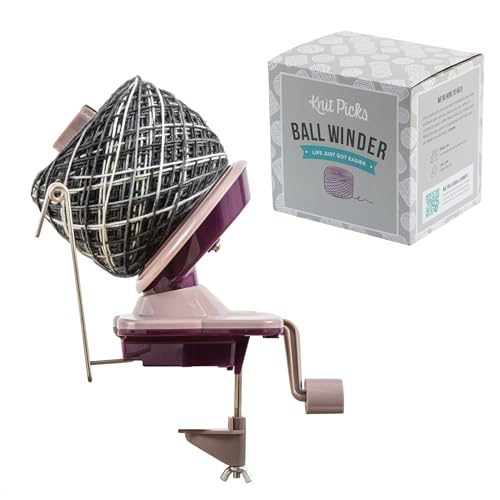
For the vast majority of knitters, the KnitPicks winder is the perfect entry point. It is reliable, lightweight, and handles standard fingering through worsted weight yarns with ease.

It is ideal for someone just starting to build a stash who doesn’t want to break the bank. While the plastic casing isn’t built for industrial-level output, it is more than sufficient for the occasional project-specific winding.
Keep in mind that this model works best when you keep the tension consistent by hand. If you try to force it too quickly, the gear teeth can occasionally skip, so keep your pace steady.
Lacis Jumbo Yarn Ball Winder for Heavy Skeins

When you are dealing with massive 400-gram cakes or bulky art yarns, standard winders often struggle to keep the cake from collapsing. The Lacis Jumbo is specifically engineered to handle these high-volume requirements.
The oversized spool allows for a much larger capacity, meaning you can wind an entire sweater’s worth of yarn without stopping to clear the base. It’s a workhorse for those who buy yarn in large, economical hanks.
Be aware that because of the size, it requires a very stable surface. A wobbly folding table will make this heavy-duty machine move, so ensure it is clamped down tightly before you begin.
ChiaoGoo Hand-Operated Yarn Winder Review
ChiaoGoo is a brand synonymous with quality in the knitting world, and their winder reflects that same attention to detail. It offers a smooth, quiet winding experience that feels much more premium than other plastic models.
The tension guide is particularly well-designed, which is a lifesaver when you are winding slippery silk or bamboo blends. Those fibers have a tendency to "creep" off the cake, but this guide keeps them locked in place.
It is a fantastic middle-ground choice for the knitter who wants something better than the basics but isn’t ready for a heavy-duty metal unit. It’s compact, efficient, and very easy to store.
U-nitt Metal Yarn Winder: Durable Choice
The U-nitt winder is a favorite among knitters who are tired of plastic gears stripping after a few months of use. The metal construction ensures that the internal mechanism remains aligned even after winding hundreds of cakes.
This is a "buy it once" tool. If you are the type of knitter who hates replacing broken equipment, the higher initial cost is easily justified by its longevity.
It does require a bit of maintenance, specifically an occasional drop of oil on the gears to keep it running silently. If you don’t mind a tiny bit of upkeep, the performance payoff is substantial.
Boye Electric Yarn Winder: Efficient Option

If you have a large stash to process or struggle with wrist fatigue, an electric winder is a game-changer. The Boye model takes the physical labor out of the equation, allowing you to wind perfect cakes with the press of a button.
The main advantage is consistency; the motor maintains a perfectly even speed, which results in a more uniform cake. This is particularly helpful for delicate fibers that might stretch if pulled inconsistently by hand.
The downside is the lack of tactile feedback. You must be vigilant to ensure the yarn doesn’t snag on your swift, as the motor won’t stop automatically if a tangle occurs.
Nancy’s Knit Knacks Heavy Duty Ball Winder

This is widely considered the "pro" option for serious fiber enthusiasts. It is designed to withstand years of heavy use, often outlasting several other winders in a knitter’s collection.
The build quality is exceptional, featuring high-grade components that make the winding process feel effortless. If you are a prolific knitter or a professional designer, this machine is an investment in your productivity.
Because it is a professional-grade tool, it is significantly more expensive than consumer-level winders. It is truly intended for those who treat their fiber arts as a long-term, high-volume craft.
How to Properly Use a Ball Winder for Yarn
The most common mistake knitters make is failing to use a yarn swift. Trying to wind a hank directly from a chair back or your knees is a recipe for a tangled disaster.
Always place your hank on a swift and adjust it so the yarn flows freely without resistance. If the yarn is too tight, it will stretch; if it’s too loose, it will fall off the swift.
When you start winding, feed the yarn through the tension guide slowly. Keep one hand on the yarn between the swift and the winder to ensure it doesn’t jump off the spool as the cake grows.
Essential Tips for Winding Cakes Without Tangles
- Go slow at the start: The first few turns are the most important for setting the center-pull core.
- Watch for knots: If you encounter a manufacturer’s knot in the yarn, stop and untie it rather than winding over it.
- Don’t overfill: Stop before the cake hits the base of the winder to prevent the yarn from catching on the rotating parts.
- Remove gently: Slide the cake off the winder slowly to keep the tension even.
Troubleshooting Common Ball Winder Issues
If your winder is making a clicking sound, check for stray yarn ends caught in the gears. This is the number one cause of mechanical failure and can usually be fixed with a pair of tweezers.
If your cakes are coming out lopsided, check that your tension guide is perfectly aligned with the spool. Even a slight misalignment can cause the yarn to build up on one side, leading to a collapsed cake.
Finally, if the winder keeps sliding off your table, use a piece of rubber shelf liner under the base. This adds extra grip without damaging your furniture and keeps the unit rock-steady.
Investing in a quality ball winder is one of the most practical upgrades you can make for your knitting practice. By choosing a tool that matches your volume and fiber preferences, you eliminate the friction that keeps you from your needles. Remember that the best winder is the one that allows you to spend less time managing your stash and more time enjoying your stitches. Happy winding, and may your yarn always flow smoothly!