6 Best Claw Weights For Wide Garment Panels To Try
Struggling with tension on wide knitting panels? Explore these 6 top-rated claw weights designed to ensure even, professional results for your fabric projects.
Knitting wide panels on a machine can quickly turn into a dropped-stitch nightmare if your tension isn’t perfectly anchored across the needle bed. Without the right downward force, the fabric tends to lift with the needles, leading to uneven loops and frustrating jams. Choosing the correct claw weight is the difference between a smooth, professional finish and a tangled mess. These six options provide the necessary stability to keep your wide-panel projects moving seamlessly.
Passap Standard Claw Weight: Best for Stability
The Passap standard claw weight is a staple for a reason: its sheer physical presence provides a reliable, heavy anchor. When you are knitting wide panels, especially with heavier yarns, you need a weight that doesn’t bounce or shift during the carriage movement.
This weight is designed to sit deep in the fabric, gripping the stitches firmly to prevent them from popping off the latch needles. It is particularly effective when working with complex stitch patterns that require multiple carriage passes, as it maintains a consistent, steady pull throughout the process.
However, its weight can be a double-edged sword. If you are working with delicate, fine-gauge fibers like lace-weight mohair, you must be careful not to over-stretch the fabric. Always monitor your stitch formation, and if the loops look elongated, consider moving to a lighter tension or using a spreader to distribute the load.
Brother KA-8216 Claw Weight: Best Performance
The Brother KA-8216 is widely regarded as the gold standard for versatility and ease of use. It features a streamlined design that allows it to glide along the needle bed without catching on the carriage or the surrounding fabric.
What sets this weight apart is its balance; it provides enough tension to pull the stitches down without the excessive bulk that can sometimes cause snagging. It is an excellent choice for knitters who frequently switch between different yarn weights, as it handles everything from light fingering to worsted-weight wool with impressive reliability.
I often recommend this to knitters who are struggling with inconsistent stitch size across a wide panel. Because the weight is so well-balanced, it minimizes the "wobble" that occurs during the carriage stroke, resulting in a much more uniform gauge from edge to edge.
Silver Reed 5-Prong Claw: Best for Wide Panels
When you are knitting the full width of a standard bed, the Silver Reed 5-prong claw is an essential tool for maintaining edge tension. Its multi-prong design allows you to hook into multiple stitches simultaneously, spreading the downward force across a wider surface area.
This is critical for preventing the edges of your panel from curling or dropping stitches. By distributing the pull across five points, you significantly reduce the risk of creating a "laddering" effect, which is common when a single-point weight is asked to carry too much fabric load.
If you are working with slippery synthetic fibers or superwash wools that tend to slide off the needles, the 5-prong grip is a lifesaver. It bites into the fabric securely, ensuring that even the most difficult-to-handle yarns stay firmly in the latch of the needle.

KnitKing Heavy Duty Weight: Best for Tension
The KnitKing Heavy Duty weight is designed for the knitter who demands absolute, unwavering tension. If you are working on a large garment panel that requires significant weight to keep the stitches from "climbing" the needles, this is your go-to tool.
This weight is particularly useful when working with dense, high-twist yarns that have a tendency to spring back. The added mass ensures that the fabric is pulled down firmly, allowing the needles to clear the old stitches cleanly and consistently.
Be mindful, however, that heavy-duty weights can leave "dimples" or marks in your finished fabric. I suggest using a thin piece of protective fabric between the claw and your work if you are using a sensitive fiber like silk or a high-twist cotton blend.
Artisan 7-Prong Claw: Best for Even Pulling
The Artisan 7-prong claw is a masterclass in weight distribution. By utilizing seven distinct prongs, it creates a wide, flat pulling force that is ideal for delicate or wide-panel knitting where you want to avoid localized pulling or distortion.
Because the weight is spread over seven points, the stress on any individual stitch is kept to a minimum. This makes it the perfect choice for intricate stitch patterns or lace, where you need to keep the fabric taut without pulling the delicate loops out of shape.
This claw is also remarkably stable. Because it grips such a wide section of the row, it is less likely to swing or twist as the carriage moves. If you are prone to uneven edges on your wide panels, switching to a 7-prong claw will almost certainly solve the problem.
Addi Express Claw Weight: Best for Versatility

While often associated with circular machines, the Addi-style claw weights are surprisingly effective for flat-bed wide panels. Their compact, ergonomic design makes them easy to clip and unclip, allowing for quick adjustments as your panel grows.
They are incredibly lightweight, making them perfect for those final inches of a project where you need a little extra tension but don’t want to risk stretching the fabric. They are also excellent for "spot-weighting," where you need to add a little extra pull to a specific section of a wide panel that is lagging behind.
Don’t underestimate these small tools; in the world of machine knitting, sometimes a little bit of weight in exactly the right place is more effective than a massive weight that is poorly positioned. Keep a few of these in your kit for those moments when you need precision over power.
Why Wide Panels Require Consistent Claw Weight
When knitting wide panels, the distance between the center and the edges of the needle bed creates a natural variation in tension. The fabric at the edges often experiences less downward force than the fabric in the center, leading to uneven stitch sizes and potential dropped stitches.
Consistent claw weight acts as a stabilizer, counteracting the natural tendency of the fabric to bunch up or lift. Without proper weighting, your carriage will have to work harder to pull the fabric through, which can lead to increased wear on your needles and potential jamming.
Think of the claw weight as an extension of your own hands. Just as you would gently tug on a hand-knitted piece to ensure the stitches are setting correctly, the claw weight provides that constant, gentle tension that ensures every loop is formed to the exact same size.
How to Properly Distribute Weights on Your Bed
Proper weight distribution is as much an art as it is a science. For wide panels, I recommend starting with a balanced weight in the center and working outward, adding smaller weights to the edges as the panel grows to ensure the selvedges remain taut.
Always avoid putting all your weight in one spot. If you concentrate too much force in the center, you will stretch the middle stitches while the edges remain loose and prone to dropping. Instead, aim for a "fan" or "spread" distribution, where the weights are spaced evenly across the width of the fabric.
Monitor your work every few rows. If you notice the fabric starting to "smile" or curve upward at the edges, it is time to add more weight to the outer sections. Conversely, if the stitches look stretched or distorted, lighten your load immediately.
Troubleshooting Uneven Tension in Large Knits
If you find that your wide panels consistently have uneven tension, the first thing to check is your weight placement. Often, a simple redistribution of your claws will solve the problem instantly.
Next, consider the fiber content of your yarn. Natural fibers like wool have a natural "grip" that makes them easier to knit, while synthetics and silk can be much slicker and require more precise weighting to stay in place. If your yarn is particularly slippery, you may need to increase the number of prongs on your claws to ensure a secure hold.
Finally, don’t overlook your carriage settings. If your tension dial is set too tight, no amount of weight will compensate for the strain on the needles. Always start with a loose tension and adjust upward until you find the "sweet spot" for your specific yarn and project.
Maintaining Your Claw Weights for Longevity
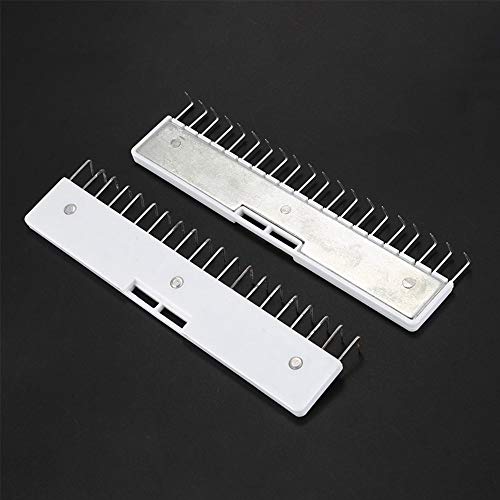
Like any precision tool, your claw weights require regular maintenance to perform their best. Check the prongs periodically to ensure they aren’t bent or dull, as a damaged prong can snag your yarn and ruin an entire row of knitting.
Clean your weights after every project to remove any dust, lint, or yarn residue that may have accumulated. A quick wipe-down with a soft cloth is usually sufficient, though you can use a mild soap and water solution for a deeper clean if necessary.
Store your weights in a cool, dry place, and try to keep them organized by type and weight. If you take care of your tools, they will last for decades, providing you with the consistent tension you need to create beautiful, professional-quality garments time and time again.
Mastering the use of claw weights is a fundamental skill that separates the casual hobbyist from the confident machine knitter. By understanding how different weights interact with your fabric, you can ensure that even your widest panels come off the machine with perfect, uniform tension. Don’t be afraid to experiment with different combinations until you find the setup that works best for your specific style and yarn. With the right tools and a bit of practice, you will find that even the most complex wide-panel projects become a joy to knit.