7 Best Project Notebooks For Tracking Progress Reviewed
Boost productivity with our top 7 project notebooks. We review the best layouts for tracking goals, milestones, and daily progress to keep you organized.
Every knitter knows the sinking feeling of finding a half-finished sweater in a project bag with no clue which needle size was used or how many rows remain. Tracking your progress isn’t just about record-keeping; it is the essential bridge between a chaotic pile of yarn and a finished heirloom. These seven notebooks represent the best tools available to help you capture your process, maintain your gauge, and celebrate your growth as a maker. Whether you are a process knitter who loves the rhythm of the needles or a project-oriented maker, the right journal will change how you finish your work.
The Knitter’s Planner: Best Overall Organizer


This planner is the gold standard for those who want a comprehensive command center for their knitting life. It manages to balance the technical data of gauge and yarn yardage with the creative joy of project planning.
If you are someone who juggles multiple works-in-progress (WIPs) at once, this is your best friend. It provides dedicated space to track your stash, manage your needle inventory, and layout project timelines.
The trade-off is the bulk; this is a desk-bound tool rather than a bag-bound one. It is best suited for the knitter who wants a permanent, detailed record of every stitch ever cast on.
Fringe Association Field Notes: Best for Travel

When you are knitting on the go, you need something that slips easily into a project bag without adding unnecessary weight. These slim, understated notebooks are designed for the minimalist maker who values function over flair.
They are perfect for jotting down quick notes about row repeats or fiber content while sitting in a coffee shop or on a train. Because they are compact, you are more likely to actually use them during a commute.
The simplicity is both a strength and a limitation. You won’t find pre-printed grids for complex lace charts, so you must be comfortable creating your own systems for tracking increases or decreases.
Cocoknits Maker’s Journal: Best for Pattern Notes
Cocoknits has a deep understanding of the practical frustrations knitters face, and their journal reflects that insight. It is specifically designed to help you organize your pattern modifications and adjustments.
The layout allows you to keep track of your "knitter’s math," like when you decided to add an extra inch to a sleeve or change the neckline depth. This is invaluable if you ever plan to knit a pattern a second time.
It is a sophisticated tool that assumes you are willing to engage deeply with your patterns. If you prefer to knit exactly as written, you might find the extra space for notes a bit overkill.
The Knitting Journal by Potter Craft: Best Layout
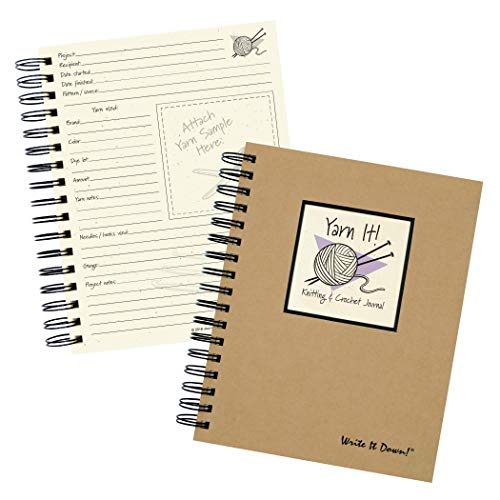
This journal excels because it treats the knitting process as a data-driven endeavor. The layout is clean, intuitive, and guides you through the necessary technical details without feeling like a chore.
It effectively prompts you to record the essential variables: yarn brand, dye lot, fiber content, and the final blocked gauge. These are the details that prevent future headaches when you need to match a yarn weight for a repair or a new project.
The structure is rigid enough to keep you organized but flexible enough to accommodate different knitting styles. It is a fantastic choice for the knitter who wants a professional-looking archive of their completed work.
Moleskine Classic Notebook: Best for Customizing
Sometimes, the best system is the one you build yourself from scratch. The Moleskine Classic is the ultimate blank canvas for a knitter who wants to sketch charts, paste in yarn labels, and write long-form notes.
If you are a visual learner who draws your own lace motifs or stranded colorwork charts, the unlined or grid paper is essential. You aren’t constrained by pre-printed boxes that might be too small for your sketches.
The downside is that you have to do the heavy lifting of setting up your own tracking system. You must be disciplined enough to consistently record your gauge and needle sizes in a format that makes sense to you later.
KnitPro Project Journal: Best for Beginners

KnitPro has created a friendly, approachable entry point for those new to the craft. It focuses on the basics, stripping away the overwhelming complexity of advanced planning to help you build a habit of tracking.
It’s perfect for someone just starting their first scarf or hat who needs to remember which needle size they used once the project is finished. It helps demystify the technical side of knitting without feeling like a math test.
As your skills grow, you might eventually find it a bit too simplistic for complex garment construction. However, it is an excellent training tool to help you appreciate the importance of keeping records.
Mindful Collection Project Log: Best Aesthetics

The Mindful Collection is for the knitter who finds as much joy in the beauty of their tools as they do in the finished garment. It is elegant, serene, and designed to turn the act of record-keeping into a ritual.
Beyond the aesthetics, the paper quality is excellent, which is important if you use fountain pens or markers to color-code your charts. It feels like an heirloom piece that you will be proud to display on your bookshelf.
The focus here is on the experience of the craft. While it functions well as a tracker, its primary value is in the tactile pleasure it brings to your knitting sessions.
Why Tracking Your Knitting Progress Matters Most
Tracking progress is the difference between guessing your gauge and knowing it. When you record your needle size, yarn fiber, and final blocked dimensions, you build a personal database that makes future projects much easier.
It also serves as a diagnostic tool. If a sweater comes out too long or too wide, your notes will tell you exactly where your gauge shifted or which modification caused the issue.
- Consistency: Helps you maintain tension over long periods.
- Accountability: Keeps you from starting too many projects at once.
- Learning: Allows you to see how different fibers—like wool, alpaca, or silk—behave on your needles.
Essential Details to Record in Every Project
Regardless of the notebook you choose, ensure your entries capture the critical data points that define your project. Neglecting these details often leads to "knitter’s remorse" when you realize you can’t replicate a successful result.
- Yarn details: Brand, colorway, dye lot, and fiber composition.
- Needle size: Include the material (wood, metal, or carbon) as this affects your tension.
- Gauge: Record both your pre-blocking and post-blocking measurements.
- Modifications: Any changes made to the original pattern instructions.
- Start and end dates: Useful for tracking your personal knitting speed.
How to Choose the Perfect Format for Your Needs
Selecting the right journal comes down to your personal knitting personality. If you are a "process knitter" who loves the meditative aspect, choose a notebook that encourages reflection and sketching.
If you are a "project knitter" focused on efficiency, lean toward a structured planner that tracks your stash and timelines. Consider your environment: if you knit primarily at home, a large, beautiful journal is fine; if you travel, choose a slim, portable notebook.
Ultimately, the best notebook is the one you actually keep in your project bag. If you find yourself leaving your notes at home, you need a smaller, more accessible format.
Investing in a project notebook is one of the most practical upgrades you can make to your knitting practice. By documenting your technical choices and creative modifications, you transform from a casual maker into a confident, informed fiber artist. Choose the journal that matches your current goals, keep it close to your needles, and watch your skills sharpen with every recorded row. Happy knitting, and may your gauge always be true.