6 Best Swatch Templates For Size Consistency To Use
Achieve perfect size consistency with these 6 top-tier swatch templates. Learn how to streamline your design workflow and ensure professional, uniform results.
Achieving the perfect fit in a hand-knit garment starts long before you pick up your needles for the final project. Many knitters overlook the importance of standardized measurement tools, leading to frustrating discrepancies between their swatch and their finished sweater. By utilizing dedicated swatch templates, you remove the guesswork from your stitch counts and ensure your tension remains uniform. This guide explores the best tools to help you master your gauge and elevate your knitting precision.
Cocoknits Maker’s Keep Gauge and Swatch Ruler

The Cocoknits Maker’s Keep is a brilliant piece of engineering for the modern knitter who values both utility and aesthetics. Its magnetic wrist strap design keeps your needle gauge and ruler close at hand, preventing the inevitable "where did I put my measuring tool?" panic.

This tool is particularly useful when you are working on complex patterns that require frequent gauge checks. Because the ruler is integrated into the design, you aren’t fumbling with loose tapes or flimsy plastic cards.
The primary tradeoff here is the price point, as it is a premium tool compared to a basic plastic ruler. However, for those who knit daily, the convenience of having your gauge measurements physically attached to your workspace is a game-changer.
The Fringe Supply Co. Knitter’s Graph Paper
Sometimes the simplest tools are the most effective, and this specialized graph paper is a testament to that philosophy. It is designed specifically to match the proportions of a standard knitting stitch, which is wider than it is tall.
When you draw your stitch patterns or cables onto this paper, you get a realistic preview of how the final fabric will drape and shape. It forces you to visualize your project in terms of actual stitch density rather than abstract squares.
While digital apps exist, there is a tactile satisfaction to sketching out your own designs on paper. It helps you catch errors in your stitch repeats before you even cast on your first row of yarn.
Della Q Circular Needle Gauge and Swatch Tool

Della Q is known for high-quality craftsmanship, and their needle gauge is no exception for the organized knitter. It provides a robust, circular template that helps you identify needle sizes quickly while providing a dedicated window for counting stitches.
The circular design is surprisingly ergonomic, fitting comfortably in your hand while you align your swatch. It feels substantial, meaning it won’t slide around your fabric while you are trying to count those tiny, elusive stitches.
The main consideration is its size; it’s a bit larger than a standard credit-card-style gauge. If you are a minimalist knitter, you might find it bulky, but for those who want a permanent tool that won’t get lost in your project bag, it is ideal.
Katrinkles Wooden Swatch Gauge and Ruler Set
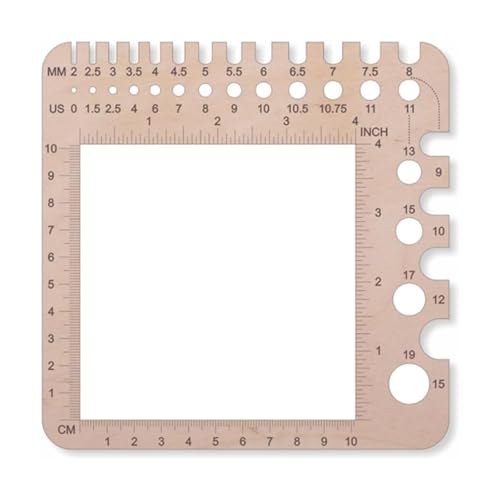
Katrinkles offers a beautiful, tactile experience with their laser-cut wooden tools that feel much warmer in the hand than plastic. The natural material provides a slight grip, which can be beneficial when you are trying to hold the ruler steady against a slippery silk or bamboo yarn.
These tools are perfect for knitters who appreciate the artisan aspect of their hobby. They are lightweight, durable, and provide a clear, high-contrast view of your stitches through the cutout windows.
Be aware that because they are made of wood, they can be susceptible to warping if left in a very humid environment or near a heat source. Treat them with the same care you would your favorite wooden needles, and they will last for years.
ChiaoGoo Needle Gauge and Swatch Ruler Combo

ChiaoGoo is a titan in the needle world, and their combo tool is a workhorse designed for the serious maker. It combines a highly accurate needle sizer with a clear, durable plastic swatch window that is easy to read against any yarn color.
The standout feature is the precision of the holes; they are machined to exact specifications. If you have a collection of older, unlabeled needles, this is the most reliable way to sort your inventory.
The tradeoff is the utilitarian design, which lacks the "giftable" charm of wooden tools. Yet, for pure, unadulterated accuracy in measuring your gauge, it is arguably the most reliable tool on the market.
Susan Bates Knit Count and Swatch Template
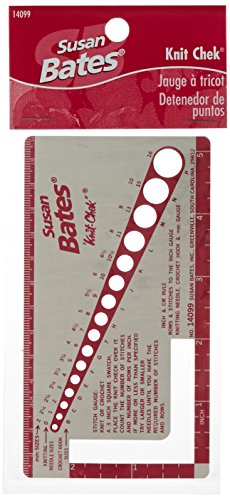
The Susan Bates Knit Count is a classic for a reason: it is affordable, accessible, and does exactly what it promises. It is a no-frills, plastic template that has been a staple in knitting bags for generations.
This is the perfect tool for the beginner knitter who isn’t ready to invest in premium accessories but needs to start practicing good habits. It provides a consistent 2-inch or 4-inch window, which is the industry standard for measuring gauge.
Don’t let the low price fool you; it is just as effective as more expensive versions for getting the job done. If you tend to lose your tools, buying a few of these to keep in different project bags is a smart, budget-friendly strategy.
Why Consistent Swatching Matters for Your Fit
Your swatch is essentially a "test drive" for your garment. If you skip this step, you are essentially gambling with your time, money, and the final fit of your sweater.
Even if you are an experienced knitter, your tension can change based on your mood, the type of fiber you are using, or even the time of day. A wool-blend yarn will behave very differently than a 100% cotton yarn, and your gauge must reflect that reality.
- Wool: Elastic and forgiving, often blooms after blocking.
- Cotton/Linen: Inelastic and prone to stretching; requires a tighter gauge.
- Silk/Alpaca: Extremely drapey and heavy; often requires going down a needle size to maintain structure.
How to Measure Your Gauge for Accurate Sizing
Measuring gauge is not just about counting stitches; it is about counting them in the right way. Always measure your swatch in the center, away from the edges where the tension is often uneven due to the turning of the needle.
Lay your template flat on a table with good lighting. Use a pin to mark the start and end of your 4-inch count so you don’t lose your place while counting.
- Stitch Count: Count the number of "V" shapes across.
- Row Count: Count the number of horizontal loops vertically.
- Half-Stitches: If you have half a stitch at the end of your 4 inches, record it! It matters for large garments.
Blocking Your Swatch for True Stitch Density
Never measure your swatch until it has been washed and blocked, as this is the most critical step in the process. Blocking relaxes the fibers and allows them to settle into their final, permanent shape.
If you skip blocking, you are measuring the "stressed" state of the yarn as it comes off the needles. Once you wash your finished sweater, it will likely grow or shrink significantly, potentially ruining the fit you worked so hard to achieve.
Use the same method to block your swatch that you intend to use for the final garment. If you are steam-blocking your sweater, steam-block your swatch; if you are soaking it, soak your swatch.
Essential Tips for Perfect Tension Consistency
Your tension is a fingerprint, but it is one you can train to be more consistent. Practice holding your yarn in the same way for every project, and pay attention to how your hands feel after an hour of work.
If you find your hands cramping, you are likely gripping the needles too tightly, which will lead to a very dense, stiff fabric. Try to relax your shoulders and take frequent breaks to reset your muscle memory.
- Slick vs. Grippy: Use metal needles for sticky wools and wooden needles for slippery fibers like silk.
- The "Swatching" Mindset: Treat your swatch like a mini-project, not a chore.
- Record Everything: Write down your needle size, yarn brand, and final gauge in a dedicated notebook.
Mastering the art of the swatch is the single most effective way to transition from a casual hobbyist to a confident, skilled knitter. By choosing the right template for your needs and committing to the blocking process, you ensure that every stitch leads to a garment you will cherish. Remember that your tools are there to support your creativity, not limit it. Happy knitting, and may your gauge always be perfectly on target.