7 Best Jewelry Findings For Attaching Beads To Knits
Elevate your knitwear with these 7 essential jewelry findings. Discover the best tools to securely attach beads and add a professional finish to your designs.
Adding beads to knit fabric transforms a simple accessory into a textured, heirloom-quality piece of art. Whether you are adding a subtle shimmer to a lace shawl or a bold statement to a winter hat, the hardware you choose dictates the longevity of your design. Navigating the world of jewelry findings can be daunting, but the right tools ensure your beads stay secure without compromising the integrity of your stitches. Here are the essential components to help you integrate beads seamlessly into your next project.
Beadsmith Size 10 Beading Needles for Fine Yarn


When you are working with lace-weight yarn or delicate fingering-weight wool, the eye of a standard sewing needle is simply too bulky. A Size 10 beading needle is incredibly thin and flexible, allowing it to pass through the center of even the smallest beads without snagging your delicate fibers.
These needles are essential when you need to "pre-string" beads onto your yarn before you begin knitting. Because they are so slender, they minimize the risk of splitting the plies of your yarn as you slide the beads into position.
However, be warned: these needles are fragile. If you try to force them through a bead with a particularly tight hole, they will bend or snap. Use them only for precision work, and keep them stored in a needle case to prevent them from vanishing into your carpet.
Dritz Size 12 Quilting Needles for Seed Beads

If you prefer to add your beads "on the fly" using the crochet hook method, you might still need a needle for securing loose ends or finishing touches. Size 12 quilting needles are exceptionally short and sharp, which makes them perfect for maneuvering in tight spaces like the brim of a sock or a folded cuff.
Their short length allows for better control when you are working on a finished garment. You won’t have to worry about a long needle shaft catching on adjacent stitches while you are trying to anchor a bead in place.
Just remember that the eye is quite small, so you will need a reliable needle threader. If you find yourself struggling to thread the needle, don’t force it; look for a "self-threading" variety or use a slightly larger needle if the yarn allows.
Cousin DIY Split Rings for Secure Bead Placement

Split rings are the unsung heroes of modular knitting. Unlike jump rings that have a seam that can pull apart, split rings function like miniature keyrings, providing a double layer of metal that keeps your beads firmly attached to the fabric.
They are ideal for heavier projects like chunky cowls or home decor items where you might want to attach charms or larger focal beads. Because they are essentially a closed loop, you don’t have to worry about a bead slipping off during a vigorous wash.
The main tradeoff here is weight and bulk. These are not appropriate for delicate lace, as they will pull and distort your stitch pattern. Use them only on sturdy, worsted-weight or heavier fabrics that can support the physical weight of the ring.
Beadalon Elastic Cord for Stretchy Knit Accents

Sometimes you want beads to move with your knit fabric rather than sitting rigid against it. Beadalon elastic cord is a fantastic choice for creating "bead islands" or clusters that have the same elasticity as your ribbing or garter stitch.
This is particularly useful for cuffs or headbands where the fabric needs to stretch over the body. By stringing beads on elastic and then anchoring the ends to your knitting, you create a dynamic element that won’t snap when the garment is pulled on.
The biggest challenge is securing the knots. Always use a dab of clear fabric glue or a surgeon’s knot to ensure the elastic doesn’t work itself loose over time.
Soft Flex Beading Wire for Durable Knit Jewelry

If you are incorporating beads into a structural element of a garment—like a beaded collar—standard thread may not be strong enough. Soft Flex beading wire is a nylon-coated stainless steel wire that offers immense strength while remaining flexible enough to drape.
It is perfect for projects that will see a lot of wear and tear, such as a beaded scarf that gets wrapped and unwrapped daily. It won’t fray or break like silk or nylon thread, ensuring your hard work stays intact for years.
The drawback is that it is not as soft as yarn. If it touches the skin directly, it can be abrasive. Always ensure your design tucks the wire ends safely away from the wearer’s neck or wrists.
TierraCast Brass Crimp Beads for Firm Attachment

When you need to terminate a strand of beads, TierraCast brass crimp beads provide a professional and permanent finish. You simply thread your wire through the crimp and squeeze it shut with pliers, locking your beads into a fixed position.
These are the gold standard for durability. They hold tight and won’t slip, even if your knit fabric is subjected to the agitation of a washing machine.
Be careful not to over-crimp, as this can weaken the metal and cause it to snap. Practice on a scrap piece of wire first until you find the perfect amount of pressure to secure the bead without compromising the metal’s structural integrity.
Nunn Design Jump Rings for Decorative Embellishment
Sometimes, you just want to add a little flair to a finished shawl. Nunn Design jump rings are high-quality, sturdy findings that are perfect for attaching charms or dangles to the edges of your work.
They are easy to open and close with two pairs of needle-nose pliers. Their aesthetic appeal is a major plus, as they come in various finishes that can complement the color palette of your yarn.
The risk with any jump ring is the seam. If it isn’t closed perfectly flush, it can snag your yarn and pull a stitch. Always check your work with a magnifying glass to ensure the gap is completely closed after installation.
How to Choose the Best Findings for Your Fiber
Choosing the right finding is a balance between the weight of the bead and the weight of your yarn. A good rule of thumb is to match the metal weight to the yarn weight: use fine, lightweight findings for lace and fingering, and heavier, sturdier findings for bulky or super-bulky yarns.
- For Lace/Fingering: Stick to thin wires and delicate, lightweight beads.
- For Worsted/DK: Mid-weight findings and standard-sized seed beads work best.
- For Bulky/Super Bulky: Use larger jump rings and heavier charms that won’t get lost in the stitch definition.
Always consider the fiber content as well. Superwash wool, for instance, has more drape and "stretch" than non-superwash wool, which might cause heavy beads to pull your fabric out of shape more quickly.
Essential Tools for Integrating Beads Into Knits
You don’t need a massive workshop to start beading, but a few key tools make the process much less frustrating. You will need:
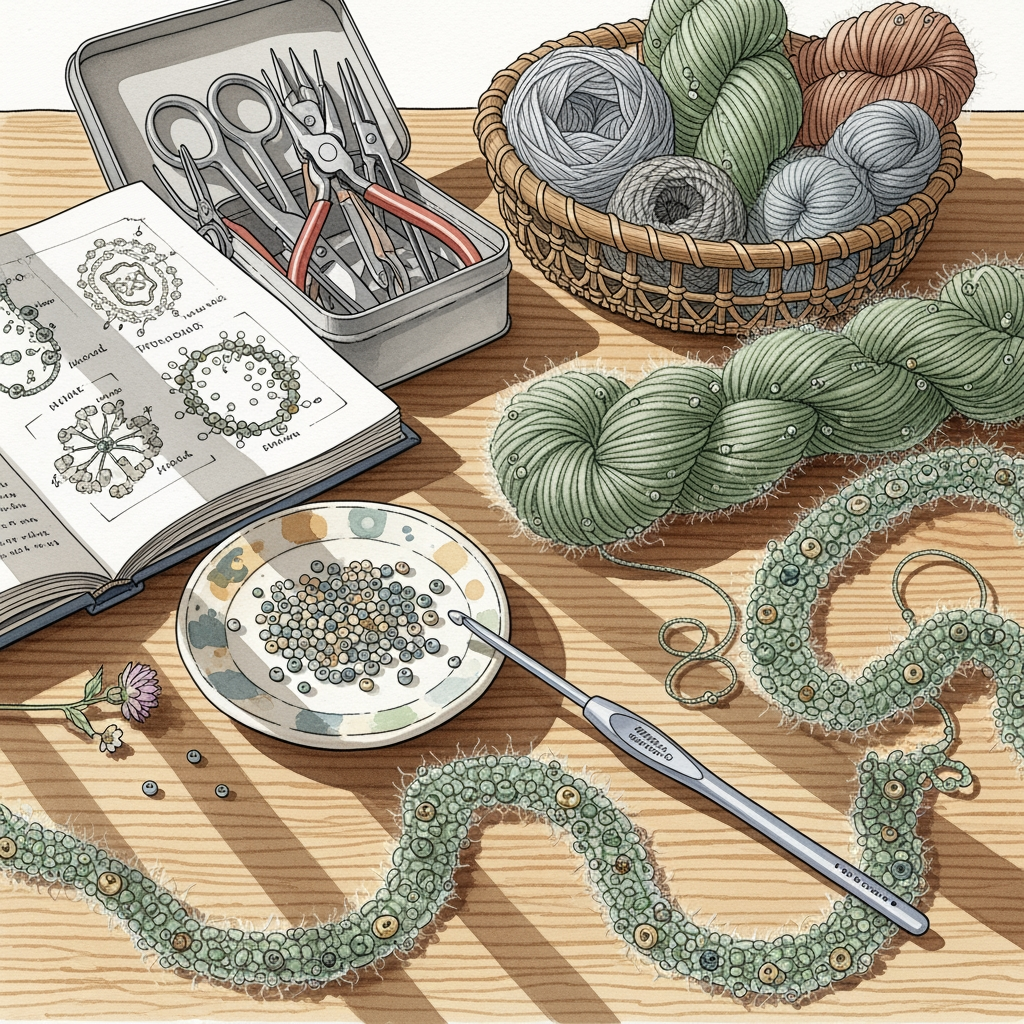
- Fine-tipped needle-nose pliers: For closing jump rings and crimping.
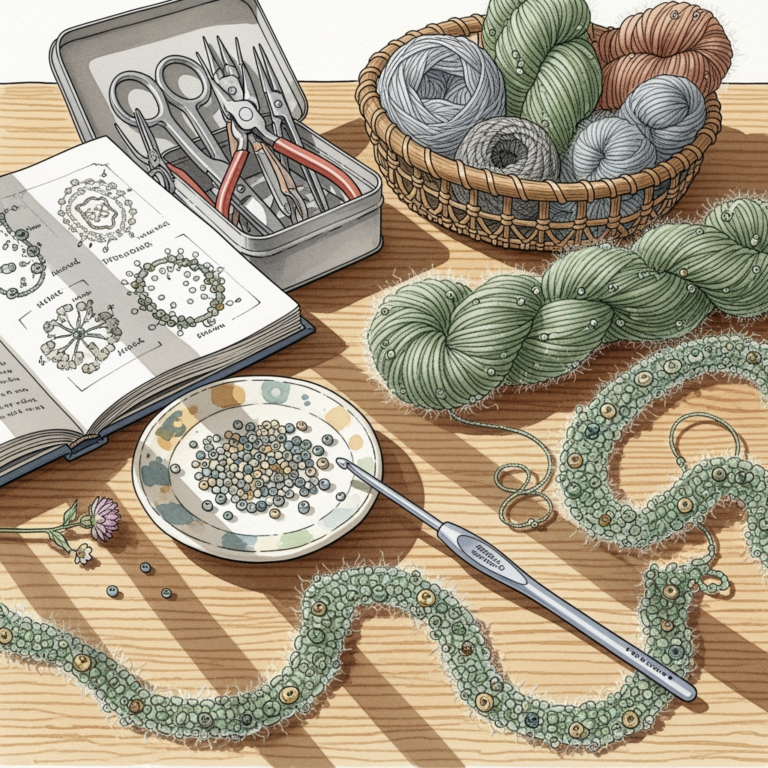
- A crochet hook (0.5mm to 0.75mm): The best tool for pulling yarn through beads.
- A bead mat: A felt-covered tray that keeps your beads from rolling away.
- Good lighting: Knitting with beads is detail-oriented work; a desk lamp is non-negotiable.
Having these items organized before you start will save you from the "bead-on-the-floor" panic that every knitter experiences at least once. Keep your workspace clear and your tools within reach to maintain your rhythm.
Troubleshooting Common Bead Attachment Challenges
If your beads are sagging, you likely need to tighten your gauge or use a thinner yarn. If your beads are splitting your yarn, you are likely using a needle that is too blunt or a bead with a sharp interior edge.
Always check the inner hole of your beads before stringing. Some cheaper beads have jagged edges that can act like a knife, eventually cutting through your yarn. If you find a sharp bead, discard it; it is not worth the risk of your garment falling apart later.
Lastly, remember that blocking is your friend. If your bead placement looks slightly uneven while the project is on the needles, don’t panic. Once you wash and block your piece, the stitches will relax and the beads will settle into their final, beautiful positions.
Integrating beads into your knitting is a rewarding way to elevate your craft and add a personal touch to your wardrobe. By selecting the right findings and keeping your tools organized, you can avoid the common pitfalls that frustrate many makers. Take your time, test your materials, and enjoy the process of watching your fabric sparkle. Your finished project will be a testament to your patience and your eye for detail.