6 Best Needle Punch Tools For Base Shaping To Try
Master base shaping with our guide to the 6 best needle punch tools. Discover which precision instruments offer the control needed for professional results.
Punch needle is the perfect bridge for knitters looking to translate their love of texture into a new, fast-paced medium. Much like choosing between bamboo or metal needles for your favorite sweater, selecting the right punch needle tool fundamentally changes how your finished piece will look and feel. These tools act as the "needles" of the craft, dictating how your yarn sits within the fabric base. Finding the right tool is the secret to achieving that consistent, professional-looking pile that makes punch needle art so satisfying.
Oxford Punch Needle: The Gold Standard for Loops
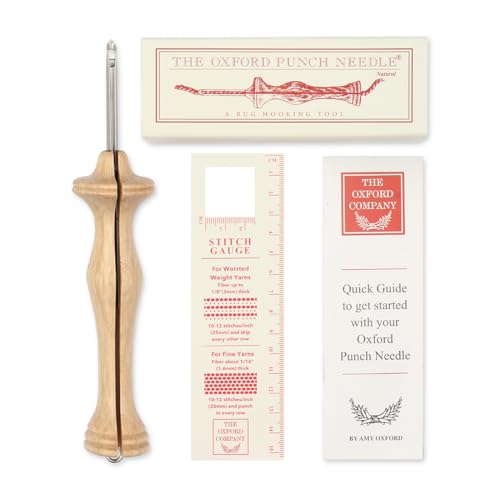

The Oxford punch needle is the tool you reach for when you want reliability that feels like a well-worn pair of wooden needles. Its ergonomic wooden handle is designed to prevent hand fatigue, which is a blessing if you’ve spent hours working on a large-scale rug or wall hanging.
The magic of the Oxford lies in its simplicity and consistency. Because it doesn’t have moving parts or adjustable barrels, there is very little that can go wrong with your stitch length. It’s a "set it and forget it" tool that lets you focus entirely on your colorwork and design.
However, the trade-off is the lack of adjustability. You are committed to one loop height per needle size, so you’ll need to purchase a specific needle for each desired pile length. For the dedicated maker, this is a worthy investment in quality.
Lavor Adjustable Punch Needle: Best for Versatility

If you enjoy experimenting with texture—mixing high-pile loops with short, dense stitches—the Lavor adjustable tool is your best friend. It functions similarly to a multi-size knitting needle set, allowing you to slide the barrel to different depths.
This tool is fantastic for creating depth in landscapes or sculptural pieces. By adjusting the length, you can create a 3D effect that makes your work pop right off the frame. It’s an essential tool for those who like to improvise as they go.
The downside is that the adjustable barrel can sometimes slip if not tightened correctly. Always double-check your setting before you start a long session, much like you’d check your tension when switching from circulars to double-pointed needles.

Ultra Punch Needle: Precision for Fine Detail Work

When you’re working with embroidery floss or fine-weight lace yarns, a chunky needle will only tear your fabric. The Ultra Punch is designed for intricate detail where you need the needle to glide through the weave without causing damage.
This tool features a fine, sharp tip that is perfect for delicate projects like coasters or small ornaments. It feels like a high-end fountain pen in your hand, offering a level of control that coarser tools simply cannot match.
Be aware that this tool requires a very specific, lightweight fabric to function properly. Using a heavy-duty rug backing with an Ultra Punch will lead to frustration and broken threads. Keep your fiber weight and fabric weave aligned for the best results.
Clover Embroidery Stitching Tool: Best for Beginners

Clover’s entry-level tool is the equivalent of a starter knitting kit—it’s accessible, affordable, and widely available. It’s designed for smaller projects and uses thinner threads, making it an excellent way to dip your toes into the craft.
The tool is lightweight and easy to hold, which is helpful if you aren’t yet used to the repetitive motion of punching. It’s perfect for adding embellishments to existing garments or creating small patches.
While it isn’t built for heavy-duty rug making, it is a fantastic learning tool. It teaches you the fundamentals of loop formation without the steep price tag of professional-grade equipment.
Amy Oxford Fine Point Needle: Ideal for Miniatures
The Amy Oxford Fine Point is a specialized instrument for the fiber artist who loves the details. If you are working on miniature portraits or tiny, intricate patterns, this needle provides the accuracy you need.
Because the needle shaft is so slim, it creates very small, dense loops that look almost like a woven tapestry. It is a precision tool that demands a steady hand and a clear, well-mapped design.
Using such a fine needle can be taxing on the eyes and hands. Ensure you have excellent lighting and take frequent breaks, just as you would when working on a complex lace chart.
Lion Brand Punch Needle: Best for Budget-Friendly Tool

Sometimes you just want to get started without a large upfront investment. The Lion Brand tool is a simple, effective option that gets the job done for those who are just exploring the craft.
It’s a great choice for school projects, quick gifts, or testing out whether you enjoy the medium. It doesn’t have the sophisticated ergonomics of the Oxford, but it is functional and reliable for basic designs.
Think of this as your "travel set" of needles. It’s inexpensive enough that you won’t worry about it getting lost or damaged in a project bag, making it a staple for your crafting kit.
Understanding Punch Needle Gauge and Yarn Weight
Just as you wouldn’t use a bulky wool on a 2.00mm needle, you cannot use any yarn with any punch needle. The yarn must move freely through the shaft of the tool without bunching or snagging.
If your yarn is too thick for the needle gauge, your loops will pull out the moment you move to the next stitch. If it’s too thin, the loops will be loose and won’t hold their position in the fabric.
- Fine needles: Use embroidery floss or fine crochet thread.
- Medium needles: Use sport or DK weight wool.
- Large needles: Use worsted or bulky weight rug yarn.
Selecting the Right Fabric for Your Punch Project
The fabric is the "canvas" that holds your stitches in place through tension. You need a fabric with a consistent weave, like monks cloth, linen, or high-quality rug backing.
If the weave is too tight, the needle will struggle to penetrate, causing hand strain. If the weave is too loose, the holes will widen, and your loops will simply fall out.
Always test your fabric by punching a small square before committing to a large project. The fabric should "grip" the yarn firmly while still allowing the needle to pass through smoothly.
Essential Tips for Achieving Even Loop Density
Even loop density is the hallmark of a master puncher. The secret is keeping your needle tip in contact with the fabric at all times; do not lift the needle too high between stitches.
Maintain a consistent angle and rhythm as you move across the frame. If you find your loops are uneven, check your yarn flow—any snag in the yarn ball will cause a change in tension that shows up immediately on the front of your work.
- Keep your yarn ball loose and tangle-free.
- Punch in a consistent, steady rhythm.
- Check the back of your work frequently to ensure loops are uniform.
Troubleshooting Common Punch Needle Tension Issues
If your loops are falling out, your tension is likely too loose, or your yarn is snagging on the needle eye. Ensure your yarn is feeding smoothly and that your fabric is stretched drum-tight on your frame.
If you find that you are tearing the fabric, your needle might be too large for the weave, or you might be punching too close to previous stitches. Space your stitches out slightly to preserve the integrity of the fabric base.
- Check the frame: A loose frame is the #1 cause of poor tension.
- Check the yarn: Ensure it is not catching on the needle handle.
- Check your angle: Always keep the "beveled" side of the needle facing the direction of your progress.
Choosing the right punch needle is a personal journey that evolves alongside your skill level. Start with a tool that matches your current project’s weight and complexity, but don’t be afraid to upgrade as your technique improves. Once you master the rhythm of the punch, you’ll find that these tools are as essential to your creative life as your favorite set of knitting needles. Happy punching, and enjoy the texture you create.