6 Best Stitch Counters For Complex Cable Patterns
Master complex cable patterns with ease. We review the 6 best stitch counters to help you track intricate rows and maintain perfect tension in your knitting.
Mastering complex cable patterns requires more than just technical skill; it demands unwavering focus on your row and repeat counts. When you are deep into a honeycomb or braided cable chart, a single missed row can ruin the symmetry of your entire project. Using a dedicated stitch counter transforms your knitting experience from a guessing game into a precise, stress-free process. These tools are the silent partners that ensure your hard work results in a perfectly balanced garment.
Cocoknits Maker’s Keep: Best Wearable Counter
The Cocoknits Maker’s Keep is a brilliant marriage of utility and fashion, featuring a magnetic slap bracelet that holds your stitch counter securely. By keeping your tools right on your wrist, you eliminate the constant search for a counter lost within the folds of a heavy cabled sweater.
This tool is particularly useful when you are working on large-scale projects like cabled afghans or oversized coats. Because the magnet is quite strong, it also serves as a convenient place to store your tapestry needles or cable needles between rows.
However, the magnetic snap can occasionally be distracting if you are prone to fidgeting. If you prefer a minimalist workspace, the bracelet might feel a bit bulky during long knitting sessions.
Clover Kacha-Kacha: The Classic Manual Clicker
The Clover Kacha-Kacha is the gold standard for tactile feedback in the knitting world. The satisfying "click" provides an audible confirmation that you have successfully logged your row, which is essential when you are distracted by complex cable crossings.
Unlike digital counters that can be accidentally bumped, this manual clicker requires a deliberate press to advance. This mechanical reliability is a lifesaver when you are working with slippery yarns like silk or bamboo, where your concentration is already taxed by maintaining consistent tension.
The main tradeoff here is size; it is not as portable as a ring-based counter. If you are a mobile knitter who prefers to keep your kit in a small project bag, you may find the Kacha-Kacha takes up a bit too much real estate.
Row Counter Ring: Best for Discreet Tracking
The row counter ring is a marvel of modern knitting ergonomics, sitting unobtrusively on your finger while you work. It is the perfect choice for knitters who find traditional counters to be clunky or disruptive to their natural rhythm.
Because it is always at your fingertips, you can advance the count without ever letting go of your needles. This is a game-changer when you are working through a difficult cable row and don’t want to lose your "flow state" or risk dropping a stitch.
Keep in mind that the small buttons on these rings can be difficult to operate if you have limited dexterity or arthritis. Always test the button tension before committing to a complex pattern, as some models are stiffer than others.
Knitters Pride SmartStix: Integrated Needle Tool
The SmartStix system is a clever innovation that embeds measurement and tracking directly into the needle itself. By utilizing the laser-marked measurements on the needles, you can verify your gauge and row progress simultaneously.
This tool is ideal for the knitter who wants to streamline their kit and reduce the number of loose accessories they carry. It removes the need for a separate counter entirely, allowing you to focus purely on the interaction between your yarn and the needle tips.
The limitation here is that it only tracks your progress relative to the length of the fabric you have already knitted. If you are working on a pattern with a high number of repeats per inch, you will still need a secondary method to track your specific cable charts.
Digital Finger Counter: Best for Fast Knitting
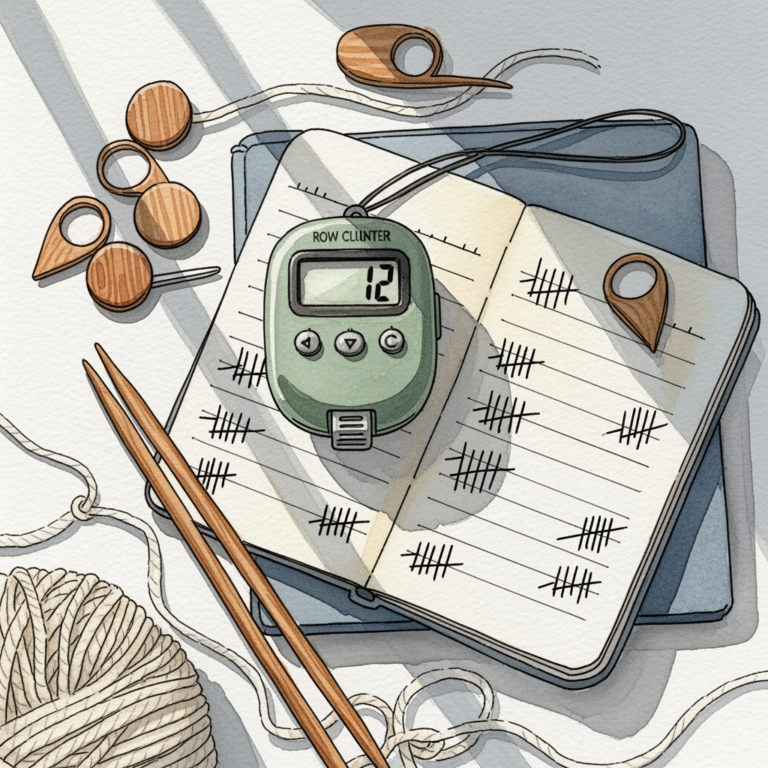
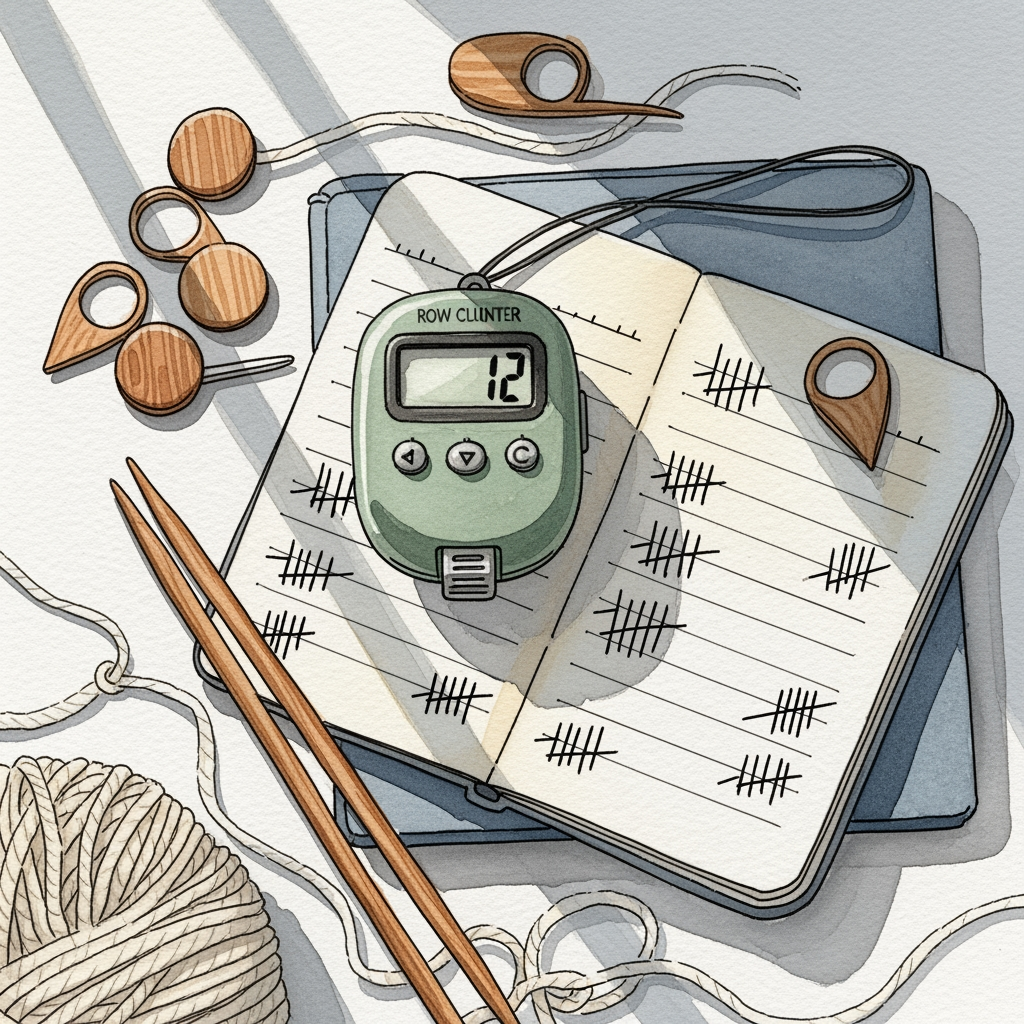
Digital finger counters are incredibly lightweight and offer a high-visibility screen that is easy to read in low light. If you are a fast knitter who works through rows quickly, the speed at which you can reset or advance these counters is unmatched.
These units are often very affordable, making them a great "backup" tool to keep in every project bag. Their simple design means there is very little that can go wrong mechanically, provided you keep a spare battery on hand.
The downside is the "bump factor." Because they are digital, they are often sensitive enough to advance if they snag on a cable or a button, potentially throwing your count off without you noticing.
Susan Bates Hand Counter: Best for Large Counts
The Susan Bates hand counter is a sturdy, traditional tool that feels substantial in your palm. It is designed for knitters who prefer a heavy-duty, no-nonsense counter that won’t slide off the couch or get buried under a pile of wool.
This counter is excellent for tracking large-scale projects where you might be counting hundreds of rows. Its large dial is easy to turn, even if your hands are tired after a long day of maneuvering complex cable crossings.
While it is reliable, it lacks the portability of wearable options. It is a stationary tool that works best when you have a dedicated knitting chair and a side table to keep your gear organized.
Why Cable Patterns Require Dedicated Counters
Cable patterns are notoriously unforgiving because they rely on specific row sequences to create their aesthetic impact. If you lose your place, you often have to "tink" (knit backwards) multiple rows to correct a crossing error.
A dedicated counter acts as a safety net for your brain. By offloading the memory task of tracking rows, you free up your mental energy to focus on the technical challenges of the cable structure itself.
Without a counter, you are forced to rely on visual inspection, which becomes increasingly difficult as the fabric grows. A counter ensures that you are always exactly where the chart expects you to be.
How to Choose the Best Counter for Your Style
Choosing the right counter is about identifying where you lose focus during your knitting sessions. If you are a "mobile" knitter who knits on the bus or at the park, a ring or wearable counter is essential.
If you are a "stationary" knitter who enjoys a quiet, organized space, a manual clicker or a desk-based counter will serve you better. Consider your physical comfort, especially if you have sensitive joints or limited range of motion.
- Consider your grip: Do you hold your needles tightly? A ring counter might interfere with your tension.
- Consider your visibility: Do you knit in low light? A digital screen with a backlight is a major advantage.
- Consider your habit: Are you likely to forget to click? A counter that is physically attached to your needle or hand is harder to ignore.
Manual vs Digital: Which Counter Suits You?
Manual counters offer the benefit of tactile feedback and zero dependency on batteries. They are the reliable choice for long-term projects that might sit in a bag for months at a time, as they are always ready to go.
Digital counters offer precision and speed, often including features like multiple memory slots. These are fantastic if you are working on several complex projects at once and need to track different cable repeats simultaneously.
Ultimately, the choice comes down to your tolerance for maintenance. If you don’t want to worry about batteries dying in the middle of a row, stick to the mechanical options.
Pro Tips for Tracking Complex Cable Repeats
Even with the best counter, you should always keep a paper copy of your chart nearby. Use a highlighter to mark off completed sections, as this provides a visual map that a digital number simply cannot replicate.
If your cable pattern has multiple repeats, use a secondary counter or a simple post-it note to track the "total row count" versus the "repeat count." This prevents the common mistake of finishing a repeat and forgetting to reset your progress.
Finally, always "click" your counter at the end of the row, not the beginning. This creates a consistent habit that ensures your counter always reflects the work you have already completed, rather than the work you are about to start.
Investing in a reliable stitch counter is one of the most practical upgrades you can make for your knitting practice. Whether you prefer the satisfying click of a mechanical counter or the convenience of a digital ring, the right tool will save you hours of corrective work. Remember that the best counter is the one you actually remember to use consistently. May your cables always cross cleanly and your row counts stay perfectly aligned.