7 Best Blocking Clips For Holding Tension To Try
Master your craft with our top 7 blocking clips. Learn how these essential tools provide the perfect tension for professional, precise, and uniform results.
Achieving a professional finish on your hand-knits is the final, crucial step that transforms a handmade item into a heirloom-quality piece. Blocking is not merely about wetting your garment; it is about manipulating the fiber to reveal the true stitch definition and drape you worked so hard to create. Using the right tools ensures that your tension remains consistent while the piece sets into its final, intended shape. These seven blocking solutions are the industry standards for managing everything from delicate lace to heavy, structured wool.
KnitIQ Blocking Combs: Best Overall Performance


When you are blocking a large project like a rectangular shawl or a sweater back, individual pins can feel tedious and imprecise. KnitIQ blocking combs solve this by allowing you to anchor a long section of fabric with a single motion, significantly speeding up the process.
These combs feature multiple pins attached to a plastic base, which keeps your edges perfectly straight. They are particularly effective for projects with long, linear seams where you need to maintain a consistent tension across a wide span of stitches.
However, they can be bulky to store and might feel like overkill for smaller items like socks or hats. If you prioritize speed and alignment over granular control, these are the gold standard for your toolkit.
Knitter’s Pride Rainbow Blocking Pins Set

These pins are a favorite for those who want a bit of flair alongside their functionality. The vibrant colors aren’t just for aesthetics; they can be used to color-code different sections of a complex garment, such as marking increases or specific pattern repeats.
The stainless steel construction ensures they won’t rust when exposed to damp wool or cotton. Because they are thin, they slide easily into blocking mats without distorting the delicate structure of your knitted fabric.
They are an excellent "workhorse" pin for everyday projects. While they don’t offer the specialized grip of a comb, their versatility makes them a staple for any knitter’s collection.
Cocoknits Stainless Steel Blocking Pins

Cocoknits is known for thoughtful design, and these pins are no exception. They are made from high-quality stainless steel, which is essential if you are blocking light-colored yarns that might otherwise be prone to rust stains from inferior metal tools.
The T-shaped head is the real highlight here, as it provides a comfortable grip for your fingers. This is a game-changer if you have arthritis or simply find that thin, straight pins are difficult to manipulate for long periods.
These are slightly thicker than standard sewing pins, which gives them superior holding power in denser fabrics. They are the perfect choice when you need a secure, non-slip hold for heavier items like Aran-weight sweaters.
Clover Blocking Pins for Delicate Lace Work

When working with fine mohair or gossamer-thin silk lace, you need a pin that won’t leave large holes or snag the fibers. Clover pins are exceptionally smooth, designed specifically to glide between stitches rather than piercing the yarn itself.
Because they are so fine, they are remarkably gentle on delicate fibers that might otherwise show "pin marks" after blocking. They are the go-to tool for blocking intricate shawls where the stitch pattern needs to open up without the risk of fiber damage.
Be aware that because they are thin, they have less "bite" in thick, heavy wool. Use these exclusively for your fine-gauge projects to maintain the integrity of your yarn.
Boye Blocking Pins for Heavyweight Projects
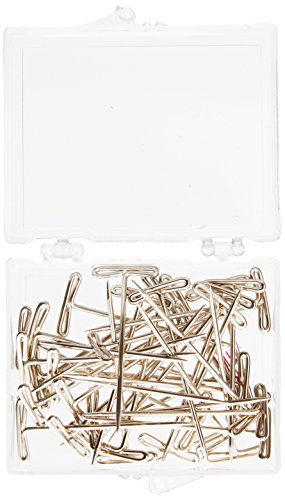
If you are working with chunky, bulky-weight wool or heavy cotton, you need a pin with significant structural strength. Boye pins are robust and long, providing the depth needed to anchor heavy fabric firmly into thick foam mats.
These pins are reliable and no-nonsense. They don’t bend under the weight of a water-logged wool sweater, which is a common frustration with cheaper, thinner alternatives.
They are an economical choice for the knitter who frequently works with heavy yarns. While they lack the finesse of specialized lace pins, they get the job done when stability is the only priority.
Susan Bates T-Pins for Secure Tension Control

T-pins are the classic, industry-standard tool for a reason. Their wide head allows you to press down firmly, ensuring that your fabric stays exactly where you placed it, even if you are applying significant tension to open up lace or cables.
Because they are readily available and inexpensive, you can easily stock up on a large quantity. This is vital for complex projects that require pinning every single point of a scalloped edge.
They are the most utilitarian option on this list. While they may not have the "designer" feel of other brands, their ability to hold tension under duress is unmatched.
Lacis Blocking Pins for Precision Shaping
Lacis pins are designed for the serious fiber artist who demands exact measurements and perfect symmetry. They are often used in historical reconstruction or professional-grade garment finishing where precision is non-negotiable.
The pins are incredibly sharp and consistent, allowing for precise placement in tight areas like armscyes or neckline curves. They are built for the kind of "blocking to measurement" that ensures a sweater fits perfectly according to a schematic.
If you are a perfectionist who treats blocking as a technical discipline, these will be your best friends. They turn the blocking process into a precise, geometric exercise.
Why Blocking Clips Are Essential for Finishing
Blocking is the bridge between a "homemade" look and a "hand-knit" professional finish. Without proper tensioning, stitches can look uneven, and the overall shape of your project may be distorted by the natural memory of the yarn.
Clips and pins allow you to manipulate the fabric while it is wet, essentially "resetting" the fibers into their final position. As the yarn dries, it relaxes into the shape you’ve dictated, resulting in a smooth, polished fabric.
Many knitters skip this step, but it is the secret to why store-bought garments look so crisp. Investing in quality blocking tools is just as important as choosing the right needles or high-quality yarn.
How to Choose the Right Pins for Your Fiber
Choosing the right pin depends entirely on the weight and delicacy of your yarn. A heavy wool requires a sturdy, thick pin to maintain tension, while a fine silk or lace-weight yarn requires a thin, smooth pin to avoid distortion.
Consider the following when selecting your tools:
- Fiber weight: Use thicker pins for heavy wools, thinner for lace.
- Fiber sensitivity: Avoid sharp, rough edges for mohair or angora.
- Rust resistance: Always prioritize stainless steel for light-colored or white yarns.
- Project size: Use combs for long, straight edges and individual pins for curves.
Never force a pin through a dense fiber if it feels like it’s straining the yarn. If you find yourself struggling, you likely need a different gauge of pin or a different pinning technique.
Essential Tips for Perfect Tension Blocking
Always ensure your blocking mats are clean and dry before you begin. If you are blocking a garment that has been seamed, pay special attention to the tension at the seam line, as this is where distortion is most likely to occur.
Patience is your best tool during the blocking process. Do not rush to remove the pins until the garment is 100% dry; if you remove them while the fiber is still damp, the yarn will "spring back" and lose the shape you worked so hard to establish.
Finally, remember that blocking is a form of fiber manipulation, not a permanent fix for poor tension. While it can smooth out minor inconsistencies, it cannot compensate for dropped stitches or significant gauge errors.
Mastering the art of blocking is a journey that rewards you with garments that look as beautiful as they feel. By selecting the right blocking pins for your specific project, you ensure that your hard work is presented in its best possible light. Take your time with the pinning process, trust your tools, and enjoy the transformation of your fabric. Your finished knits will thank you for the extra care and attention to detail.