6 Best Magnifying Glass Attachments For Knitting Needles
Struggling to see intricate stitches? Explore our top 6 magnifying glass attachments for knitting needles to improve precision and reduce eye strain today.
Knitting intricate lace or working with dark, high-twist yarns can quickly strain even the most experienced crafter’s eyes. When your stitches begin to blur into a single mass of fiber, a magnifying aid becomes an essential part of your toolkit rather than a luxury. Finding the right magnification allows you to maintain consistent tension and catch dropped stitches before they cascade down your work. This guide explores the best tools to keep your vision sharp and your knitting stress-free.
Daylight Company Wafer Magnifying Lens Attachment


The Daylight Company Wafer lens is a standout for those who already use their popular ultra-slim light pads. It attaches directly to the light surface, providing a clear, distortion-free view of your chart or your work-in-progress.
This is particularly useful for knitters who follow complex, multi-page lace charts. By placing the lens over your pattern, you can easily track your row progress without losing your place in a complicated repeat.
The primary trade-off is that it is a stationary tool, meaning it won’t follow your hands as you move. It is best suited for desk-based knitting where you can keep your work positioned consistently under the lens.
Mighty Bright LED Lighted Magnifier for Crafters

Mighty Bright offers a portable, flexible solution that is perfect for knitters who like to move from their favorite armchair to the sofa. The built-in LED lighting is a massive advantage when working with dark-colored yarns like navy blue or black wool.
These yarns are notoriously difficult to see, often hiding stitch definition and making it hard to spot gauge inconsistencies. The combination of magnification and targeted light effectively "opens up" the stitch structure, allowing you to see exactly where your needle needs to enter.
Be aware that the clip-on mechanism can be a bit heavy for some lightweight project bags. Ensure your knitting chair has a sturdy surface nearby to clamp the unit onto for the best stability.
Donegan OptiVisor Headband Magnifying Glass
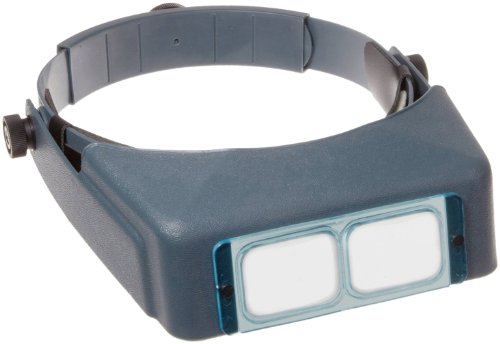
The OptiVisor is the gold standard for those who need a truly hands-free experience. Because it sits on your head like a visor, the magnification moves exactly where your eyes look, which is ideal if you tend to fidget or shift your posture while knitting.
Many professional lace knitters swear by this for working with fine-gauge mohair or silk blends. When you are working with a thin yarn, the ability to see the individual plies helps you avoid splitting the yarn, which ruins the drape of the finished garment.
The downside is the weight; wearing a headband for several hours can lead to neck fatigue. Start with shorter sessions to build up your tolerance before committing to a full evening of marathon knitting.
Carson MagniVisor Deluxe Hands-Free Magnifier

The Carson MagniVisor offers a slightly more ergonomic approach to the headband style, featuring an adjustable dial for a custom fit. It comes with interchangeable lenses, allowing you to choose the level of magnification that suits your specific project.
If you are working on a pair of socks with a 2.25mm needle, you might need the higher magnification setting to monitor your tension. Conversely, for bulky weight yarns, a lower power is often sufficient and more comfortable for your eyes.
This versatility makes it a great "all-in-one" tool for knitters who switch frequently between different yarn weights. Just remember to keep the lenses clean, as any smudge or scratch will be amplified significantly.
Weaver Select Clip-On LED Magnifying Glass

This clip-on model is designed to attach to your existing lamp or a nearby table edge. It is a fantastic option if you already have a preferred lighting setup and just need that extra bit of visual clarity for the "tricky bits," like grafting a kitchener stitch or picking up stitches along a neckline.
The neck is highly adjustable, allowing you to hover the lens right over your hands. This is perfect for those moments when you are working on a complex cable crossing and need to ensure you haven’t twisted a stitch.
Because it is lightweight, it doesn’t offer the same industrial-grade clarity as the OptiVisor, but it is much easier to store. It’s the perfect "on-demand" tool for when your eyes are tired at the end of a long day.
Brightech LightView Pro Flex Magnifying Lamp

The Brightech LightView Pro is a heavy-duty, floor-standing solution that replaces your standard craft lamp entirely. It provides a massive field of view, which is essential if you are working on a large project like a cabled sweater or a wide shawl.
The biggest benefit here is the sheer size of the lens. You can see a large portion of your knitting at once, which helps you spot errors in your colorwork or pattern repeats much faster than a small, handheld glass would.
While it takes up floor space, the stability is unmatched. If you are a serious knitter who spends hours at a time in one spot, this is the most professional-grade investment you can make.
How to Choose the Right Magnifier for Knitting
Choosing the right magnifier depends entirely on your project type and your physical comfort. If you are working on a small, portable project like socks, a clip-on or portable model is superior.
However, if you are working on a large, intricate heirloom project, a hands-free headband or a floor lamp is worth the investment. Always consider the weight of the device and how it will interact with your knitting posture.
- Project Type: Lace and fine yarn require higher magnification.
- Mobility: Do you knit in one spot or move around?
- Lighting: Does the magnifier have built-in LEDs?
- Comfort: Is the device lightweight enough for long sessions?
Magnification Power vs. Field of View Explained
It is a common misconception that more power is always better. In reality, as magnification power increases, your field of view decreases significantly.
If you use a very high-powered lens, you might only be able to see two or three stitches at a time. This makes it impossible to see how your tension is developing across the row.
For knitting, a lower power (1.5x to 2x) with a wider field of view is almost always the better choice. You want to see enough of your work to understand the fabric’s drape and the overall pattern progression.
Best Lighting Strategies for Detailed Knitting
Lighting is just as important as magnification. Even the best magnifying glass won’t help if your work is in the shadows.
Aim for "daylight" balanced bulbs (around 5000K-6000K). These bulbs mimic natural light, which is crucial for distinguishing between similar colors in stranded colorwork projects.
Avoid harsh, direct light that creates glare on your needles, especially if you use metal needles. Instead, use a diffused light source that illuminates your work evenly from multiple angles to reduce shadows.
Essential Tips for Reducing Eye Strain While You Knit
Even with the best tools, you must practice good "knitting hygiene" to protect your eyes. Follow the 20-20-20 rule: every 20 minutes, look at something 20 feet away for 20 seconds.
Ensure your knitting is held at a comfortable distance, roughly 14 to 16 inches from your eyes. If you find yourself hunching over to see your stitches, it is a sign that you need more light or a different magnification level.
Finally, don’t be afraid to put the knitting down. If your eyes feel tired, no amount of magnification will fix the fatigue; give yourself a break and come back to your project refreshed.
Investing in a magnifying tool is a sign of a thoughtful knitter who values their craft and their long-term health. Whether you choose a simple clip-on lamp or a professional-grade headband, the right choice will make your knitting more enjoyable and precise. Remember that the best tool is the one that fits seamlessly into your natural knitting flow. Happy stitching, and may your rows always be even and your stitches perfectly defined.