7 Best Weights For Tensioning Machine Knitted Fabric
Achieve perfect stitches with our guide to the 7 best weights for tensioning machine knitted fabric. Discover the right tools to ensure consistent tension.
Achieving consistent tension is the single most significant hurdle for any machine knitter moving from manual operation to professional-level results. Without proper weighting, your fabric will suffer from dropped stitches, uneven loops, and erratic stitch formation. Selecting the right weights for your specific machine and yarn fiber is an art form that balances gravity against mechanical resistance. Mastering this balance is what separates a frustrating afternoon of tinkering from a smooth, productive knitting session.
Passap Claw Weights: Best for Heavy Fabrics
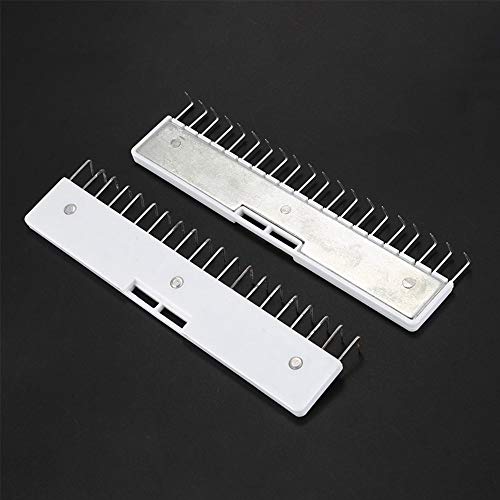

When you are working with thick, lofty wools or multi-strand mohair blends, your machine needs extra help to pull the fabric through the needle bed. Passap claw weights are renowned for their aggressive grip and substantial mass, making them the gold standard for heavy-duty projects.
Because of their unique design, these weights distribute load across a wider area of the fabric than standard hooks. This is critical when knitting dense, feltable wools that tend to snag on the needle latches.
The main tradeoff here is the weight itself; these are not delicate tools. If you use them on fragile, fine-gauge acrylics, you risk stretching your stitches into a distorted, permanent mess. Always match the weight to the density of your fiber.
Brother Cast-on Combs: Best for Even Tension

The Brother cast-on comb is a staple for a reason: it provides a uniform, horizontal pull across the entire width of your needle bed. By distributing tension evenly from edge to edge, it prevents the "puckering" effect often seen in wide garments.
For beginners, this is the most forgiving way to start a project. It eliminates the need to constantly monitor individual weights as you move across the carriage.
However, remember that the comb is only as good as the weights you hang from it. If you don’t add enough side weights to the comb, the edges of your work will still lag behind the center, leading to uneven selvedges.
Silver Reed Hanging Weights: Best for Ribbing
Ribbing requires a delicate touch because the yarn is constantly being pulled between the main bed and the ribber. Silver Reed’s hanging weights are designed to be modular, allowing you to add or subtract mass as the fabric grows.
When you are working on a 2×2 rib, you need consistent downward pressure to ensure the needles on both beds clear their stitches properly. These weights allow for that fine-tuned control.
Be careful not to over-weight your ribbing. If you pull too hard, you’ll lose the elasticity that makes ribbing valuable in the first place, resulting in a garment that looks "stretched out" before it even leaves the machine.
KnitKing Claw Weights: Best for Versatility
KnitKing claw weights are the "Swiss Army knife" of the machine knitting world. They are lightweight enough for small swatches but can be ganged together to handle larger, more complex panels.
Their strength lies in their ability to be placed exactly where you need them. If your machine is dropping stitches on the left side due to a slight misalignment, a single KnitKing claw can often solve the problem instantly.
They are particularly useful for stranded colorwork. When you have long floats on the back of your work, these weights help keep the tension balanced so the floats don’t pull the fabric tighter than the front.
Addi Express Tension Weights: Best for Circulars

Circular knitting machines operate on a completely different mechanical principle than flat-bed machines. The Addi Express tension weights are designed specifically to handle the constant, rotating pull required for hats and tubes.
Without these specific weights, circular machines often suffer from "dropped stitches" at the point where the yarn feeds into the machine. The tension must be constant to keep the needles engaged.
If you are using a slippery synthetic yarn, these weights are non-negotiable. They provide the necessary friction to keep the yarn seated in the needles as the drum spins.
Studio Universal Weights: Best for Fine Gauge

When you are working with lace weight or high-twist cotton, the fabric is incredibly light and prone to flying off the needles. Studio Universal weights are designed to be subtle and precise.
These weights provide just enough "tug" to keep the stitches under the latches without distorting the delicate structure of a fine-gauge knit. They are the expert’s choice for intricate, airy patterns.
The danger here is complacency. Because they are light, you might be tempted to use too many of them to compensate for a machine that isn’t pulling correctly. Always check your machine’s carriage timing before piling on extra weights.
Hague Tension Springs: Best for Precise Control

Hague tension springs are not weights in the traditional sense, but they are essential for managing the yarn feed. They act as a shock absorber, smoothing out the tension before the yarn even hits the needles.
If you have a heavy hand or tend to knit quickly, these springs prevent the sudden jerks that lead to uneven stitch size. They are a game-changer for maintaining a professional, commercial-looking gauge.
They require a bit of setup time, but the payoff is a much more consistent fabric. If you find your tension varies throughout the day as you get tired, these springs will effectively "level out" your performance.
How to Balance Weight Distribution for Tension
Weight distribution is not just about how much weight you use, but where you place it. A common mistake is hanging all your weight in the center of the fabric, which creates a "V" shape in your tension.
- For wide panels: Use a cast-on comb with weights distributed evenly across the entire length.
- For narrow strips: Use smaller claw weights on the edges to prevent curling.
- For heavy, long garments: Periodically move your weights up as the fabric grows to prevent the weight of the fabric itself from distorting the stitches.
Always aim for a "balanced pull." You want the fabric to feel taut but not strained. If the needles are struggling to close, you need more weight; if the fabric is distorting or the needles are bending, you have too much.
Troubleshooting Uneven Stitches With Weights
Uneven stitches are rarely a result of the machine alone; they are usually a result of poor tension management. If you see horizontal lines or "ladders" in your work, check your weights first.
If the problem is on one side only, check your weight distribution. You may need to add an extra claw weight to the side that is dropping stitches or appearing loose.
If the entire row is uneven, consider your yarn tension dial. Sometimes, the issue isn’t the weight at all, but the tension mast settings. Weights should support the stitch formation, not mask mechanical issues.
Essential Safety Tips for Machine Knitting
Never leave your machine unattended with heavy weights hanging from the fabric. If the fabric drops or the machine jams, the weight can cause the needle bed to warp or the needles to shatter.
Always keep your feet clear of the area directly beneath the machine. If a heavy weight falls, it can cause significant injury to your toes.
Finally, inspect your weights for burrs or sharp edges. A rough edge on a claw weight can catch on a fiber, causing a run that ruins an entire project. Smooth them with a fine-grit file if you find any imperfections.
Finding the perfect tension is a journey of trial and error that relies heavily on the quality of your tools. By selecting the right weights for your specific project and fiber, you gain the control necessary to produce professional-grade knitwear. Remember that your weights are partners in the knitting process, meant to assist the machine, not to force it. With practice, you will develop an intuitive sense for how much tension is just right, allowing you to focus on the creativity of your designs.