6 Best Wool Carders For Fiber Blending To Try
Master fiber blending with our top six wool carder picks. We evaluate performance and durability to help you find the perfect tool for your spinning projects.
Mastering the art of fiber blending begins with choosing the right tools to align your raw fleece with your desired yarn structure. Whether you are aiming for a lofty woolen-spun yarn or a dense, durable worsted-spun project, your carders act as the bridge between raw lock and finished skein. This guide explores the best carding tools on the market to help you achieve consistent, professional results in your spinning. By understanding the mechanical differences between these options, you can elevate your hand-spun yarn from amateur to artisanal.
Strauch Petite Hand Carders: Best For Beginners
If you are just starting your journey into fiber preparation, the Strauch Petite carders are an incredibly forgiving entry point. Their smaller surface area makes them significantly lighter and easier to manage than full-sized industrial tools, which prevents wrist fatigue during long sessions.
The design focuses on balance and ease of use, ensuring that you don’t have to fight the tool to get an even batt. Because they are smaller, you are less likely to overload them, which is a common mistake that leads to "neps" or tangled clumps in your fiber.
The bottom line: These are perfect for someone who wants to learn the mechanics of carding without the physical strain of larger, heavier equipment. They are a reliable investment that will remain useful for small color-blending projects even after you’ve mastered the basics.
Howard Brush Co. Curved Hand Carders: Precision
Howard Brush Co. has long been the gold standard for those who demand professional-grade precision in their fiber prep. Their curved design is intentional; it allows for a rocking motion that encourages the fiber to move across the teeth more fluidly.
This specific geometry is excellent for creating a smooth, airy rolag—a cylindrical roll of fiber ready for long-draw spinning. If you are preparing fine fibers like Merino or Angora, the control offered by these curved paddles is unmatched.
The bottom line: Choose these if you are serious about woolen-spun yarns that require maximum loft and minimal fiber breakage. While they require a bit more practice to master the rocking motion, the resulting consistency is worth the effort.
Ashford Student Hand Carders: Reliable Choice
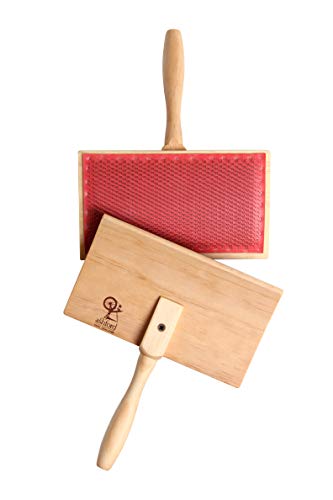

Ashford is a staple in the fiber arts world for a reason: they prioritize durability and accessibility. Their student carders are built to withstand the heavy-handedness that often comes with learning a new craft, making them a "workhorse" tool.
The teeth are set at a standard density that handles a wide variety of wool breeds, from coarse Jacobs to finer Corriedale. You won’t find many bells and whistles here, but you will find a tool that functions exactly as expected, every single time.
The bottom line: If you want a dependable, no-nonsense tool that will last for years, this is your best bet. They are the "Toyota Camry" of carders—predictable, sturdy, and entirely capable of getting the job done.
Patrick Green Flick Carder: Best For Processing
The flick carder is a specialized tool designed for a specific task: opening up the tips of raw locks before you move them to larger carders or combs. You hold the lock in one hand and "flick" the tips with the carder, effectively cleaning and aligning the fiber.
This is an essential step if you are working with raw fleece that has a lot of vegetable matter or matted tips. By processing the fiber in smaller increments, you ensure that your final yarn is free of debris and smooth to spin.
The bottom line: Do not try to use a flick carder to create a full batt; it is a preparatory tool, not a blending one. If you frequently work with raw, unwashed, or "greasy" fleece, this tool is an absolute necessity for your kit.
Schacht Fine Tooth Hand Carders: Versatility

Schacht is known for their exquisite craftsmanship, and their fine-tooth carders are no exception. The higher density of teeth allows for finer control, making them ideal for blending different fiber types, such as mixing wool with silk or mohair.
The precision in the tooth setting means you can achieve a very thorough blend of colors or textures. If you are trying to create a custom "heathered" yarn with subtle color variations, these carders will provide the blending power you need.
The bottom line: These are the best choice for the advanced spinner who wants to experiment with fiber blending and intricate color work. They offer the versatility needed to transition between different types of fiber without needing to buy a new set of tools for every project.
Clemes & Clemes Hand Carders: Artisan Quality
Clemes & Clemes tools are often passed down through generations, and for good reason. The craftsmanship is impeccable, featuring high-quality wood and teeth that are set with extreme attention to detail.
Using these feels different; there is a tactile satisfaction in the way the teeth grip the fiber. They are designed for the artisan who views fiber preparation as a meditative part of the creative process rather than just a chore to be finished.
The bottom line: If you appreciate fine tools and want to invest in equipment that will last a lifetime, look no further. They are a joy to use and provide a level of performance that makes the preparation process feel like a luxury.
Understanding TPI: Choosing Your Carder Density
TPI stands for "teeth per inch," and it is the most critical metric when shopping for carders. A lower TPI (e.g., 72) is generally better for coarse, long-staple wools, while a higher TPI (e.g., 108 or 120) is essential for fine, short-staple fibers.

- Low TPI (72): Best for coarse wool, alpaca, or mohair. It prevents the fiber from getting stuck deep in the teeth.
- High TPI (108-120): Best for fine wools like Merino, Rambouillet, or blending silk/synthetic fibers.
If you use a high-density carder on a coarse, thick fiber, you will find it nearly impossible to pull the fiber off the carder. Conversely, using a low-density carder on fine fiber will result in poor blending and messy, uneven batts.
Curved vs. Flat Carders: Which One Is For You?
The choice between curved and flat carders often comes down to the style of spinning you prefer. Curved carders are designed to facilitate a rocking motion, which is ideal for creating airy, woolen-spun rolags.
Flat carders are generally better for creating dense, flat batts that are easier to store and transport. They are also often preferred by those who use a "flick and pull" method to create smooth, worsted-style preparation.
The bottom line: If you love lofty, warm sweaters, go for curved. If you prefer sleek, durable, worsted-spun socks or lace, flat carders will likely serve your needs more effectively.
Essential Tips For Maintaining Your Carder Teeth
Your carder teeth are delicate and can easily become bent or misaligned if not cared for properly. Always use a cleaning brush to remove residual fiber after every session; never leave fiber sitting in the teeth, as it can attract moisture and lead to rust.
Avoid pressing the two carders together with too much force. You should be "kissing" the teeth, not crushing them together, as excessive force will dull the tips and damage the wooden base over time.
- Store in a dry place: Humidity is the enemy of metal teeth.
- Use a carder cover: If your set came with one, use it to protect the teeth from dust and accidental bumps.
- Check for bent teeth: If a tooth gets bent, gently nudge it back into place with a small flathead screwdriver.
Best Practices For Blending Different Fiber Types
When blending, always start by layering your fibers in thin, even strips across the carder. Do not try to blend everything at once; it is much better to do three light passes than one heavy, difficult pass that leaves you with tangled, unusable fiber.
If you are blending a slippery fiber like silk with a grippy wool, place the wool on the carder first to act as a "bed" for the silk. This prevents the silk from sliding off and helps the two fibers interlock more effectively during the carding process.
The bottom line: Patience is your best tool. If you feel resistance, stop and pull the fiber off—don’t force it. The goal is a uniform, cloud-like batt that makes spinning a pleasure rather than a struggle.
Selecting the right wool carders is a personal decision that should reflect the type of yarn you love to knit with most. By matching your tool’s TPI and shape to your specific fiber needs, you ensure that every batt you prepare is a pleasure to spin. Take the time to practice your technique, keep your teeth clean, and don’t be afraid to experiment with different fiber blends. Your hands-on experience will eventually guide your preferences, leading you to the perfect setup for your unique creative style.