6 Best Darning Needles For Garment Repair To Use
Restore your favorite clothes with ease. Discover the 6 best darning needles for durable garment repair, chosen for their precision, strength, and comfort.
Every knitter eventually faces the heartbreak of a snagged sweater or a worn-out sock heel that demands immediate attention. Having the right darning needle in your notions pouch is the difference between a seamless, invisible repair and a bulky, frustrating mess. After decades at the workbench, I have learned that the quality of your finishing tool is just as vital as the quality of your yarn. This guide breaks down the best needles to ensure your hand-knits stand the test of time.
Clover Chibi Darning Needle Set: The Best Overall


If you have ever lost a needle in the couch cushions, you know why the Clover Chibi set is a staple in almost every serious knitter’s kit. The set comes in a convenient, portable tube that keeps your needles organized and prevents them from migrating into the abyss.
These needles feature a slightly bent tip, which is a massive help when you are trying to weave ends into tight, stranded colorwork or complex cables. The eyes are large enough to accommodate most worsted-weight yarns without fraying the fibers as you pull them through.
While these are made of a sturdy, smooth plastic, they are surprisingly durable. They strike the perfect balance between being easy to handle and gentle on delicate wool fibers. For most daily repairs, this is the set I recommend keeping within arm’s reach.
Bohin France Retractable Eye Needles for Knits

Bohin needles are the gold standard for those who struggle with threading thicker yarns through small eyes. These needles feature a flexible, retractable wire loop that collapses as it passes through the eye, making threading a breeze even if your eyesight isn’t what it used to be.
I find these particularly useful when working with high-twist or multi-ply yarns that tend to split when forced through a standard needle eye. Because the eye is essentially a wire loop, it offers very little resistance, allowing you to focus on the precision of your stitches rather than the frustration of threading.
The tradeoff here is that the wire eye can eventually fatigue or bend if you are constantly pulling heavy, bulky-weight yarn through it. They are an investment in convenience, perfect for finishing fine lace or delicate fingering-weight socks.
Tulip Tapestry Needles with Large Eyes: Best Value

Tulip needles are renowned in the sewing world for their incredibly smooth finish and superior tip geometry. These tapestry needles are polished to perfection, meaning they glide through your knitted fabric without snagging or splitting the surrounding plies of yarn.
The large eye is a welcome feature for knitters who frequently work with mohair or fuzzy alpaca blends. When you are dealing with fibers that have a halo, the last thing you want is a rough needle that catches on every stray fiber.
These are exceptionally sturdy and resist bending, even when you are navigating through dense, felted, or tightly knit fabric. If you want a professional, high-end feel at a reasonable price point, these are the needles to reach for.
Dritz Finishing Needles: Best for Heavy Yarns

When you are working with chunky wools or heavy-duty roving, standard needles often feel flimsy and inadequate. Dritz finishing needles are designed with a thicker gauge and a blunt, rounded tip that pushes aside the yarn structure rather than piercing the individual fibers.
Using a needle that is too sharp on a chunky knit will often result in accidentally splitting your yarn, which creates an unsightly bump in your repair. These needles are blunt enough to navigate the path of your existing stitches safely.
They are an essential tool for "kitchener stitch" repairs on heavy items or for weaving in ends on blankets. While they aren’t meant for fine detail work, their utility for heavy-weight projects is unmatched.
John James Bent Tip Needles: Best for Seaming

When it comes to mattress stitch or joining shoulder seams, the angle of the needle can change your entire experience. John James bent-tip needles allow you to scoop up the "V" of your stitches without having to twist your wrist at an awkward angle.
This ergonomic advantage reduces hand fatigue, which is a major factor if you are seaming an entire sweater together in one sitting. The point is sharp enough to find the correct loop but blunt enough to prevent accidental piercing of the yarn.
These are my go-to for construction-heavy projects where precision is paramount. If you find your seams looking uneven or bulky, switching to a bent-tip needle often provides the leverage needed for a cleaner finish.
Cocoknits Steel Stitch Needles: Best for Repair
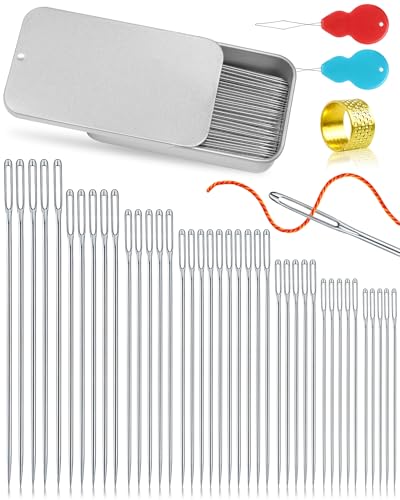
Cocoknits has mastered the art of the "tool as an object of desire," and their steel stitch needles are no exception. These are weighted, durable, and feature a nylon cord loop that acts as the eye, making them incredibly flexible.
The nylon loop is particularly brilliant for repair work because it can pass through almost any stitch density without resistance. It is essentially a "soft" needle that follows the path of least resistance through your fabric.
Because they are made of steel, they have a satisfying heft that makes them feel substantial in the hand. They are the best choice for intricate repairs where you need to weave a thread through a very specific, tight path in your knitting.
How to Choose the Right Needle Size for Your Yarn
The rule of thumb is to choose a needle that is slightly smaller than the needle size you used to knit the project. You want the eye to be large enough to hold the yarn without it slipping out, but the body of the needle should not be so thick that it stretches your stitches.
- For Fingering Weight: Use a thin, flexible needle to avoid distorting the delicate gauge.
- For Worsted/DK: A standard medium-gauge blunt needle is usually sufficient.
- For Bulky/Super Bulky: Reach for a larger, thicker needle to maintain the integrity of the thick yarn.
Always test your needle by threading it and pulling it through a scrap piece of your project fabric. If you have to force it, the needle is too thick and will likely leave a permanent gap in your knitting.
Material Matters: Steel vs. Plastic Darning Tools
Steel needles are generally stronger, thinner, and glide more easily through dense fibers. They are the professional’s choice for long-term durability and precision, especially when working with high-twist wools that can be stubborn.
Plastic needles, conversely, are excellent for beginners because they are lightweight and have a bit of "grip" to them. They are also much gentler on your hands if you are prone to arthritis or fatigue, as they aren’t as cold or rigid as metal.
I recommend having both in your kit. Reserve your high-quality steel needles for the final finishing of a garment, and keep the plastic ones for quick, on-the-go fixes or for teaching others.
Essential Tips for Seamless Invisible Mending
The secret to invisible mending is to follow the path of the existing stitches. Never pull your thread tight; you want the repair to have the same tension as the surrounding fabric, or it will look like a "puckered" scar.
When weaving in ends, always go in the direction of the stitch, mimicking the original knit structure. If you are repairing a hole, use a duplicate stitch technique to recreate the "V" shape of the knit, which hides the repair entirely.
Finally, always block your repair once you are finished. A little steam or a gentle wash will help the fibers "bloom" and settle into their new position, making the repair virtually disappear.
How to Properly Store Your Darning Needle Set
Needles are easy to lose, and there is nothing worse than having a repair project ready to go but no needle to finish it. I suggest keeping your needles in a dedicated magnetic needle minder or a small, labeled tin.
Avoid storing your needles loose in your knitting bag, as they can easily snag your yarn or poke through your project bags. If you have a set, keep them in their original case or a dedicated needle book to prevent them from becoming bent or lost.
A clean, organized set of needles is a sign of a thoughtful maker. Taking care of your tools ensures they will be ready whenever you need to save a favorite garment from the scrap pile.
Repairing your hand-knits is a rewarding act of preservation that honors the time you spent creating them. Whether you prefer the flexibility of a nylon loop or the precision of a bent steel tip, the right needle will make your repair work feel like a natural extension of your knitting process. Don’t be afraid to experiment with different types to see which fits your unique hand and project style. With these tools in your kit, you are well-equipped to keep your favorite garments in rotation for years to come.