6 Best Drying Racks For Wet Blocking For Your Studio
Optimize your studio space with our top 6 drying racks for wet blocking. Discover durable, efficient options to ensure your fiber projects dry perfectly.
Proper blocking is the difference between a project that looks "homemade" and one that looks truly professional. When you spend dozens of hours on a sweater, the final wet block is your last opportunity to even out your stitches and set the dimensions. Choosing the right drying rack ensures your hard work retains its shape without developing unwanted creases or mildew.
Eucalan Folding Sweater Drying Rack: Best Overall


This rack is a staple in many studios because it balances durability with a smart, space-saving design. It features a sturdy frame that holds its shape even when supporting a heavy, water-laden wool sweater.
The mesh is taut enough to prevent sagging, which is crucial when you are blocking delicate fibers like alpaca or merino. If you have ever had a garment "stretch out" on a flimsy rack, you know that a saggy center can ruin your stitch definition.
The folding mechanism is straightforward, making it easy to tuck away between projects. For the knitter with limited floor space, this rack is the gold standard for consistent, reliable results.
Honey-Can-Do Heavy Duty Mesh Drying Rack

If you frequently knit oversized, heavy garments like cabled fisherman sweaters, you need a rack that won’t buckle under the weight. This model is built with a reinforced frame designed to handle more mass than standard plastic-mesh alternatives.
The heavy-duty mesh is less likely to tear over time, even if you are constantly pinning your work directly into the surface. While it occupies a larger footprint, the stability it offers is unmatched for projects that require significant "weight" to set the stitches properly.
Keep in mind that its size is its primary drawback; it is not the best choice for a small apartment studio. However, if you have the room, it provides a secure foundation for even your most ambitious projects.
Whitmor Stackable Mesh Sweater Drying Rack

The brilliance of a stackable system lies in its ability to maximize vertical space. If you are a prolific knitter who often has multiple projects blocking simultaneously, this is the most efficient way to organize your studio floor.
By stacking units, you can block a full-sized sweater on one level and a pair of socks or a lace shawl on another. The airflow remains consistent across all layers, provided you don’t overcrowd the racks.
Be aware that stability can be a concern when stacking three or more units high. Always place your heaviest items on the bottom rack to maintain a low center of gravity.
Songmics 3-Tier Rolling Garment Drying Rack

This is a versatile, heavy-duty solution for the knitter who treats blocking like a production line. With three tiers and rolling casters, you can move your entire blocking station out of the way when company arrives.
The vertical design is perfect for those who don’t have enough floor space for multiple flat racks. It is particularly useful for drying smaller items like mittens, hats, or baby clothes in large batches.
While it is excellent for volume, remember that rolling racks can be less stable than fixed ones. Ensure the unit is locked in place before you begin laying out your wet knits to avoid accidental tipping.
OXO Good Grips Foldaway Sweater Drying Rack
This rack is designed with the user experience in mind, featuring a clever folding mechanism that makes setup instantaneous. It is ideal for the knitter who wants a high-quality surface that disappears completely when not in use.
The mesh is high-quality and gentle on delicate fibers, ensuring no snagging occurs during the delicate process of laying out your work. It is particularly well-suited for smaller garments like scarves or cowls.
Its main limitation is its size; it is not designed for large, heavy sweaters. If you primarily knit smaller accessories or lightweight summer tops, this is a fantastic, low-profile choice.
Household Essentials Expandable Drying Rack
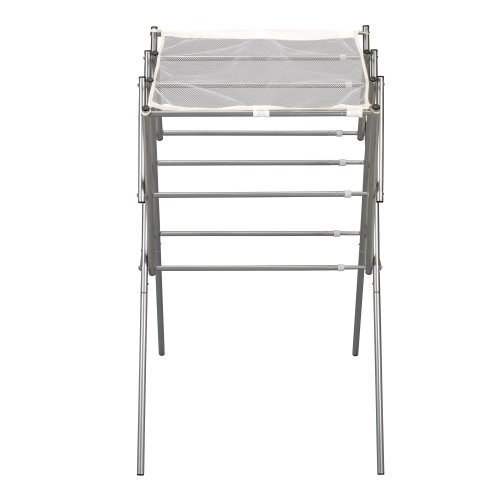
An expandable rack is a lifesaver when your project sizes vary wildly from month to month. You can adjust the width to fit a narrow scarf or pull it out to accommodate a wide-bodied pullover.
This flexibility prevents you from having to buy multiple racks for different project types. It is an economical choice for the knitter who wants one tool to handle every item in their wardrobe.
The trade-off is that the adjustment mechanism can sometimes feel less rigid than a fixed frame. Always double-check that the locking pins are secure before placing your damp wool on the rack.
Essential Features for Blocking Your Knitwear
When evaluating a drying rack, look for a frame that is rust-proof and mesh that is non-absorbent. Metal frames can rust if they get wet, which can permanently stain light-colored yarns.
- Tautness: The mesh must remain flat. If it dips, your garment will take on the shape of the dip.
- Size: Ensure the rack is larger than your garment when laid flat.
- Weight Capacity: Check that the joints are reinforced to support the weight of wet wool, which can be surprisingly heavy.
Avoid racks with rough plastic edges or exposed metal fasteners. Even a tiny snag can pull a loop in your knitting, leading to a dropped stitch or a distorted row.
Why Mesh Surfaces Are Vital for Fiber Care
Mesh is the gold standard for blocking because it allows air to circulate underneath the garment. Without this airflow, the bottom of your knitwear stays damp for too long, which can lead to a "wet dog" smell or, in extreme cases, mold.
Natural fibers like wool and silk are particularly sensitive to moisture. Keeping them in a humid environment for an extended period can weaken the fiber structure over time.
A good mesh surface also acts as a filter, keeping your work elevated off dusty floors. Clean air circulation is the key to ensuring your project dries evenly and retains its original luster.
Proper Airflow Techniques for Wet Blocking
Never place your drying rack directly in front of a heat source like a radiator or a fireplace. Rapid drying can cause fibers to become brittle and can lead to uneven shrinkage.
Instead, place your rack in a well-ventilated area, preferably near a window or in a room with a ceiling fan. If you are in a rush, a small desk fan pointed toward the room—but not directly at the garment—can speed up the process safely.
Remember that patience is a virtue in blocking. Rushing the drying process often leads to uneven tension and a garment that doesn’t hold its shape in the long run.
Tips for Blocking Large Garments Effectively
Blocking a large sweater requires a strategic approach to weight distribution. Always support the weight of the garment while moving it from the basin to the rack to avoid stretching the shoulders.
- Squeeze, don’t wring: Use a towel to roll the garment and press out excess moisture before moving it to the rack.
- Shape from the center: Start by aligning the center front and back, then work your way out to the sleeves.
- Pinning: If the garment is heavy, use rust-proof T-pins to secure the edges to the mesh to maintain your desired dimensions.
If you are blocking a sweater with a heavy collar or hood, make sure that section is also supported by the mesh. Leaving a heavy hood hanging off the side of the rack will stretch the neckline out of proportion.
Investing in a quality drying rack is an investment in the longevity of your hand-knitted wardrobe. By providing proper support and airflow, you ensure that your stitches bloom and your fabric settles into its final, perfect form. Choose the tool that fits your most frequent project size, and your finished sweaters will thank you for years to come.